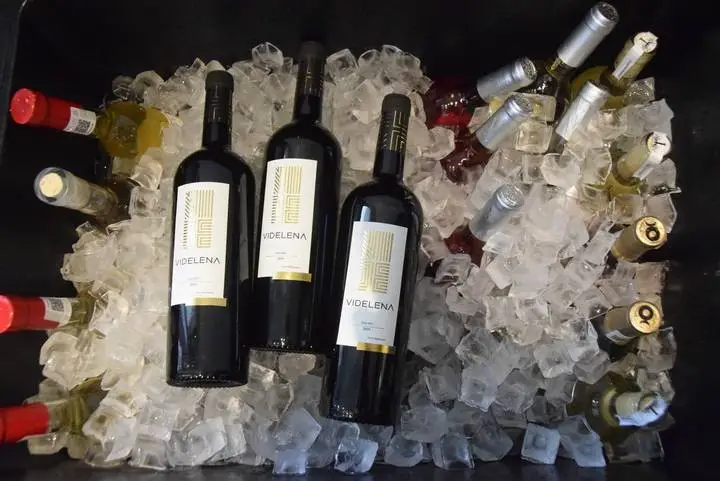

In the state there are more than 10 thousand hectares available to produce grapes and thus generate quality wines for national and international consumption
The water crisis in the state of Guanajuato has led people dedicated to agriculture to look for options to be more productive in order to have more profits on their plots.
In recent years there has been a boom in the planting of agave in Guanajuato, due to the proximity to Jalisco, a high consumer of the plant and also because the lands are considered equally important as those of the municipality of Tequila, offering a quality product to the producers of this liquor.
However, in the state of Guanajuato, producers of the field have also found in the planting of grapes a profitable product, which has caused the planting of hectares of vines to grow, which deliver a quality product, which also does not require as much water as agave.
The planting of grapes, like agave, takes approximately five years to bear fruit for the production of wine, but year after year the number of producers and cultivated hectares grows.
Elias Torres Barrera, president of the Association of Grapes and Wine in Guanajuato, told the Mexican Editorial Organization that there is currently no direct competition between the planting of agave and grapes, as they go to completely different markets, and he acknowledged that the tequila industry is still on the palates of national and international consumers, while Guanajuato’s table wine is just on the rise.
Reforms to regulate agave production will wait to be approved
As for land, he stressed that there is no competition between producers, because the land of producers who were previously dedicated to planting vegetables is now diversifying and one of their crops is grape planting.
Guanajuato is the fourth place in wine production in the country and this year it hopes to close with more than 600 hectares planted and to produce more than 1.8 million bottles for next year.
“There is a great potential for growth in Guanajuato. It has been identified that there are more than 10 thousand hectares of land available in the state with favorable climates for growing grapes. Even the city of León has a type of soil and a favorable climate for growing grapes,” explained Elías Torres Barrera.
Profitable business
The president of the Association of Grapes and Wine in Guanajuato explained that although it seems that it is an expensive process and the investment is long-term, it is prorated with the wine that is produced. The wine production chain is long, at least four years, and producers require government support and tax incentives to withstand the long time.
“But we are in a privileged place, due to the lands that we have in Guanajuato, in addition to the fact that the vine is more sustainable and uses little water compared to other crops. An alternative in this season of drought and heat helps save water. The entire wine industry in the state of Guanajuato is drip-fed and requires the continued implementation of new irrigation techniques to continue saving even more water in the vineyards,” he explained.
For this reason, he reiterated that the vineyard area is practically 100% technified, “since producing grapes without an irrigation system is practically impossible in Guanajuato.”
Industry booming
In Guanajuato, the industry generates more than 3,500 direct jobs in the state and another significant number of indirect jobs.
“The industry is integrative, where there is a vineyard it approaches people to be in contact with the vine and wants to learn about the important world of wine in Guanajuato,” explained Elías Barrera.
The largest wine producing cities in Guanajuato are San Miguel, Dolores Hidalgo and now San Felipe.
The cultivation is long-term, the plant, in the first four years, bears fruit and then the wine is produced and depending on the process that is given to it, it can take another two years.
“It is a long-term industry, but we are happy because it started in Guanajuato with nine projects and currently there are already 45 projects, that gives us the guideline to continue growing even more, there has already been a lot of growth in an organized way.”
70% of Guanajuato’s production is consumed in the country and 30% goes abroad. Some wineries are exporting, mainly to the United States, where there has been a very good acceptance. In addition to this, we have won international competitions, because the quality of the wine is good in Guanajuato and that positions us as an entity that produces high-quality wines.
Source: elsoldeleon