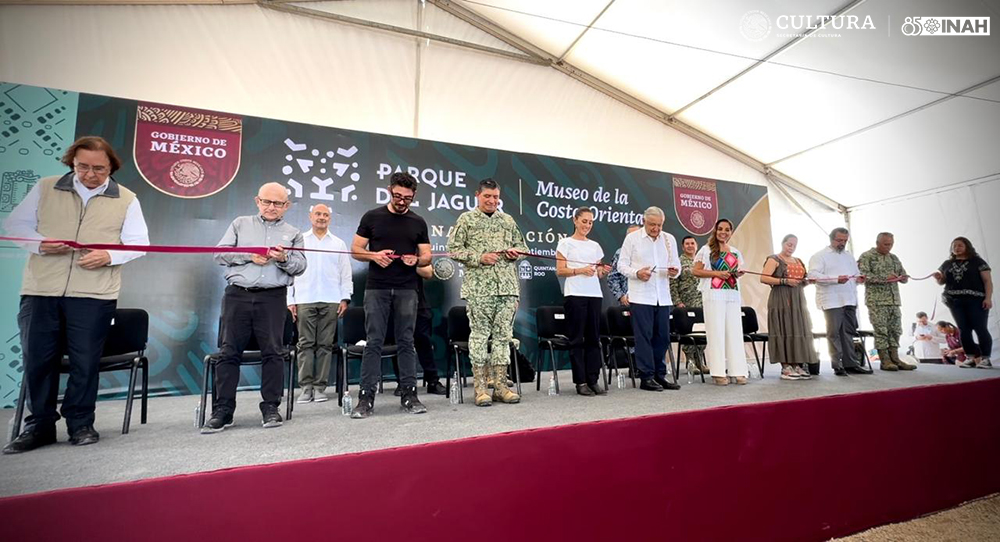

The Museum of the Eastern Coast is a gateway to the vast panorama of the Mayan cosmos, as well as a dynamic, didactic, and visually expressive proposal that will disseminate knowledge of this Mesoamerican culture through national collections and high-quality replicas.
This was stated by the Director General of the National Institute of Anthropology and History (INAH), Diego Prieto Hernández, during the inauguration of the museum on September 7, 2024, built as part of the Archaeological Zones Improvement Program (Promeza), implemented by the federal Ministry of Culture through INAH.
During the event, led by the President of Mexico, Andrés Manuel López Obrador, and the President-elect, Claudia Sheinbaum Pardo, anthropologist Prieto Hernández declared that this opening proves that the Maya Train is more than a railway project.
“We are witnessing the vindication of southeastern Mexico and the Yucatán Peninsula. The Maya Train is justice and balanced development, it is progress with equality and the recovery of historical memory.”
The Museum of the Eastern Coast, he added, is located in the Jaguar Park – also inaugurated during the event – and is the largest cultural venue in the Maya Train system, with 1,200 square meters of exhibition space, more than 300 original pieces, and 50 reproductions, 25 of these inside the halls and 25 outside.
The new space addresses the history of the Mexican Caribbean, from the Late Pleistocene (40,000 to 10,000 years before our era) to the presence of the Mayans, showcasing their archaeological past, encounters with European cultures, their resistances, and their present.
The curatorial approach, noted the head of the National Coordination of Museums and Exhibitions (CNMyE) of INAH, Juan Manuel Garibay López, offers national and foreign visitors a general vision of the biocultural richness of the Mayan area, particularly Tulum, through a tour of three exhibition halls and an immersion hall with high-definition curved screens.
The exhibition, he detailed, consists of archaeological and ethnographic objects, including large-format reproductions and medium and small-scale models; a model of the Tulum Archaeological Zone, five dioramas, four stations for audiovisual projections, and eight electronic labels.
Some of the emblematic pieces, he added, include a tetrapod plate with the representation of a lobster, belonging to the Late Classic period (600-900 AD), which is in Hall 2.
In Hall 3, there is a stela with calendrical inscriptions and text in low relief, from the Early Classic period (200-600 AD), from the Museum of the Mayan People in Dzibilchaltún, Yucatán.
In this same space, visitors can admire the replica of the hieroglyphic staircase from the archaeological site El Resbalón, located in the town of San Román, in southern Quintana Roo, associated with the transition from life to death; as well as facsimiles of the Maya Codices of Mexico and Dresden.
The curatorial script was developed by researcher Karina Romero, while the museographic project was carried out by CNMyE and the Ministry of Agrarian, Territorial, and Urban Development.
Most of the pieces come from INAH venues such as the National Museum of Anthropology, the Maya Museum of Cancun, and the Palenque Site Museum, as well as the INAH Centers of Quintana Roo, Campeche, and Yucatán.
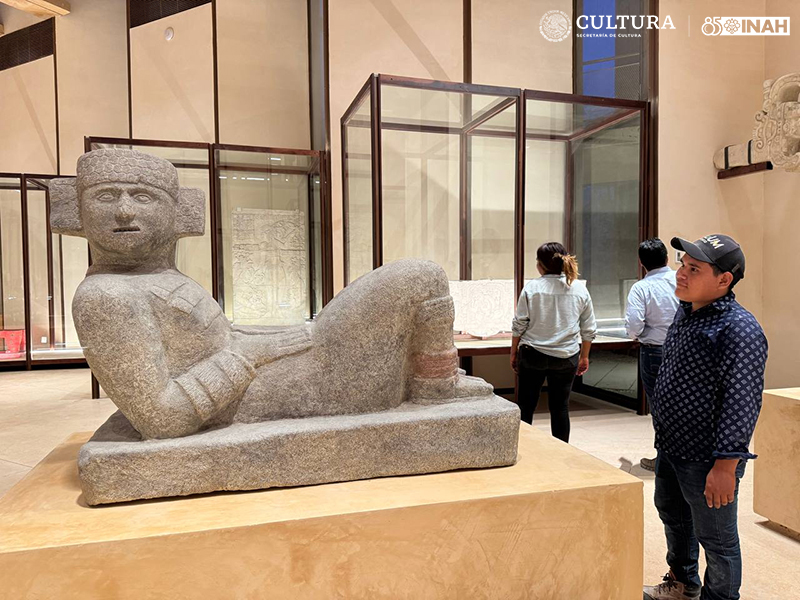
Room 1, The Caves: Subterranean Memories, is dedicated to the karst systems of the Yucatán Peninsula; it addresses the importance these spaces had for pre-Hispanic inhabitants as sites of refuge, for astronomical observation, ritual performance, and, in the imagination, as the dwelling place of deities associated with water and death.
Within this space is the Immersion Room, which offers a dynamic virtual experience, where attendees are transported to various landscapes where they can observe the terrestrial and aquatic flora and fauna of Quintana Roo, as well as the archaeological zones of the region.
Room 2, Mayas: A Millenary Culture, explores the worldview, social aspects, and scientific knowledge developed by this population in different regions and time periods.
Mayas of the Eastern Peninsula is the title of Room 3, which presents a sample of the Costa Oriental architectural style, developed in the Postclassic period (1000-1550 AD), whose maximum exponent is Tulum, characterized by its horizontal design, in which small platforms or large bases with lintels, moldings, and friezes decorated with geometric figures were placed. The use of columns and mural painting was also common.
Additionally, this section focuses on the present-day Mayas, heirs of millenary traditions, which they keep alive through their language, customs, and ways of understanding the world.
Source: INAH