
Since June 2021, Chiapas has been experiencing a spiral of violence associated with drug trafficking. Violence is not new. It dates back to colonization itself. Since the 16th century, Fray Bartolomé de las Casas documented the atrocities committed against indigenous peoples during the Conquest. Nor is the presence of organized crime in the state new. It has been operating for decades in that region, which shares 658 kilometers of border with Guatemala, a country that is, in fact, a large warehouse for illicit goods: from drugs to undocumented persons in transit to the United States.
What is unprecedented in this cycle is the magnitude, extent and depth of violence related to the dispute of road cartels, production areas, drug consumption centers, recruitment of young people, population displacement, collection of protection money and counterinsurgency tasks.
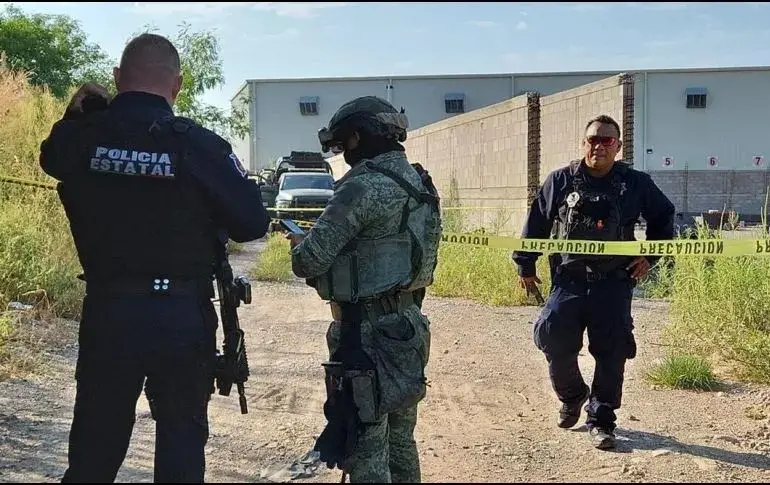
Between December 1, 2018, and June 2024, the state prosecutor’s office recorded 6,147 homicides, 2,386 intentional and 3,761 negligent; 177 femicides; 78 kidnappings; 943 cases of sexual abuse; 18,550 robberies (to homes, businesses, public roads, and transportation); 319 extortions; 5,795 drug dealing incidents, and more than 40,000 displaced persons.
According to the Executive Secretariat of the National Public Security System (SESNSP), between January 1 and September 30, 2024, there were 525 intentional homicides, 49 percent more than those that occurred in the same period in 2023.
However, there is an underreporting of what is really happening. These figures are just the tip of the iceberg. The casualties in the fighting between criminal groups in the Sierra and the Border, who are collected and buried by their companions, are not contemplated there. Nor are those tortured, or the thousands of those who must pay protection money to the gangs in order to work and live, or the abused women who do not report it out of fear. Even less, the de facto power that the bosses have in large regions, and which, in practice, makes them authorities that dispense justice, above those legally recognized. They make the siege against the communities in resistance invisible.
The recent murder of Father Marcelo was a turning point in this escalation to decapitate those who promote peace. Simón Pérez, a catechist at the parish of Santa Catarina in Pantelhó, former president of the civil association Las Abejas de Acteal, was executed by hitmen on July 5, 2023 (https://shorturl.at/ANvkA). Professor José Artemio López, organizer of the anti-drug marches in Chicomuselo, was tortured and executed in front of his family on October 31, 2023 (https://shorturl.at/UZBTI). Catechist Ignacio Pérez López and his family (six members), along with five other people, were brutally killed on May 15.
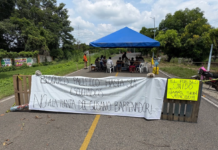
The old life no longer exists. Thousands of farmers cannot plant or raise cattle. Merchants do not open their businesses or do so for a short time. Transporters and taxi drivers are at a standstill. In Chicomuselo, more than 12 communities (4,200 people) were abandoned by their inhabitants. At the beginning of the current 2024-25 school year and in the first few months, drug violence prevented at least 300,000 preschool, primary and secondary school students from the Sierra, Frailesca and Centro regions from returning to school.
As a human rights defender explains: Before, violence came from the State or from companies when there was economic interest. Now it comes from organized crime. They have taken control. They have displaced the population. There is a siege on daily life. They exercise terror to control the territory. It began in Frontera Comalapa in June 2021. It started with the murder of the plaza boss who had control of the state. It spread to Chicomuselo and then to Motozintla, Mazapa de Madero, La Grandeza, Bellavista, Honduras de la Sierra. Now it is moving towards Fraylesca: Montecristo de Guerrero, Ángel Albino Corzo, La Concordia.
On September 4, 2008, the Jesuit priest Ricardo Ronco Robles published in La Jornada, after the Creel massacre, in which a commando killed 13 people in Bocoyna, Chihuahua, during the government of Felipe Calderón, the article “The conquest of drug trafficking is the same” (https://shorturl.at/wmrv1). There he provides substantive keys to understanding what is happening in Chiapas. He says: “All this entangles a web of economy, politics, regional infrastructure, normative principles and values of drug trafficking – a culture perhaps – that penetrates to varying degrees, gradually, to all social levels. It is really a conquest with its gold in the middle, its despotism, its slavery… with its war and everything.
“A Rarámuri made me see this in a simple conversation. He asked what is new that we see in drug trafficking, when it has always been the same for five centuries. It is another activity in which indigenous people are pressured and forced to work, but it is the same. The mines were the same, he said – more or less –, there was violence and crimes, there were deaths, there were rich and poor people and in everything they left us the worst part. The invasion of our territories was the same, the plundering of our forests, tourism is becoming the same, even our water is being taken, the mining companies are returning. One day they brought marijuana and poppy crops. For us it is the same thing, that is how the invaders are, but maybe for you it is something new.”
In Chiapas, furthermore, this offensive is framed in the counterinsurgency war against Zapatismo and the communities in resistance. Not in vain, many old paramilitaries or their children have joined organized crime in this crusade. The new drug colonization demands the annihilation of the will to fight for another life, which the rebels embody.
Source: nodal