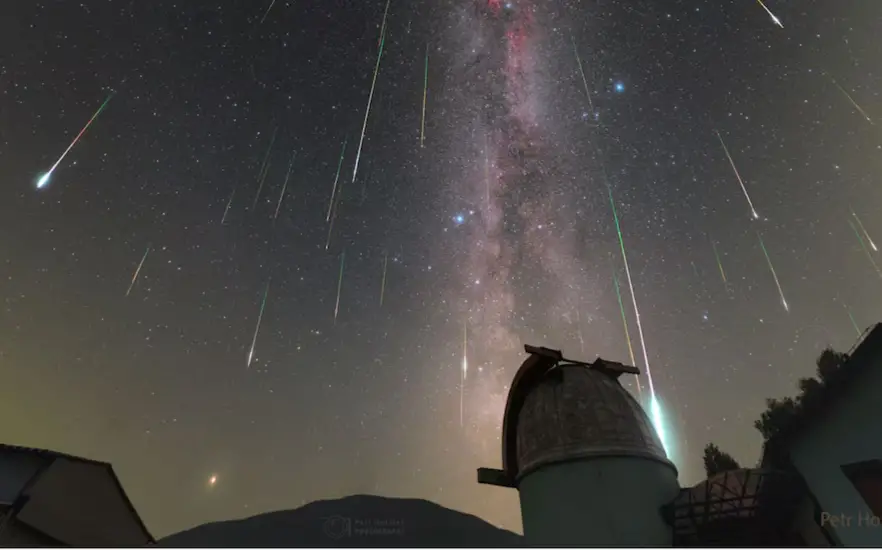

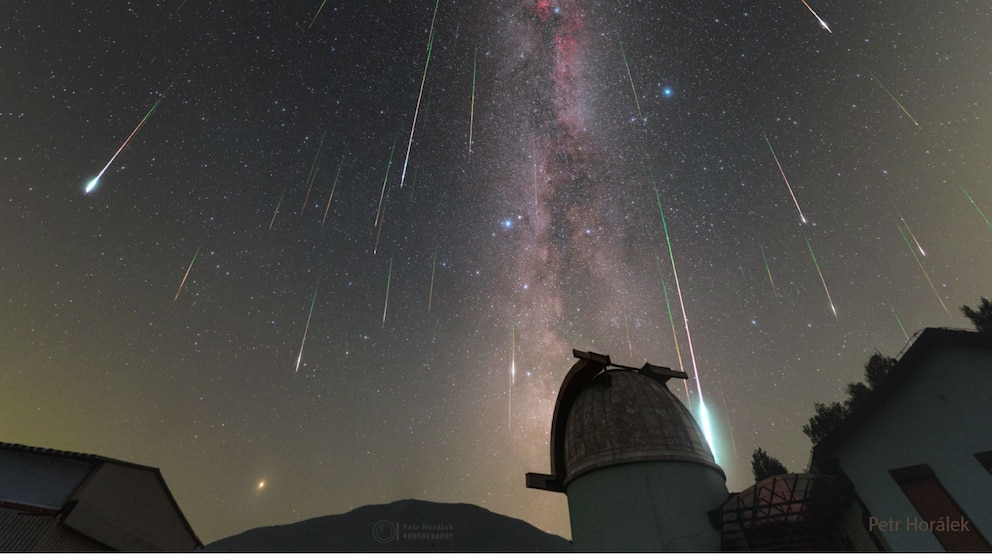
The Lyrid meteor shower occurs during the month of April. Occasionally, one of these meteors penetrates deeper into the Earth’s atmosphere, transforming into fireballs and meteors, as happened early Wednesday morning in the Valley of Mexico.
In this regard, the American Meteor Society (AMS) indicates that the Lyrids are a medium-strength meteor shower that can occasionally produce bright fireballs crossing the Earth’s sky.
In 2025, astronomical calculations indicate that this astronomical phenomenon will last from April 17 to 26. However, the peak of meteor activity is expected during the night of April 21 to 22, with an estimated 18 meteors per hour.
These small particles, which travel at a speed of approximately 49 kilometers per second, generate flashes of light as they forcefully enter the Earth’s atmosphere.
Friction with the air heats them until they disintegrate, producing what we know as shooting stars or meteors.
The waning moon will facilitate observation of the meteor shower, and according to forecasts, it will be possible to see it streaking across the sky around midnight.
It is important to remember that when they enter the Earth’s atmosphere, they are called fireballs, which usually disintegrate before reaching the surface. Only the fragments that reach the ground are classified as meteorites.
Most meteorites that enter Earth’s atmosphere disintegrate before reaching the surface, generating meteors visible as shooting stars. Their impact on the surface is minimal or nonexistent.
Where the Lyrids Come From
The constellation Lyra, recognizable by the presence of the star Vega, serves as a reference point each year from which the Lyrid meteors appear to emerge as they pass through our atmosphere.
This astronomical spectacle takes place when the Earth passes through a cloud of tiny dust particles left behind by comet C/1861 G1 Thatcher, a celestial body with an orbital period of approximately 400 years.
Although the Lyrid meteor shower is characterized by moderate intensity, averaging 10 to 15 meteors per hour, it occasionally features more active bursts and bright trails that can persist for several seconds.
Thousands of people were surprised to see the night sky illuminated for several seconds. Credit: @cabeceramx /@OscarAdrianL
In the Northern Hemisphere, the constellation Lyra will appear above the horizon starting at 10:00 p.m., while in regions like Peru and other countries in the Southern Hemisphere, it will be visible around 1:00 a.m.
This phenomenon can be enjoyed throughout the night, although conditions may be affected by the brightness of the waning moon, which could make observing the less intense meteors difficult.
The Lyrid meteor shower serves as an annual reminder of the passage of Comet Thatcher and the particles it leaves behind.
Source: infobae