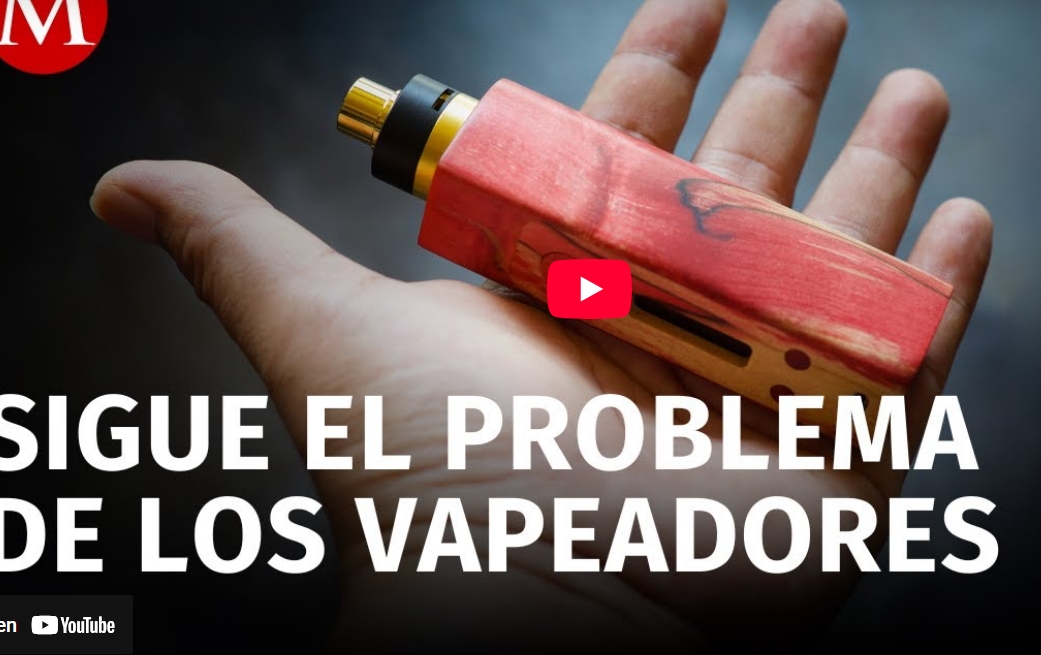

The production, distribution, marketing, and sale of vapes and e-cigarettes has been prohibited in Mexico since January of this year due to a reform to Articles 4 and 5 of the Constitution. However, there were previously prohibitions on their importation and sale resulting from presidential decrees issued in 2020 and 2022.
These reforms and decrees were justified with the argument of protecting consumer health and preventing minors from accessing these types of products.
Despite this impediment, people vaping can still be seen on the streets of the country’s cities without any problem, as obtaining the necessary supplies is easy, either at established stands or on websites, which has prevented a reduction in their use. This easy access to vapes and e-cigarettes was also confirmed by the evidence collected in the research “The Market for Alternative Nicotine Delivery Products in Mexico” conducted by the Colegio de México (Colmex) by academics Jaime Sempere and Iñaki Zardain.
Despite their ban five years ago, nearly 1.7 million people frequently used e-cigarettes, and 45 percent of adolescents were familiar with them, according to information from the Federal Commission for the Protection against Sanitary Risks (COFEPRIS). This entire market represents nearly 26 billion pesos annually, according to calculations made by Colmex researchers.
According to data from ENSANUT 2022, the use of these products increased from 0.6 percent in 2015 to 2.1 percent in 2022 among Mexico’s adult population. A constantly growing demand, coupled with the current ban, has forced Mexican users to obtain their vapes or e-cigarettes illegally, as this has become the only way to access these devices.
“A lack of regulation like the one currently in place is causing products to reach this market through irregular channels, making it difficult to determine their quality and the amount of nicotine they contain. If there were regulations, it would be possible to raise revenue by taxing them with an IEPS (Spanish Tax on the Use of Personal Income Tax), which could be a relatively significant source of revenue.”
Regulation, a Field of Opportunity
Sempere and Zardian’s research focuses on recommending regulating the vape and e-cigarette market in Mexico. By applying a tax similar to the one implemented in Spain, potential revenue has been estimated to range between 4.483 billion and 6.941 billion pesos.
“This fundraising proposal could fund social programs. In one of the scenarios we simulated, we could raise around seven billion pesos. This is approximately 30 percent of the 2024 budget for the Sembrando Vida program,” Sempere stated.
The research, in addition to estimating revenue collection, also presents a set of recommendations for implementing a potential regulation.

Decalogue of Recommendations
Prohibit sales to minors, with locks in physical and digital stores and the elimination of vending machines.
Implement quality standards and clear labeling, as is the case with cigarettes.
Control points of sale, with authorization from COFEPRIS.
Ban disposable devices, due to their environmental impact and risk to young people.
Reform the IEPS (Spanish Social Security Tax), to tax these products differently according to their nicotine content.
Restrict advertising, ensuring clear information for adults.
Regulate ingredients in liquids, prohibiting harmful substances.
Traceability and health codes, similar to those for cigarettes, to control distribution and prevent adulterated products.
Access to reliable information, allowing adult consumers to understand the proper use of these products.
Regulate flavors, limiting those that may encourage youth consumption.
Regulation of the vaping market would allow for product quality controls. (Leslie Cruz)
expand
Ban and its local impact
During the COVID-19 pandemic, the e-cigarette market in Mexico grew because it became an alternative source of income for people and because it was considered less harmful than cigarettes.
Once the ban was implemented in 2020, entrepreneurs and regulated companies could no longer sell their inventories of these products because they couldn’t find a legal way to capitalize on an investment they had already made.
“The consequences of the ban have been disastrous because it strengthens the country’s black market, where those who find petty cash in the sale of these types of products finance their activities. There is also a loss of tax revenue, of fiscal resources, which is very significant in times like the present, when we have a trade war with the United States,” commented Cuauhtémoc Rivera, director of ANPEC.
In addition to the fiscal opportunity, Rivera highlighted the public health problem posed by the use of devices whose origin and the quantities of nicotine and other substances used in their manufacture are uncertain, which increases the risk of contracting diseases.
The Ministry of Health reported that more than 116 billion pesos are spent each year treating smoking-related illnesses, including heart disease, stroke, various types of cancer, pneumonia, and chronic obstructive pulmonary disease (COPD).
“A commercial ban is not an option to improve a population’s consumption habits. We, at ANPEC, will be striving to regulate the market rather than impose bans, which only strengthen the black market that is currently being combated. We say no to commercial bans; prohibition is prohibited,” Rivera commented.

Vaping in Other Latitudes
The topic of e-cigarettes has been discussed around the world, but generally two predominant approaches have emerged. The first favors regulation of these devices, and the second favors non-regulation or prohibition.
“In terms of regulation, the perfect example is England, where quality and the concentration of nicotine in the milligrams of liquid stored in the device are being regulated. Interestingly, it’s a country where e-cigarettes are even seen as less harmful than cigarettes, so they are used to promote them in health campaigns to encourage tobacco users to quit,” commented data analyst Iñaki Zardain.
Similar cases to England are New Zealand, the European Union, and the United States, which have implemented regulatory schemes with quality controls, taxes, and advertising restrictions.
Within the prohibition group, two iconic cases are Australia and now Mexico. In both, Zardain pointed out the possibility of a black market emerging, bringing consumers products that lack a regulatory framework that allows for quality control. This is detrimental to consumers’ health, as it is not known what these devices contain or how they are produced.
“Currently, there are products that are not regulated, and we wanted to see what the opportunity cost is of not having regulations on these products. A lack of regulation increases the black market, which is normally associated with products that lack a good regulatory framework, and all of this is detrimental to consumers and the healthcare system itself,” Zardain concluded.
Source: milenio