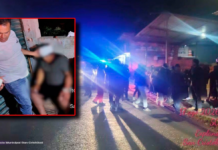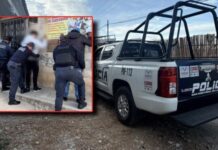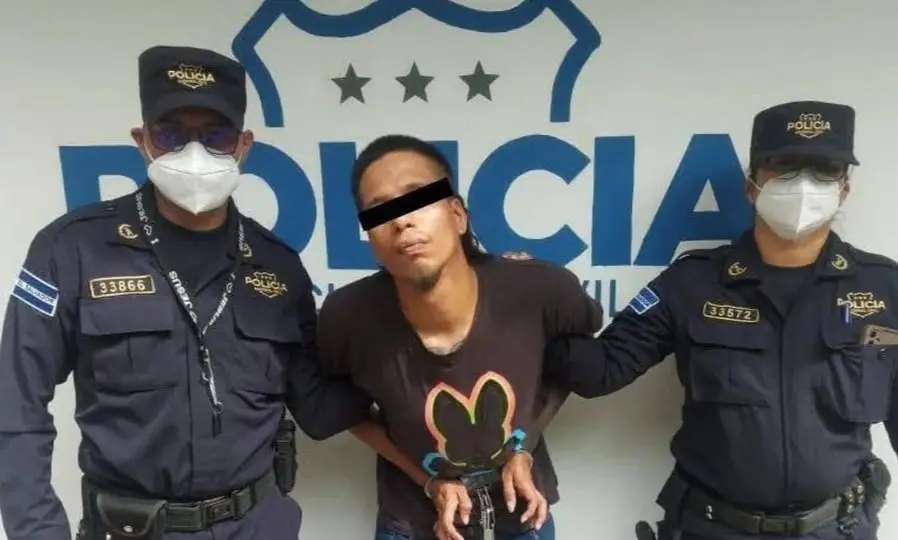

Douglas Vladimir Mejía Girón, identified by the Salvadoran government as a “terrorist” and one of the most dangerous gang members in that country, was arrested this week in Tapachula, Chiapas, where, in addition to hiding, he continued to commit crimes.
Known by the aliases “Negro,” “Roro,” or “Burro,” Mejía Girón was wanted on various charges, including aggravated homicide, illegal possession of weapons, resisting criminal activity, and belonging to illicit groups. According to Gustavo Villatoro, Salvadoran Minister of Justice and Public Security, the detainee is an active “homeboy” and gunman for the 18 Sureños gang, included on the Salvadoran most wanted list.
The arrest occurred during an operation led by the Pakal Immediate Reaction Force (FRIP) and other security forces in the Las Delicias neighborhood of Tapachula a few days ago. During the operation, three men, including Douglas, were arrested for crimes against public health and resisting criminal activity. According to the report, 23 doses of a substance with characteristics similar to “crystal” were seized.
Sources consulted indicated that Mejía Girón could be linked to other criminal acts in Tapachula and the Soconusco region.
On his official X account (formerly Twitter), Minister Villatoro warned: “Wherever you flee, know that we will find you, and when we capture you, you will be sent to the Cecot (Center for the Confinement of Terrorism), where you will spend the rest of your lives and will never see the light of day again.”
Cecot is a maximum-security mega-prison built in 2022 by order of Salvadoran President Nayib Bukele. It has a capacity for 40,000 inmates, mostly gang members. Mejía Girón has already been transferred to the Central American country.
The capture of Mejía Girón occurs within a context of growing regional security cooperation. Recently, the governments of the United States and Guatemala announced an agreement to strengthen the border with Mexico, with an emphasis on combating arms and drug trafficking, and organized crime. A stronger police and military presence is expected.
As part of this coordination, on June 8, FRIP members entered Guatemala through the La Mesilla border crossing to support comrades who were confronting members of the Chiapas and Guatemala Cartel (CCyG). This operation resulted in a confrontation that left four hitmen dead, including Baldemar Calderón Carrillo, alias “Tío Balde,” identified as the leader of the criminal group.
Why is this issue important?
Context: The 18 Sureños gang is one of the two main factions of the Barrio 18 gang, one of the largest and most violent criminal structures in El Salvador, also present in other Central American countries and the United States. Emerging in Los Angeles during the 1980s and later spreading to the Northern Triangle, the 18 Sureños gang has been involved in crimes such as homicide, extortion, drug and arms trafficking, as well as territorial control of entire neighborhoods. Its members, known as “homeboys,” operate under a hierarchical structure and strict internal rules, and often travel to other countries to hide or continue committing crimes.
Since March 2022, President Nayib Bukele has implemented a state of emergency with the aim of eradicating gang power in El Salvador. This policy has resulted in the arrest of more than 80,000 people, many of them accused of belonging to the MS-13 and 18 gangs. As part of this strategy, the government built the Terrorism Confinement Center (Cecot), a maximum-security mega-prison designed to house up to 40,000 inmates.
Although this offensive has been supported by a large part of the Salvadoran population, human rights organizations have pointed out arbitrary arrests, torture, and lack of due process. Even so, Bukele’s security plan has drastically reduced homicides in the country and has resonated with other nations with similar problems.

Source: lasillarota