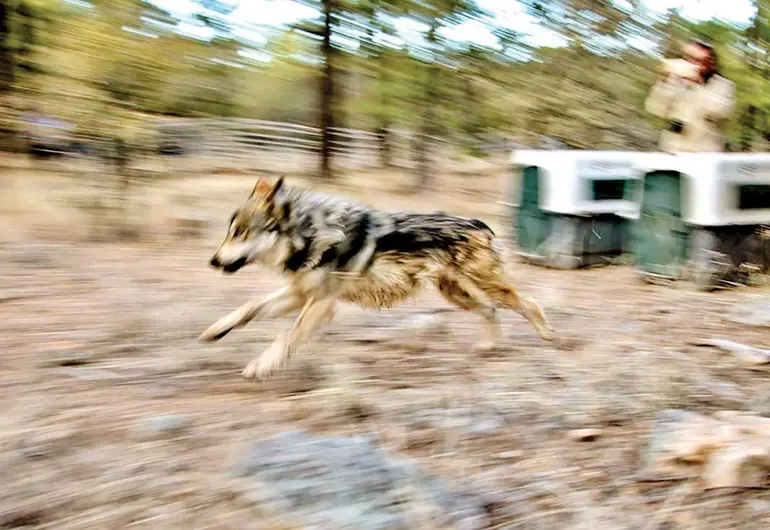

After being declared extinct in the wild in 1976 due to indiscriminate hunting in the 1950s, the Mexican wolf (Canis lupus baileyi) returned to howl in the Sierra Madre Occidental in 2011, thanks to the first reintroduction in the Janos Biosphere Reserve in Chihuahua. This led the Ministry of Environment and Natural Resources (Semarnat) to change its status to Endangered in 2019.
The strategy, part of the Mexico-United States Binational Program, promoted the recovery of wild populations, starting with purebred specimens kept in zoos and conservation centers. Today, it is estimated that there is a free-living population of approximately 35 to 40 Mexican wolves, with litters born in their natural habitat.
In this context, Fernando Gual, Director General of Wildlife for Semarnat, revealed at the 31st Binational Meeting for the Conservation of the Mexican Wolf, held at the Chapultepec Zoo, that there are approximately 600 Mexican wolves under human care in Mexico and the United States, and this year progress is being made on establishing a new release site in the state of Durango.
There is a team led by Dr. Jorge Servín (professor-researcher at the Universidad Autónoma Metropolitana Unidad Xochimilco), who has been working for years in this area to reach this point where we can now think about the short-term release of Mexican wolves in Durango, which is one of the best-preserved sites for this species and which, in collaboration with Arizona and New Mexico, will become a reality,” he stated.
Fernando Gual shared that the breeding, reintroduction, and conservation efforts will allow for a new era for the Mexican wolf to begin in 2025, following the reintroduction of the species that began 14 years ago.
In this regard, the head of the Mexico City Ministry of the Environment (Sedema), Julia Álvarez Icaza, highlighted the historic role of the country’s capital in the conservation of this emblematic species, while also highlighting the recent birth of four Mexican wolf pups at the San Juan de Allende Wildlife Conservation Center. Aragón.
These pups belong to one of the most important families of Mexican wolves, the Aragón Lineage, as they are offspring of the female identified with Studbook number 1407, which has the highest genetic value within the Binational Program, and the male Studbook 2039, who were transferred from Tamaulipas to Mexico City.
To date, Mexico has 23 institutions, zoos, and conservation centers participating in this initiative and caring for 116 Mexican wolves—47 females and 69 males—under professional care.
The Binational Committee, made up of specialists from Mexico and the United States, holds annual meetings where all the breeding, management, and fate of each Mexican wolf is determined as part of the program. This program aims to maintain the genetic variability of the species and recover endangered wild populations.
:quality(75)//media/inside-the-note/pictures/2025/08/03/lobo-mexicano-787.jpg "Imagen Intermedia")
Source: excelsior