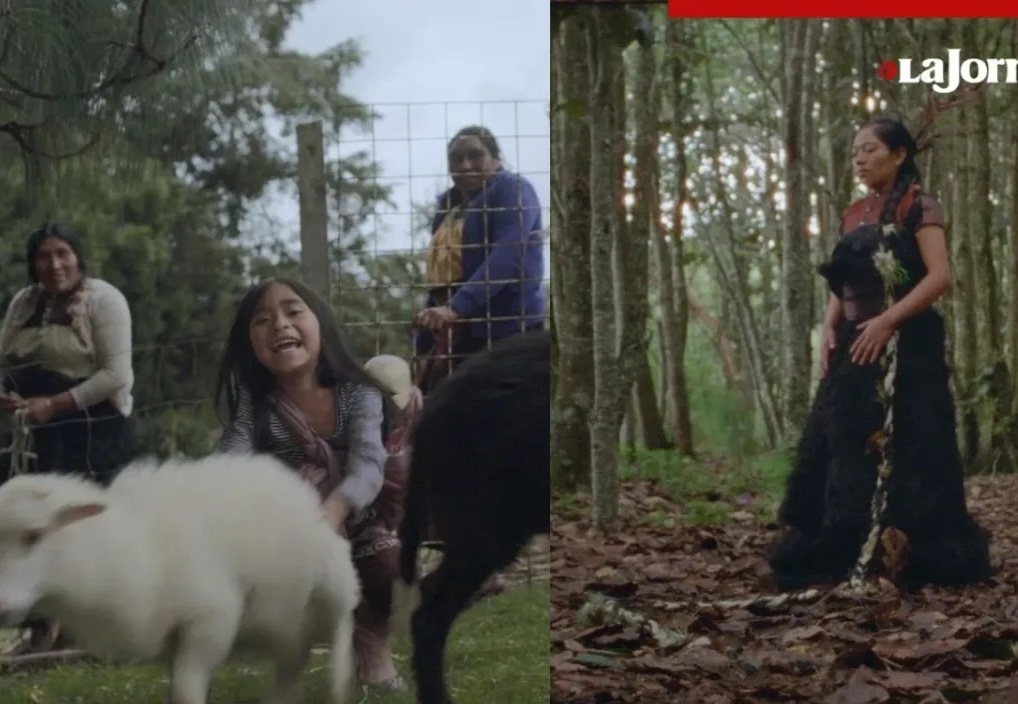

The traditional practices of a family of Tsotsil women from San Cristóbal de las Casas, Chiapas, reveal the complex relationships between nature and the culture of a territory that stands the test of time. This is the guiding thread of the film essay “Formas de tramonto un territorio” (Ways of Traversing a Territory), by Mexican filmmaker Gabriela Domínguez Ruvalcaba, which hits theaters this weekend.
Dominguez Ruvalcaba’s camera followed Doña Sebastiana and her nine daughters, the film’s protagonists, as they went about their daily activities, from farming, herding sheep, and producing wool for clothing, to harvesting medicinal plants.
“I’m from San Cristóbal de las Casas. I had a very clear image stored in my memory: always stepping out of the city and seeing women, almost always grandmothers with daughters, Tsotsil shepherdesses with a flock, and that image became very close to my understanding of the territory I lived in.
“My interest was to learn about that reality and a way of inhabiting the territory different from my own. When I started making this film, I realized that we truly share a space, and what connects us is greater than what separates us,” Domínguez Ruvalcaba shared in an interview with La Jornada.
Through lyrical images and an introspective narrative, the film showcases the world of the Tsotsil community and reflects on the importance of preserving the cultural memory of Indigenous peoples, as well as not forgetting the connection between humanity and nature.
During 15 days of filming, an all-female crew accompanied the family on their journey. through the Highlands of Chiapas, where she captured the identity and belonging they feel in their living space.
“The way I got involved with Doña Sebastiana was by working as a volunteer on agroecology projects, and we went to that territory, very close to San Cristóbal. From the beginning, I told them I wanted to make a film to record their journey along the mountain trails. They said, ‘Yes, yes, yes, let’s do it.’” “Doña Sebastiana was interested in her granddaughters and later generations being able to see what she does,” added Domínguez Ruvalcaba.
One of the challenges the director faced was communication, since she doesn’t speak Tsotsil. It was also about bridging the cultural gap, “recognizing ourselves in a different way in that territory.”
“I feel that due to the rhythms of daily life, cultural memory has been lost, as has knowing how supplies were once obtained. These are women who don’t just stay in their villages; in the case of Doña Sebastiana’s family, they go to the city to work or go to school. It’s like living in this other territory of modernity, but without abandoning their connection to the land, to farming, to the wool process. With this film, I wanted to capture those moments so that they too can recognize themselves and continue carrying out their ancestral activities with dignity without losing the present,” she said.
“Ways of Traversing a Territory” is Gabriela Domínguez’s second feature film and was presented at various film events last year. These include the UNAM International Film Festival, the Locarno Critics’ Semaine, the Havana International Festival of New Latin American Cinema, the Morelia International Film Festival, where it won the MUSA award for best documentary directed by a woman, and the Portland Ecofilm Festival, where it won the award for Best Documentary Film.
The documentary will tour Mexico City, Chiapas, Puebla, Tlaxcala, Veracruz, Hidalgo, and the State of Mexico to showcase the material in venues outside the film industry, bringing it to women and young people from indigenous communities to generate an exchange of experiences through these encounters.
“This weekend, it begins its screening in cultural screening spaces such as the film libraries of the In the country, we also have a tour that’s going to be very special because we’re organizing a tour with Artegios, our distributor, to cross territories in a van. We’ll bring a screen, a projector, and kitchens to show the documentary.
“Margarita, one of the protagonists, will accompany us to travel through seven states in the country and set up a room to show the film. We’ll be in the municipalities where shepherding and wool spinning are still prevalent, so that at the end of the screening, there will be an exchange between the inhabitants of that community and the protagonist. The film will be a pretext to talk about what they do and share their knowledge,” concluded Gabriela Domínguez.

Source: jornada