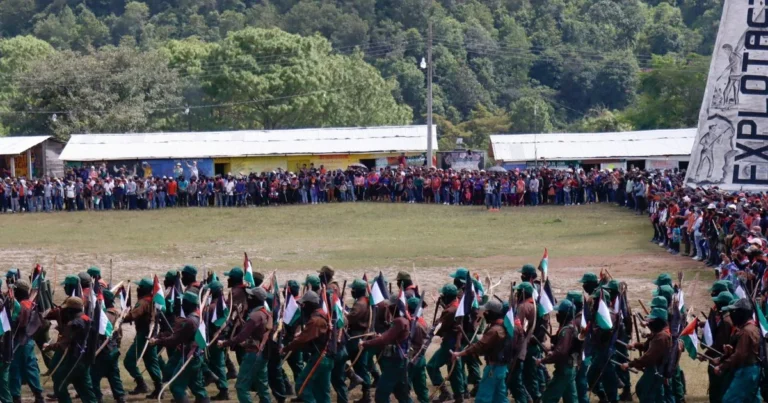
The Indigenous Congress, held 51 years ago, emerged as a moral and political benchmark. Its echoes resonated in peasant struggles, in the formation of independent organizations, and ultimately in the uprising of the Zapatista Army of National Liberation (EZLN). This event was “the root, the matrix” of the EZLN’s armed uprising in 1994, a statement shared by Juan Hernández Meza, Tiburcio Ruiz Clara, and Antonino García, a researcher at the University of Chapingo.
Antonino García, a researcher at the University of Chapingo, emphasizes that 51 years after its conception, the Indigenous Congress of Chiapas remains an ethical compass. He emphasized that what emerged in 1974 was not an assembly under state manipulation, but the first public act of contemporary Indigenous self-determination. The meeting, held from October 12 to 15, 1974, had the fundamental support of the then Bishop of San Cristóbal, Samuel Ruiz García.
This congress, according to García, taught that equal rights and opportunities for Indigenous peoples could not be achieved without transforming the very structures of power. It was not about including Indigenous communities in national development, but rather about redefining the nation from a multicultural and communal perspective. That principle, barely glimpsed then, is consolidated today as a political horizon that challenges both the Mexican state and the global arena.
The Evolution of Principles: From Denunciation to Reconstruction
The four major themes addressed at the Indigenous Congress of Chiapas—land, trade, education, and health—remain fully relevant, although their significance has broadened and deepened over time.
Land: From Access to Property to the Defense of Territory
The struggle for land today transcends mere access to property to become part of the comprehensive defense of territory against the threat of extractive megaprojects. This transformation reflects a deeper understanding of the relationship between Indigenous peoples and their environment.
Unequal Trade: Global Chains and Community Dispossession
The critique of unequal trade that emerged in 1974 has now extended to complex global chains. These, in their dynamics, deprive communities of both their produced goods and their common natural resources, evidencing a continuation of historical exploitation.
The demand for a community-based education has evolved into a demand for cultural autonomy. This is manifested through the development and implementation of community pedagogies that seek to preserve and transmit ancestral knowledge and values.
Health: Caring for Life in All Its Forms and Mother Earth
The concept of health has transcended mere medical care. It is now understood as caring for life in all its expressions, including the fundamental health of Mother Earth, recognizing the intrinsic interconnection between human and environmental well-being.
If in 1974 the word was raised against exploitation and injustice, in 2014 it was raised in defense of Mother Earth. Both struggles are part of the same historical current that progresses from resistance to care, from denunciation to reconstruction, and from oppression to the common good.
Researcher Antonino García asserts that in the 21st century, superficial political divisions between right and left no longer exist. Instead, the “voices of life and death” have emerged. He argues that on a planet where social, economic, political, environmental, and cultural relations have been radically transformed by capitalism—generating a civilizational crisis that threatens the very continuity of life—two clear positions emerge. On the one hand, the extreme concentration of wealth in a small one percent of the world’s population and the excessive consumption of privileged sectors. On the other, the voices of indigenous peoples and conscious citizens promote social movements sustained by the ethic of caring for the planet and the continuity of life.
Today, faced with new forms of dispossession and the worsening crisis of civilization, the message of the Indigenous Congress of Chiapas takes on renewed relevance. Communality, understood as a way of life and thought, presents itself as a powerful alternative to the model that has fractured the balance between human beings and nature.
Remembering the 1974 congress is not an act of nostalgia, but an exercise in active memory. It means listening again to the common word, the one that reminds us that justice can only be built from the “we-we.” Fifty-one years later, the crucial challenge is to keep that word alive. In times of fragmentation and political simulation, the indigenous peoples of Chiapas continue to show the world that another way of doing politics is possible: a politics that emerges from the collective heart, from the land that speaks, and from the community that resists.
Source: caribepeninsular