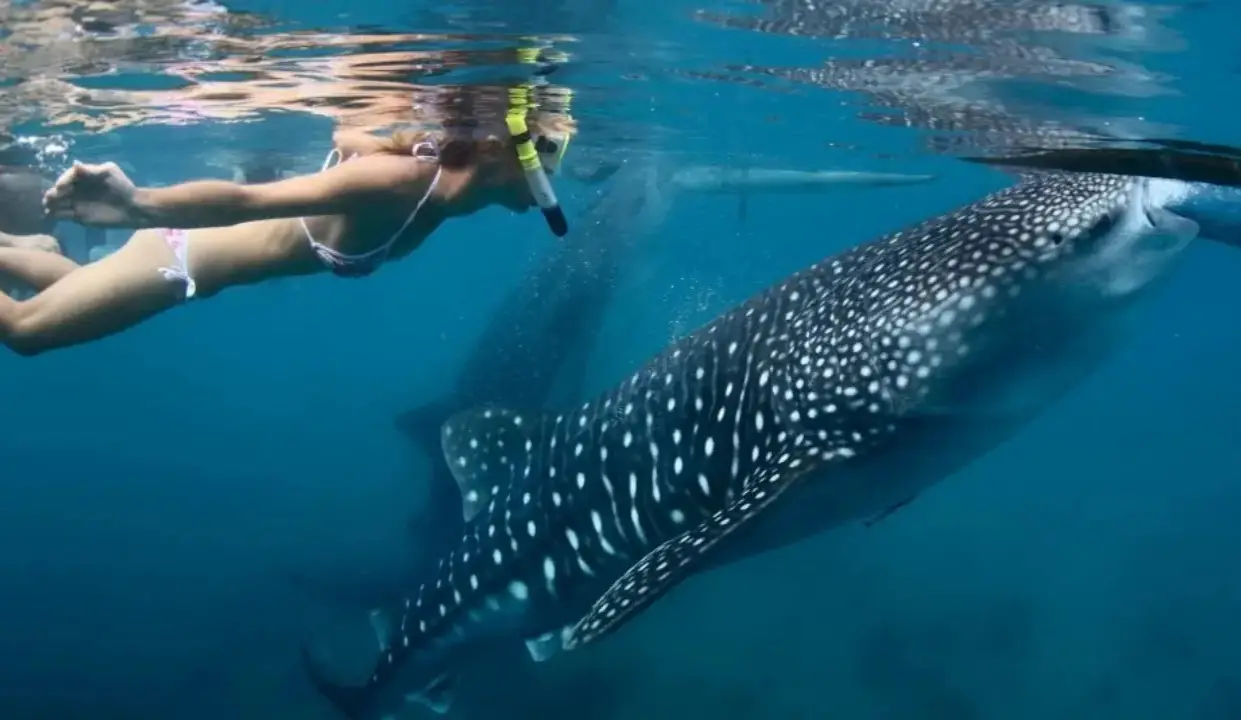

The whale shark (Rhincodon typus) is one of the most amazing creatures inhabiting the ocean. At over 12 meters long, it can measure the size of a city bus; its tail reaches the width of a compact car, and its mouth opens up to 1.5 meters wide, large enough for a standing person to fit inside without being swallowed.
Unlike the large predators with which it shares its name, the whale shark feeds by filtering tiny prey such as plankton, larvae, and small crustaceans.
These gentle giants roam tropical and subtropical seas around the world, from the Philippines to Mexico, and in La Paz, Baja California Sur, they have become a true marine emblem and a driving force for sustainable tourism.
When is whale shark season in La Paz?
Every year, La Paz Bay is visited by dozens of juvenile whale sharks that feed in its warm, calm waters. The official sighting season established by the National Commission of Natural Protected Areas (CONANP) runs from October 1 to April 30, although the actual start date may vary depending on the presence of whale sharks in the bay.
Authorities open the season only when at least 14 sharks are recorded in the protected area of El Mogote, which typically occurs between mid-October and November.
During the central months of December, January, and February, the probability of seeing them increases considerably, due to the stable climate, increased plankton, and the highest concentration of individuals.
Why do whale sharks choose La Paz, Baja California Sur?
Various studies by CICIMAR-IPN and UABCS have identified La Paz Bay as one of the main feeding and breeding areas for whale sharks in the eastern Pacific.
Most of the specimens observed are juveniles between 4 and 8 meters in length, which remain in the bay during the winter due to the abundance of plankton and the calm waters. The phenomenon is related to nutrient upwellings that occur between October and March, when sea temperatures drop to 21–26°C, creating optimal conditions for the microscopic life these giants feed on.
Thanks to this natural balance, La Paz has become a “marine nursery” where whale sharks feed and grow before migrating to deeper waters.
Best months and conditions to see whale sharks
Although the season runs until April, the best months for this tour are December, January, and February. During this period, numbers peak and the weather is most favorable.
The clear, calm waters allow for excellent visibility for snorkeling and close observation of the world’s largest fish. Tour operators recommend choosing morning tours, as the sea is usually calmer in the early hours, improving the swimming experience and reducing stress for the animals.
To participate in this activity, you must travel with operators certified by CONANP and SEMARNAT (National Commission for the Conservation of Nature and Wildlife), who have regulated vessels and trained guides.
Observation rules include maintaining a minimum distance of 3 meters, not touching or blocking the shark’s path, avoiding non-biodegradable sunscreen, and limiting the number of people per group.
Local companies such as MéXplore, Baja Adventure Co., and Punta Baja Tours are part of the cooperatives with permits valid until 2025.
Seeing whale sharks in their natural habitat is one of the most impressive experiences Baja California Sur has to offer.
Their slow, majestic gait, the spots that decorate their bodies like a star map, and the calmness with which they move are reminders of the importance of protecting the marine ecosystems of the Gulf of California.
Source: posta