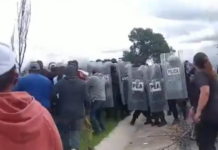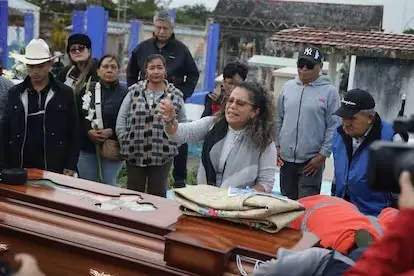

The train was traveling through the Isthmus of Tehuantepec on a route that symbolizes the reactivation of rail service in southern Mexico. It was a Sunday, and 250 people were on board, traveling from Oaxaca to Veracruz, when at 9:28 a.m., the train derailed on a curve. One of the cars plunged down a ravine more than six meters deep, and another was left partially suspended. Almost a week later, the stories of the 14 people who lost their lives in the accident are beginning to emerge. Among the victims were students, retirees, an entire family, a grandmother and her granddaughter, and a journalist. Two of the deceased were minors: a six-year-old girl and a 15-year-old teenager. The rest were between 49 and 73 years old.
Six-year-old Elena Solorza Cruz was traveling with her family, who were going to spend a few days of vacation in Veracruz, and died on impact. Her grandmother, Hilda Alcántara Alvarado, 73, survived the initial impact but died four days later in the hospital. Alcántara was first taken to the ISSSTE Tehuantepec Hospital and then to the IMSS Bienestar Regional High Specialty Hospital in Oaxaca. From the moment she was admitted, she was in critical condition: multiple traumas, fractures to her femur, tibia, and fibula, as well as several rib fractures. She underwent surgery to treat the fractures, but a pulmonary thromboembolism ended her life this Thursday. Her death raised the official death toll to 14.
Another passenger was María Antonia Rosales Mendoza, 58, originally from Acayucan, Veracruz. She had retired two years prior after a lifetime behind the wheel as a taxi driver. That Sunday, she was traveling to visit her sister, accompanied by her husband and daughter, who were injured but survived the accident. Also traveling on the train were Berzaín Cruz López and María Concepción Barbosa Acevedo, both 65 years old. They were members of the Diocese of Tehuantepec and coordinators for their congregation, which mourned their deaths.
Among the deceased was also journalist Israel Enrique Gallegos Soto (60 years old), known as Henry del Toro, who worked for Heraldo Radio Oaxaca and was one of the first victims identified. He was traveling with his wife. After his death was confirmed, colleagues and friends remembered him on social media: “Israel leaves an indelible mark on those of us who had the honor of knowing him. His voice, his commitment, and his humanity will always remain in our memory.”
Following the accident, the governor of Veracruz, Rocío Nahle, confirmed that three of the victims belonged to the same family from Minatitlán: Patricia Medina (49 years old), Honoria Medina (56), and Rogelio Luna (63). They had departed that morning from the port of Salina Cruz bound for Coatzacoalcos, accompanied by two acquaintances who survived the crash. Another passenger, originally from Veracruz, was 57-year-old Inés Alvarado Rojas, who was reported missing after the accident, and whose death was confirmed days later. She had traveled to Oaxaca to spend Christmas with her son, an employee of the State’s Legal Counsel and Legal Assistance Office, which sent a message of condolence. Amada Rasgado Lázaro, 70, also died in the derailment. Her brother, José Rasgado, remembered her as a hardworking woman who loved to travel.
Fifteen-year-old Luisa Camila Serrano Moreno was from Salina Cruz. She was traveling with her mother and sister, both of whom were injured in the accident. Serrano was a student at Conalep 155, a school that mourned her death with a message shared on social media. Among the fatalities are also María Luisa Pasaron González (66 years old) and Raúl López Cruz (67), about whom few details have been released.
The accident initially left 98 people injured. As the days passed, the number dropped to 17 hospitalized, according to the latest official report. The injured were treated in hospitals in Salina Cruz and the city of Oaxaca. Among the survivors is Katherine Vásquez, a 21-year-old woman who was traveling in the car that fell into the ravine. She recounted to this newspaper her last memory before the accident: “We were scared because of the speed on the curve. I felt it jerk and the weight shifted. It was a very sharp curve, almost a U-turn. I feel like it took it at a lot of speed. I couldn’t think straight anymore. There wasn’t a jolt, it just went sideways.”
On Monday, Mayor Claudia Sheinbaum visited hospitals in Matías Romero, Juchitán, Ciudad Ixtepec, and Salina Cruz, where the injured were being treated. She also went to the crematorium where the victims’ bodies were being held and met with their families, who will receive initial support of 30,000 pesos to cover urgent expenses. On Tuesday, at the last morning press conference of 2025, she stated that she is open to hearing the opinions of international experts and asked Admiral Raymundo Pedro Morales Ángeles, Secretary of the Navy, to seek an international certification body to give its approval before reopening the highway after the accident. “If there are recommendations on what needs to be done for greater safety, then those recommendations should be taken into account,” Sheinbaum said after the accident.
Source: elpais