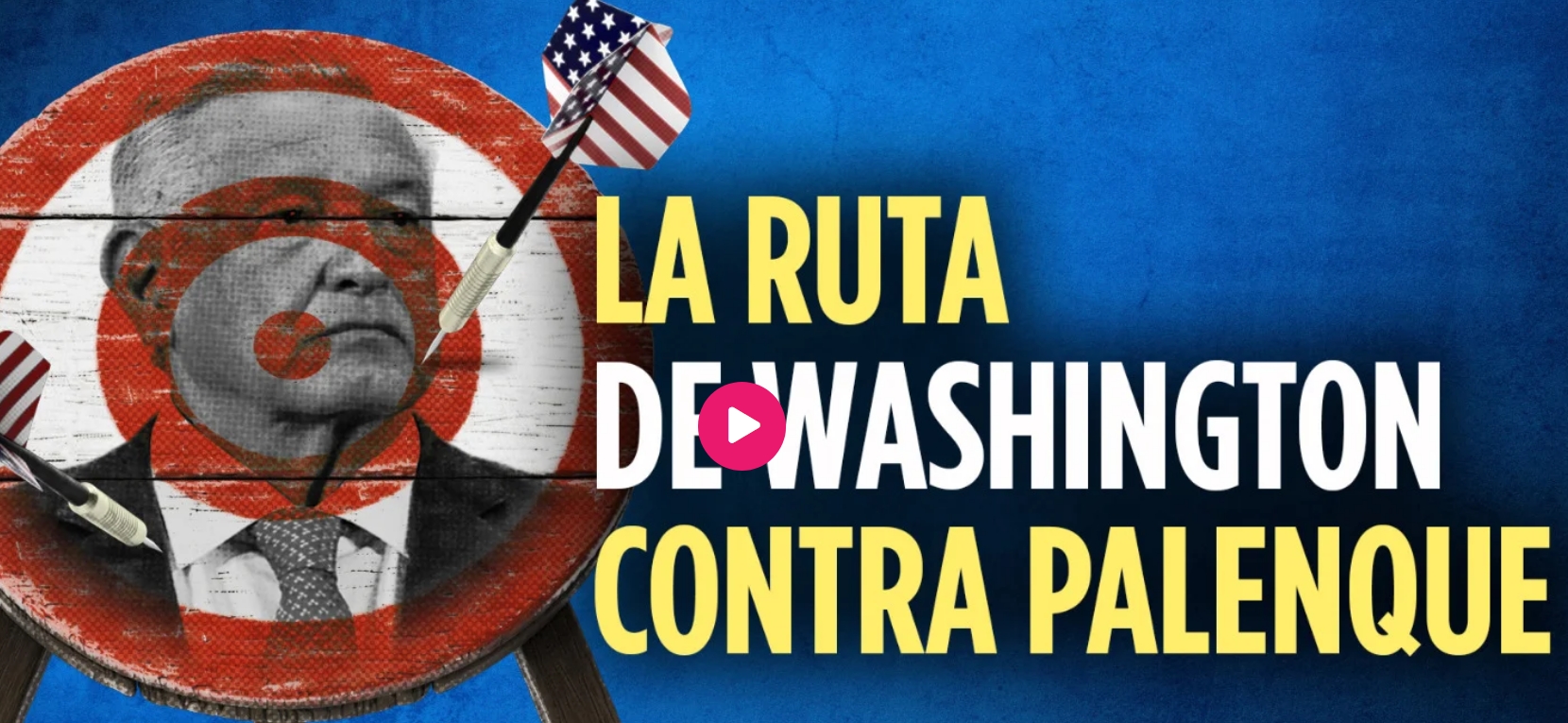

“In Washington, the decision has already been made to go after Andrés Manuel López Obrador.” This assertion comes from a political operative deeply connected to the U.S. intelligence apparatus. His prediction might seem far-fetched. His words, however, are backed up by facts.
Last week, the Donald Trump administration launched two attacks that have shaken the former president of Mexico.
The first: the arrest by ICE agents of Mexican businessman Manfred Mauricio Quintanilla, a partner in Transportes Unidos Mexicanos. He is a key figure in the context of Operation Polanco, the DEA investigation that proved the Beltrán Leyva Cartel made financial contributions to López Obrador’s 2006 presidential campaign. According to testimonies from high-level officials and documents reviewed by ProPublica, the money was delivered to Mauricio Soto Caballero, a politician who partnered with Manfred Mauricio Quintanilla in 2002 in the company Arte y Creatividad Digital SA de CV. The direct intermediary between López Obrador’s campaign and the Beltrán Leyva cartel was Nicolás Mollinedo, who for decades was the driver and confidant of the founder of the Fourth Transformation movement. Mollinedo is also the cousin of Rafael Marín Mollinedo, the current head of the National Customs Agency in Claudia Sheinbaum’s government, a position he held briefly during the previous administration. According to a recap published by the newspaper El País, in 2002, while serving as director of the Mexico City Passenger Transportation Network under López Obrador’s administration, Rafael Marín Mollinedo awarded a contract to a company in which Manfred Mauricio Quintanilla and Mauricio Soto Caballero were partners. The circle closes with last week’s arrest in the United States.
The second attack by the Trump administration against López Obrador came via a leak: the news outlet Pie de Nota published a document that Homeland Security Investigations allegedly sent to Mexico’s Special Prosecutor’s Office for Organized Crime, warning about the alleged role of businessman Jack Landsmanas Stern in assisting an organized crime group classified as a terrorist organization. The document uses terms like “kleptocracy,” “money laundering,” “tax evasion,” and “logistical and financial support” to describe Landsmanas’s alleged activities. The document adds that the Lithuanian-born businessman has “maintained and nurtured a chain of corruption” within the Mexican Social Security Institute (IMSS), the National Migration Institute, Pemex (the state-owned oil company), the Federal Electricity Commission (CFE), and the finance departments of various state governments.
Jack Landsmanas is one of the best-connected businessmen within the governments of the Fourth Transformation (the current administration). His company, Corporativo Kosmos, and its subsidiaries Productos Serel and La Cosmopolitana, have been referred to in journalistic investigations as “the food cartel” due to their extensive network of contracts as food suppliers to public hospitals, prisons, and immigration detention centers. In fact, Landsmanas was one of the few businessmen who successfully transitioned from the inner circle of Enrique Peña Nieto’s administration to that of Andrés Manuel López Obrador and Claudia Sheinbaum. In the last year of the PRI government, Landsmanas’s companies obtained federal public contracts worth 5 billion pesos. In the first three years of López Obrador’s administration, the amount of these contracts reached 18 billion pesos. In 2021, Contralínea magazine, a pro-government publication, reported that the Financial Intelligence Unit, the Tax Administration Service (SAT), and the Ministry of Public Administration had launched an investigation into Landsmanas’s companies for “tax evasion, money laundering, and bribery.” Despite this, the so-called “food cartel” continued to operate at the highest levels of the 4T (Fourth Transformation).
Given the possibility of regime change in Venezuela, the Landsmanas name has become a focus of interest for the Donald Trump administration. Additionally, this has raised concerns about the power network surrounding López Obrador, which has facilitated the survival of Nicolás Maduro’s regime. In October 2018, a few months before Morena came to power, the Attorney General’s Office published a report on a “fraudulent scheme” of “unusual operations” to supply the Local Committees for Supply and Production (CLAP) program of the Chavista dictatorship.
In reality, this was a facade for a massive scheme to divert public resources to Venezuela’s military and political elite. The scheme was operated by the controversial Colombian businessman Alex Saab, who was sentenced in the Southern District Court of Florida for money laundering related to this program. Saab was later released in an out-of-court settlement between the United States and Venezuela. However, the CLAP embezzlement was exposed. Israel Lira, head of the SEIDO (Specialized Unit for Organized Crime) at the Peña Nieto administration, warned that Mexican companies were involved in this fraud, but refrained from naming them. In November 2018, the Venezuelan investigative journalism outlet Armando Info documented that the import scheme involved companies belonging to Landsmanas and Panamanian businessman Ramón Carretero Napolitano, who was connected to the top brass of the Castro regime in Cuba.
When López Obrador took office, far from continuing the investigation initiated by Israel Lira, he created his own structure to provide resources to the Maduro regime: Libre Abordo, a company operated by Mexican national Joaquín Leal, was assisted by Segalmex (the Mexican Food Security Agency) and the Undersecretary of Foreign Affairs, Maximiliano Reyes, to help the Venezuelan government evade sanctions imposed by Washington. Through this vehicle, Mexico received oil in exchange for food supplies.
Last weekend, The New York Times reported that the Venezuelan oil tanker seized by the U.S. Armed Forces was intended to deliver oil to Cuba. The Trump administration explained this mission as an operation to curb the financing of terrorist groups. The Skipper was operated mostly by Russian personnel and had previously been used to help Iran evade financial sanctions imposed by the U.S. government. The seizure was a show of force by the massive military deployment of the U.S. Army and Navy’s Southern Command: an operation costing $200 million a day and concentrating 10 percent of the firepower of the world’s leading military power. It also demonstrated that the U.S. National Security Strategy now prioritizes the Western Hemisphere.
For Nicolás Maduro, the program of delivering Venezuelan oil to Cuba implies that, in exchange, he receives protection and counterintelligence from the Cuban regime’s security services. Does former President Andrés Manuel López Obrador receive the same treatment? Through a private subsidiary of Pemex, Gasolinas del Bienestar SA de CV, Mexico transfers an average of about 20,000 barrels of oil per day to Cuba, according to the state-owned company’s financial reports. This assistance is valued at $600 million annually. In November 2024, already under Sheinbaum’s administration, during Cuba’s latest energy crisis, Mexico supplied 400,000 barrels of crude oil and 65,000 barrels of diesel.
Sheinbaum’s administration has not suspended crude oil shipments or the Cuban doctors program, another scheme for providing financial resources to Miguel Díaz-Canel’s regime in Cuba. Carlos Giménez, a Republican congressman from Florida, warned this week that “in the United States Congress, we know that Claudia Sheinbaum’s government in Mexico supports the narco-tyrant Nicolás Maduro of Venezuela so much because it knows that as soon as he falls, she will fall too, due to her complicity with the drug traffickers who have destroyed the country.”
Whether it’s because of the Manfred Mauricio Quintanilla case, Landsmanas’s operation in Venezuela, or the oil program sent to Cuba, Washington is sending dangerous signals to the Fourth Transformation coalition, particularly to its founder, Andrés Manuel López Obrador.
Source: codigomagenta