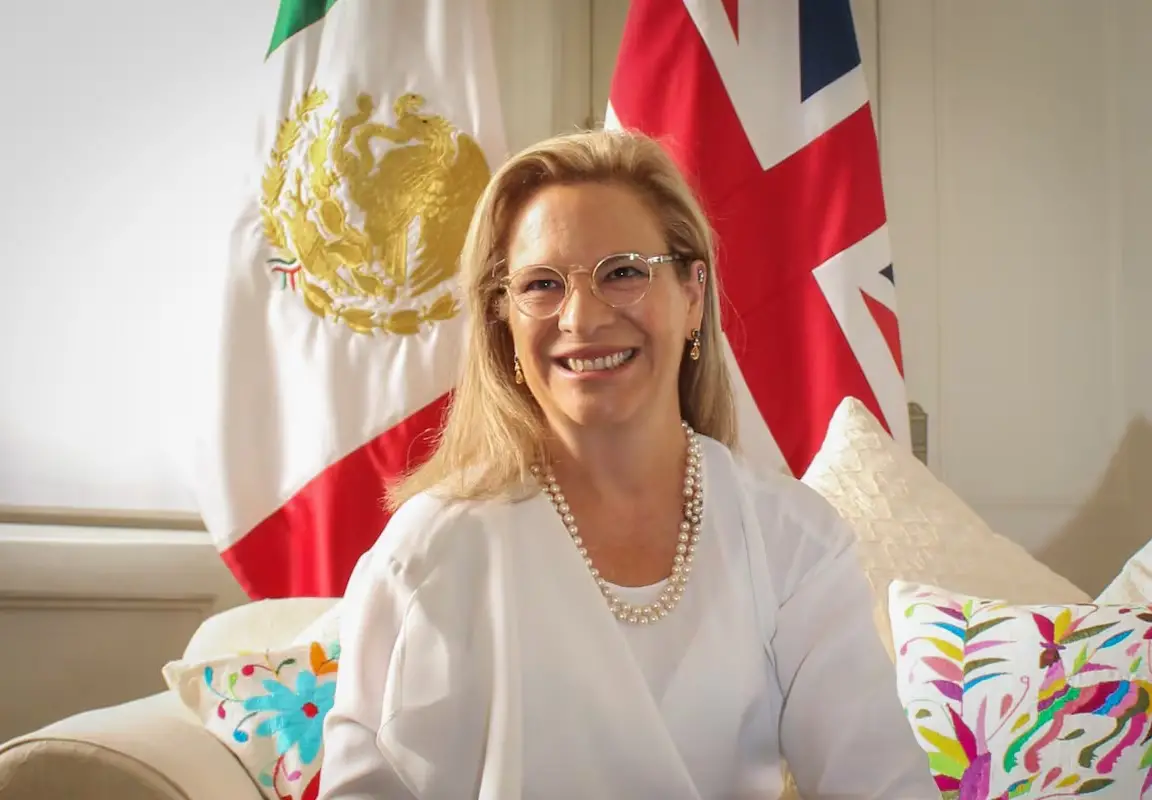

There’s a common order within the Mexican Embassy in the UK, one that its employees hadn’t heard before dealing with its head, Josefa González-Blanco: “You’re going to the doghouse.” “At first, we didn’t understand. Then we learned it means ‘the doghouse.’ A systematic punishment. She freezes you out, stops talking to you, doesn’t pass you any information, and you simply cease to exist. She tells the rest of the staff that they can’t have any contact with you. Internally, it’s chaos; nobody knows who they can and can’t talk to, who’s frozen out and who isn’t,” an embassy source, who prefers to remain anonymous for fear of reprisals, told EL PAÍS. This idea is echoed in the testimonies of six other current and former employees collected by this newspaper: “She froze him out because she didn’t like him”; “he was frozen out for a year and a half”; “there’s no academic relationship with the UK because she had the person in charge of that area frozen out”; “you go to the freezer and you stay there.”
Josefa González-Blanco is now leaving her post as ambassador to the United Kingdom amid a trail of 16 complaints from employees, who accuse her of workplace harassment, mismanagement of resources, and having severed bilateral relations. Since 2021, at least 40 employees have left the Embassy, through resignations and transfers to other missions, leaving it with less than half its original staff. The employees won their complaints before the Internal Control Body and the Ethics Committee, in which they detailed the stressful and harassing work environment, but, they claim, it was to no avail, as the ambassador refused to comply with the recommendations and the Ministry of Foreign Affairs took no action. The Ministry of Foreign Affairs (SRE) had not responded to this newspaper’s inquiries at the time of publication.
The ambassador did indicate, in response to questions from EL PAÍS, that these accusations “stem from disagreements with audit and investigation processes currently underway within the mission.” She added, “Given that these are ongoing procedures, it is not possible to offer further details at this time.” Regarding the bilateral relationship between Mexico and the United Kingdom, González-Blanco maintained that “it remains solid, active, and constantly strengthening, as can be seen through the public agenda and the daily work between both governments.” Former Attorney General Alejandro Gertz Manero will be in charge of replacing her.
The situation in the Mexican foreign service is fragile. Diplomats struggle with salaries that have not been updated since 1998, which in delegations like the United States translates into poverty (some representatives have to rely on food banks and live in shelters), and with heads of missions typically appointed by the current administration. This is the case with Quirino Ordaz as ambassador to Spain, Omar Fayad in Norway, and Esteban Moctezuma in the United States. All of them were chosen by then-President Andrés Manuel López Obrador, who appointed 30 heads of missions for political reasons. One of them was Josefa González-Blanco.
The official comes from a family with a long political tradition. Both her grandfather and her father were governors of Chiapas; in addition, her grandfather served as Secretary of Labor for 12 years in the federal government, and her father, Patrocinio González-Blanco, was the controversial Secretary of the Interior under Carlos Salinas de Gortari (1988-1994) before and after the Zapatista uprising. The now former ambassador worked at an ecological refuge founded by her family in Palenque, Chiapas, before López Obrador appointed her as Secretary of the Environment in 2018. She lasted six months. The reason for her dismissal is no secret; she herself acknowledged it: she was running late for a flight between Mexico City and Mexicali, so she called an Aeroméxico executive to have the plane wait for her. The captain had to inform the passengers that they would have to wait because there was a “presidential order.” It took 38 minutes. “We cannot tolerate acts of arrogance,” the president said after accepting her resignation.
González-Blanco returned to public service in 2021, when López Obrador gave her the opportunity to serve as ambassador to London, the capital of the United Kingdom. A source close to the Foreign Ministry identifies this appointment as “a political payoff,” especially given López Obrador’s connection to the ambassador’s father. At that time, the British Embassy had no representative. In fact, throughout the Brexit process, the Mexican representation was headed by a chargé d’affaires. “The last major task for this Embassy was Enrique Peña Nieto’s trip in 2015,” the source notes, adding that “it has lost much of its importance, but it was always a very prestigious embassy within the diplomatic corps.”
The United Kingdom is the fifth country with the most Mexicans living outside of Mexico. It was there that Josefa González-Blanco, who had already lived and studied in Mexico, arrived for her second political post. “She stayed in charge and left us without a team,” one of these employees points out. The seven current and former employees contacted by EL PAÍS provided documents including resignations, complaints, and resolutions from the Ethics Committee and the Internal Control Body. All emphasized their declining health after working for her. They point to “systematic mistreatment,” an ambassador who uses the resources of the embassy “only to promote her personal image” and who has “destroyed bilateral relations with the United Kingdom.” In short, they maintain: “We are a ship adrift, where Josefa does whatever she pleases.”
In February 2023, the then Undersecretary of Foreign Affairs, Carmen Moreno, began a tour of Europe “with the aim of continuing the high-level political dialogue between Mexico and various European partners,” the government stated at the time. The official visited Luxembourg, France, and Germany. “They asked [Josefa González-Blanco] to arrange two high-level meetings with a UK deputy minister,” recounts a source at the Embassy. “She couldn’t get them because she doesn’t know the people; she doesn’t interact with them.” “The undersecretary ended up not coming,” notes another employee.
The employees consulted maintain that “there is no bilateral relationship with the United Kingdom.” “We’re not on bad terms, but she doesn’t talk to anyone. There’s no political or academic relationship,” they clarify. Along the same lines, they point out: “There are no relationships with universities, neither exchanges nor joint research; the issue of international cooperation is on hold.” The Embassy in the United Kingdom also represents Mexico in several international organizations. The International Maritime Organization (IMO), the International Sugar Organization (ISO), and the International Coffee Organization (ICO) are all represented there. The employees maintain that these organizations are “leaderless.” “We are maintaining an embassy that doesn’t function,” they summarize, “all diplomatic relations are handled at the British Embassy in Mexico.”
One of the biggest successes shared on the ambassador’s social media accounts refers to the exhibition of painter José María Velasco, which opened in 2024 at the National Gallery, London’s most important art museum. In a communication obtained by EL PAÍS, the ambassador informed the Ministry of Foreign Affairs (SRE) about the efforts she had made over two years to develop the exhibition. However, the National Gallery confirmed to this newspaper that the negotiations and planning of the project were carried out directly with the Ministry of Culture, without the Embassy’s involvement.
According to the testimonies gathered, Josefa González-Blanco is absent from the embassy for days at a time. The official was not interested in signing expense reports or contracts, nor in “political dialogue,” nor in activities unrelated to culture; yet she does organize more than a hundred events a year. In 2024, there were 108 such gatherings, averaging one every three days. They vary in size, from around 30 attendees to as many as 600, officials say: “She runs the events like her own parties; they’re not Mexican Embassy events with any purpose, they’re for her image.” “There are no speeches or conversations, just drunken revelry,” they point out.
These gatherings are a source of problems at the Embassy. On the one hand, they force staff—those not on furlough—into extremely long workdays that stretch into the early hours of the morning, for which they are even denied breaks and vacations, according to these testimonies. These grueling schedules led to staff leaving the diplomatic residence. “Working hours were from Monday to Sunday at ‘official’ events, which ended up being out-of-control parties until two or three in the morning,” they say: “The cleaning lady ended up becoming a bartender.”
Another issue surrounding these gatherings is the financial aspect, because “the events count as embassy administrative expenses”: “She wanted to use the protection funds earmarked for medical care or repatriation. She wanted to use those for the parties.”
The consequences for anyone who opposes the ambassador, employees point out, are direct. They maintain that mistreatment is common among Mexican Foreign Service (SEM) personnel, as well as with local staff and even with those appointed under Article 7, those handpicked by the ambassador—in other words, “her own people.” Thus, in four years, there were four heads of chancery (the highest position below the ambassador).
Source: elpais