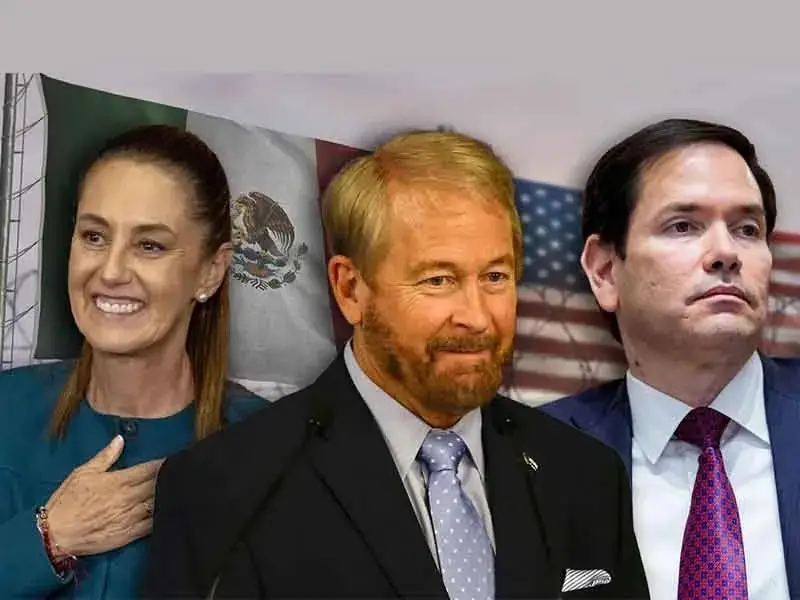

The 15th phone call, which took place a few days ago between President Claudia Sheinbaum and Donald Trump, was no walk in the park. It was preceded by an open threat: the US president’s threat to attack Mexican cartels on the ground, on Mexican soil—the equivalent of a military intervention.
Hours before the call, Sheinbaum instructed Foreign Minister Juan Ramón de la Fuente to contact Marco Rubio. The result was not what she had hoped for: the US Secretary of State hardened his rhetoric and brought the concept of “narco-terrorism” back into the conversation.
For Sheinbaum’s call to take place, the Mexican government had to explain the content and limits of the conversation to Ambassador Ronald Johnson beforehand. On his social media account, the diplomat credited himself as a “facilitator.”
The conversation lasted only 14 or 15 minutes. They first discussed Venezuela. Sheinbaum maintained Mexico’s historical stance: neutrality, respect for sovereignty, and non-intervention, which apparently did not sit well with Trump. The dialogue then shifted to more delicate territory: the insinuation of alleged links between Mexican politicians and Nicolás Maduro, and the supposed protection they receive from Mexico.
US newspapers highlighted that the American president grew tired of waiting for a positive response from Mexico to his proposal to dismantle the cartels. “If we want to move forward, we have to see results, which we haven’t seen to this day,” he reportedly stated. For the US president, the “zero fentanyl” rhetoric is no longer enough. He is now demanding concrete actions against Mexican politicians whom Washington links to organized crime. There are even reports of lists with names and surnames, which allegedly include figures from Morena and other parties.
The Wall Street Journal revealed that, following the capture of Nicolás Maduro, US pressure on Mexico intensified. It reports demands for arrests and a central dilemma for Sheinbaum: how to balance the defense of sovereignty with external pressure that threatens the political stability of the Fourth Transformation.
Despite everything, Sheinbaum ruled out a military intervention. We have to believe her. She bought time and contained the crisis in the short term. But the underlying issue remains unchanged. Trump will maintain a strategy of escalating pressure: he will demand not only results against the criminals, but also against their alleged protectors, and a clearer alignment of Mexico with countries he considers enemies, such as Venezuela, Cuba, Russia, and China.
However, in matters of security, bilateral cooperation exists and is deeper than the US acknowledges. The Mexican Army has played a key role in the exchange of intelligence, operational coordination, and the design of joint strategies with the Trump administration, always under the principle of respect for sovereignty. The arrest of targets, the destruction of laboratories, and actions against trafficking routes are part of that collaboration.
Marco Rubio and Ronald Johnson themselves have praised the work of the Mexican Armed Forces and also recognized the strategy for combating organized crime implemented by the Secretary of Public Security, Omar García Harfuch, which has abandoned the failed “Hugs, Not Bullets” policy.
Therefore, a unilateral military intervention seems unlikely. The costs would be enormous for both countries, particularly considering that Mexico is the United States’ main trading partner, with nearly $900 billion in annual trade. Precisely for this reason, the instrument of pressure will not be military, but rather tariffs and the USMCA (United States-Mexico-Canada Agreement).
- The SSPC (Secretariat of Security and Citizen Protection) and the National Guard arrested members of the Venezuelan Tren de Aragua cartel. The transnational criminal group operates in ten states of the country. It entered Mexico with the support of the JNG (Jalisco New Generation Cartel) and the Sinaloa Cartel, under a context of complacency, if not outright permissiveness, during the administration of Andrés Manuel López Obrador.
From Imaginaria. There will be significant changes at the Ministry of Defense. Most notably, Major General Hernán Cortés Hernández, formerly commander of the National Guard, will become Chief of Staff of the Ministry of Defense. Major General Enrique Martínez López will serve as Undersecretary of Defense, and Major General Guillermo Briseño Lobera will be the new commander of the National Guard.
Source: diariodechiapas