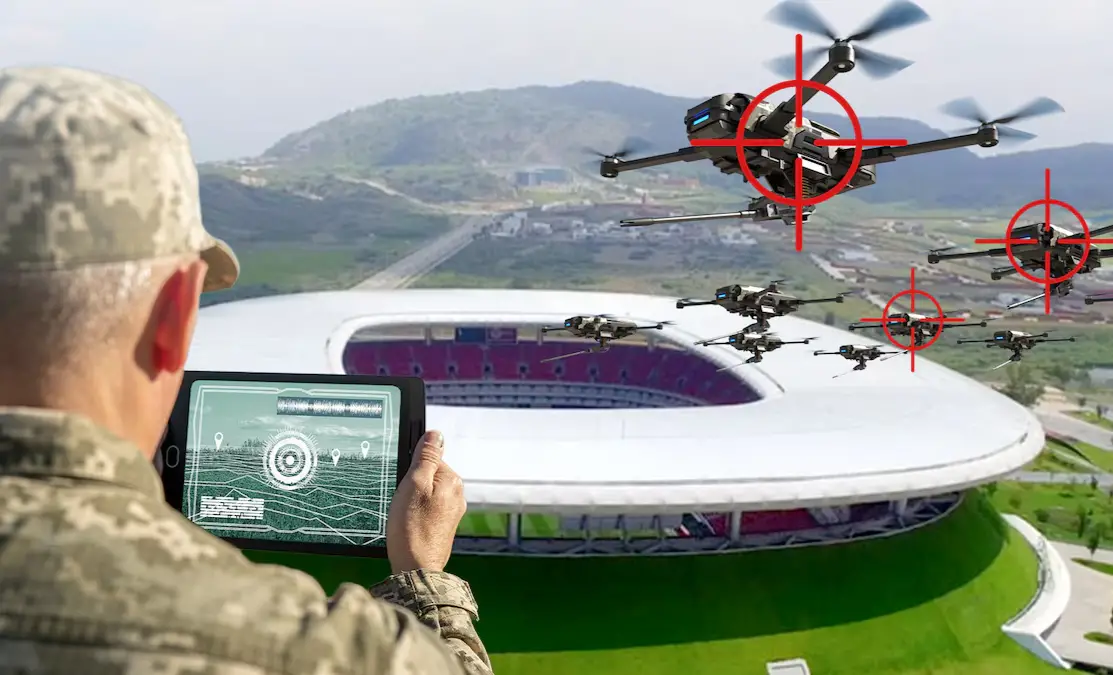

It’s the night of June 18th. The Mexican and South Korean national teams are warming up on the field at Chivas Stadium for their second match of the 2026 World Cup when the security team receives an alert: a drone attack by the Jalisco New Generation Cartel (CJNG).
This and other hypothetical scenarios were part of the training that FBI agents—like those who deceived El Chapo’s cousin—gave to Mexican police officers for the detection and neutralization of high-profile threats against the 2026 FIFA World Cup, which will be played in the United States, Mexico, and Canada next summer.
Juan Pablo Hernández González, Jalisco’s Secretary of Public Security, explained in an interview with El Financiero that Mexican police officers will be ready to protect the population in a context where drug cartels are increasingly using more sophisticated weapons.
“They will be able to prevent threats and analyze scenes where explosions have occurred, including evidence collection and preservation, and possess specialized knowledge, especially regarding drone systems,” he stated.
The FBI training of Mexican police officers focused on drone attacks in stadiums and other locations with high concentrations of people, and even included containment measures in the event of a bioterrorist attack.
The Jalisco state police have equipment to combat the illegal use of drones, which are used in operations against organized crime.
“It is a technological device that emits waves to disable drones, commonly used for criminal purposes, and secure them for investigative tracking,” explained the Secretary of Security.
The police forces of Jalisco and Guadalajara also have drones in their arsenal equipped with 4K cameras, thermal imaging, and zoom capabilities for surveillance, search and rescue, and support at mass events.
Organized crime groups don’t just use these devices for attacks: U.S. Customs and Border Protection (CBP) reported in 2025 that cartels use drones to monitor the U.S. border and smuggle drugs.
Police officers in Jalisco were also trained by elite agents of the French National Police in crowd and riot control.
The “Phantom Menace” operation also included training for paramedics from Jalisco’s Emergency Medical Services System (SAMU), which will have four state-of-the-art mobile hospitals, one of them at the Guadalajara Stadium.
Yanick Nordin Servín, director of SAMU (Emergency Medical Service), explained that drills are being conducted with the State Police and the Ministry of Public Security in “a scenario involving a riot at the stadium, but the directive is also to prepare for a bioterrorist attack, nuclear attack (even though the risk is low), and bacteriological or chemical attack. We are working on the procedure for decontaminating patients before they enter the hospital.”
The Jalisco Health System will temporarily hire 600 doctors, nurses, and paramedics to cover all fronts during the 2026 World Cup, Yanick Nordin Servín announced.
Héctor Raúl Pérez Gómez, Jalisco’s Secretary of Health, detailed that care protocols will be tightened due to possible outbreaks of Ebola or Marburg virus.
“We will have at least three isolation units in the highly specialized hospitals for diseases with a very high risk of transmission,” he stated.
In addition to the Mexican National Team’s second match, Estadio Guadalajara will also host the clash between Spain, Euro 2024 champions and number 1 in the FIFA rankings, and Uruguay’s fighting spirit, one of the most anticipated matches of the 2026 World Cup group stage.
Guadalajara will also welcome Colombia, one of the countries that requested the most tickets for the 2026 World Cup, according to FIFA data. The Colombian national team will play at Estadio Chivas against an opponent that will emerge from the international playoff between the Democratic Republic of Congo, Jamaica, and New Caledonia.

Source: elfinanciero