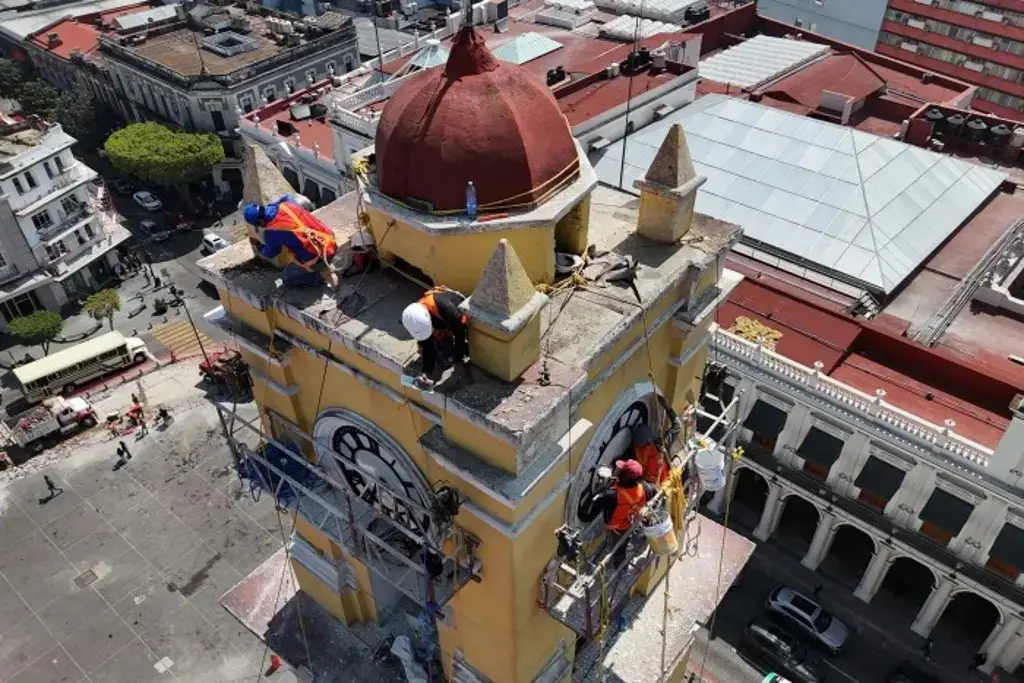

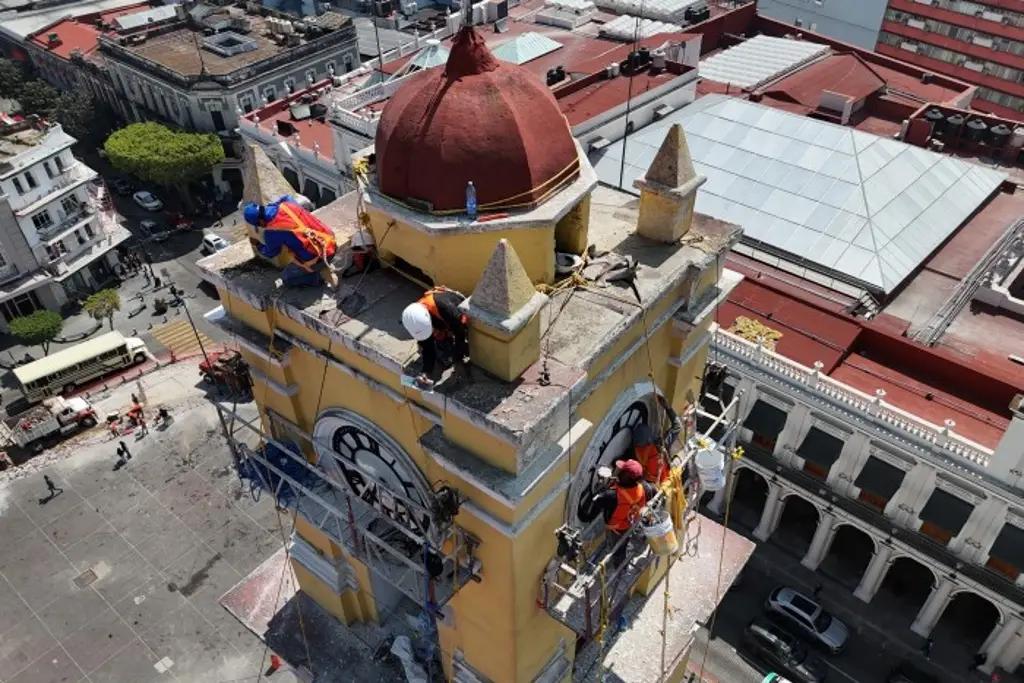
The renovations currently underway at the Xalapa Metropolitan Cathedral have reignited the debate about the importance of conducting archaeological studies during interventions in the historic center, as well as about traditional narratives surrounding the pre-Hispanic past of the Veracruz capital.
Archaeologist José Antonio Contreras, a researcher at the National Institute of Anthropology and History (INAH) based in Xalapa, pointed out that these types of projects present opportunities to obtain information about the city’s past, although he lamented the frequent lack of prior coordination between authorities and specialists.
He explained that his work focuses on investigating the pre-Hispanic settlement of Xalapa, particularly in the area now occupied by the historic center, where he seeks to verify the hypothesis that, as has traditionally been stated, during the pre-Hispanic era—that is, before the arrival of the Spanish—the city was indeed comprised of four ancestral neighborhoods.
However, the researcher indicated that, so far, there is no material evidence to support that version in the area where Juárez Park, the cathedral, and the Government Palace are located.
“To date, we haven’t found anything, but it’s also true that we haven’t examined all the layers. But it’s during public works projects that we can find them; for example, when they remodeled Enríquez a few years ago, we found remains of the storm drain system,” he explained.
Contreras emphasized that urban interventions are often crucial moments for archaeological research, as they allow access to the subsoil, something that cannot be done regularly in a functioning city.
Nevertheless, he pointed out that the speed at which construction projects are usually carried out limits the possibility of conducting specialized studies.
“Public works move very quickly, and the time needed to carry out archaeological investigations, which require more time, is generally not considered. That’s why we are vigilant,” he stated.
The researcher emphasized that the National Institute of Anthropology and History (INAH), in accordance with the Federal Law on Archaeological, Artistic, and Historical Monuments and Zones, has the responsibility to protect, conserve, and investigate cultural heritage, although he acknowledged that, in some cases, construction projects are not presented in advance to assess their cultural impact.
Contreras explained that, legally, archaeological remains are all material remains created before the arrival of the Spanish, that is, between 1519 and 1521. All material remains manufactured before that date are cultural heritage and must be conserved, investigated, and protected.
On the other hand, historical heritage is everything built from 1521 to 1900.
Therefore, he pointed out that the importance of the excavations lies in the possibility of identifying what elements might be found beneath current structures, such as the cathedral floors.
“We will only know if archaeological remains exist when excavations are permitted. There may be some, or there may not be, but we will know when sampling is allowed,” he stated.
The researcher questioned the widely circulated historical narrative that Xalapa originated from four pre-Hispanic neighborhoods, indicating that there is no archaeological evidence to support this claim.
He explained that the only site with clear evidence of original settlement in the region is Xallitic, an area that, according to archaeological research, was inhabited at the time of the Spanish expeditions’ passage through the central highlands.
“The problem is that versions without archaeological backing continue to be repeated. To confirm or rule out these hypotheses, we need more research,” he commented.
The archaeologist believes that knowledge of the past contributes to strengthening cultural identity and a sense of belonging within society, and therefore insisted on the need for authorities to prioritize heritage conservation alongside urban development. “Knowing our history strengthens national, state, and local identity. It’s unfortunate that there is often insufficient awareness of these issues,” he noted.
The specialist also emphasized the need to disseminate the results of archaeological research to the public through outreach activities and projects that bring historical knowledge closer to the citizenry.
Source: oem