

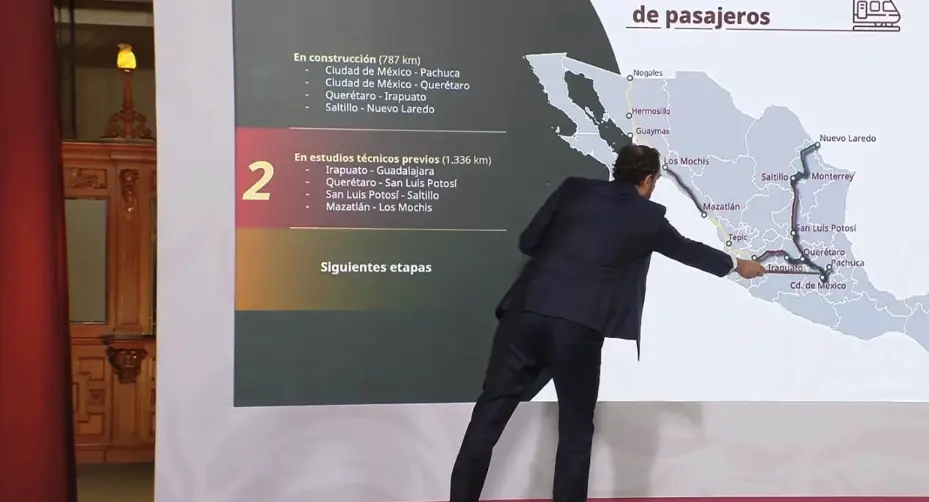

The federal government reported progress in the construction of the new passenger trains that will connect the central and northern parts of the country, with the goal of beginning operations on some sections before 2027 and consolidating a rail network with speeds of up to 200 kilometers per hour.
President Claudia Sheinbaum announced this Thursday that the Mexico City–AIFA train will begin operations before Easter; the Mexico City–Querétaro and AIFA–Pachuca lines will be operational in 2027.
She emphasized that the progress of the works has been possible thanks to inter-institutional coordination and the collaboration of the public in the right-of-way acquisition processes.
At the morning press conference on February 19, the head of the Railway Transport Regulatory Agency, Andrés Lajous, announced that the first phase of construction is underway for the trains that will run from Mexico City to Pachuca, Mexico City to Querétaro, Querétaro to Irapuato, and Saltillo to Nuevo Laredo.
He also detailed that the basic engineering work has begun for the Irapuato–Guadalajara, Querétaro–San Luis Potosí, San Luis Potosí–Saltillo, and Mazatlán–Los Mochis sections, while the second phase of the project will begin later this year.
The trains will have dedicated tracks and design speeds between 160 and 200 kilometers per hour. In the case of the Mexico City–Pachuca line, the design—still preliminary—includes wider aisles, considering that many passengers travel with luggage or bags, especially on weekends.
On the other hand, he indicated that the contract for the manufacture of 47 electric trains with a maximum speed of 165 kilometers per hour and a length of 100 meters, with the possibility of coupling them together to reach 200 meters, was awarded to Alstom Mexico. There will be configurations for metropolitan services, with a capacity for 632 passengers, and for long-distance services, with 271 passengers. The first train is expected to be ready by the middle of next year.
Regarding the Saltillo–Nuevo Laredo section, he commented that the longest segments have already been put out to tender and that the Monterrey metropolitan area—considered the most complex—was divided into three sections, two of them elevated. The tendering processes for stations and signaling and control systems are also underway.
In total, clearing and grubbing work is already being carried out on 171 kilometers of this more than 300-kilometer section, in addition to the construction of assembly yards and preliminary track work.
Regarding the Querétaro–Irapuato section, the contract for stations, stops, and maintenance depots was awarded on February 12, and the bidding process for auxiliary buildings and signaling systems is ongoing.
In Celaya, the dismantling of the freight track in the urban area has begun, a long-standing demand of the population, to replace it with passenger infrastructure.
Meanwhile, the commander of the “Felipe Ángeles” Engineering Group, Gustavo Ricardo Vallejo Suárez, reported that the Ministry of National Defense has completed the basic engineering for almost 800 kilometers corresponding to the first stage.
On the Mexico City–Pachuca section, a 58-kilometer stretch of electrified double track, work is underway that will involve a total of 141 kilometers of construction, including adjustments to the existing right-of-way. The project is 22% complete and is expected to be finished in the first half of 2027. This section includes four stations—Jaltocán, Tizayuca, Temascalapa, and Pachuca—and four bus stops, as well as a maintenance depot.
For the 232-kilometer Mexico City–Querétaro line, the project is 10% complete and is expected to be finished in September 2027. Work is underway on 14 simultaneous fronts, and more than 14,000 jobs have been created.
Source: eleconomista


