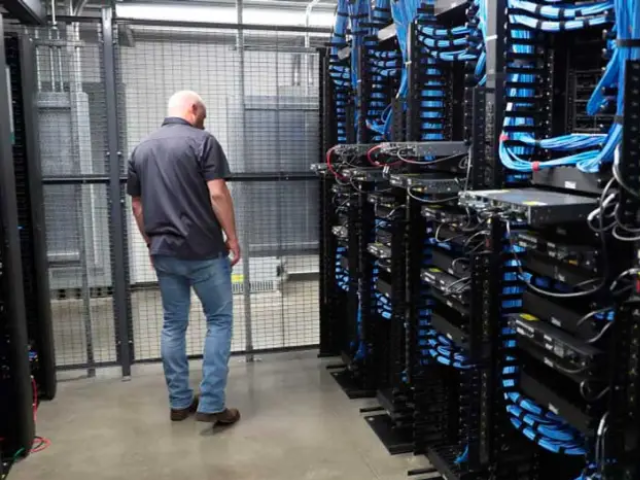

Data centers are companies that drive technological development.
The state not only leads in operational infrastructure but also in expansion: of the 83 MW under construction nationwide in 2025, 57 MW corresponded to projects in Querétaro.
The state’s leadership surpasses others in the country:
-Mexico City and metropolitan area: 21.2 MW
-Monterrey: 18.3 MW
-Guadalajara: 10 MW
Companies such as Equinix, Amazon, Kio, Microsoft, and Triara concentrate their operations in the state. Industry projections estimate that by 2030, it could reach 1,120 MW of installed capacity.
The region—with developments in the PyME Industrial Park and municipalities such as Colón, El Marqués, and Huimilpan—is home to projects that are raising its international profile. One of the most significant projects is the campus being developed by CloudHQ, with a $4.8 billion investment in six buildings that will add 900 MW of capacity and are scheduled to begin operations in 2027.
Meanwhile, ODATA inaugurated its QR03 campus with an initial capacity of 24 MW, scalable to 300 MW by the end of 2026.
The projected investment for the next four years amounts to $18.142 billion, with an estimated indirect impact of $54.426 billion. In terms of employment, the generation of 68,220 jobs is expected, of which 19,708 would be direct and 48,512 indirect.
Challenges: Energy, Water, and Skilled Talent
This rapid growth also presents challenges. Experts warn that the increasing demand for electricity could put pressure on the national infrastructure in the medium and long term. The new CloudHQ development alone will require up to 900 MW of electrical load, putting a strain on the regional transmission grid.
Faced with this scenario, private initiatives like Ammper’s—with plans to contribute 400 MW at the QR03 campus—and federal calls for proposals promoted by the Ministry of Energy (SENER), which include 5,970 MW of renewable capacity, seek to mitigate potential bottlenecks through solar, wind, and energy storage projects.
In addition to the energy challenge, the state faces difficulties related to water availability, training of specialized talent, and streamlining permits to sustain the pace of expansion.
Internationally, Querétaro ranks 14th in data processing capacity, surpassing other Latin American destinations and consolidating its position as a regional hub for hyperscalers. This boom not only boosts the state’s GDP but also positions Mexico on the strategic path for digital infrastructure in Latin America.
If it maintains its pace of expansion and addresses the challenges, the state could be one of the most influential technology centers in Latin America by the end of the decade.
Source: newslinereport