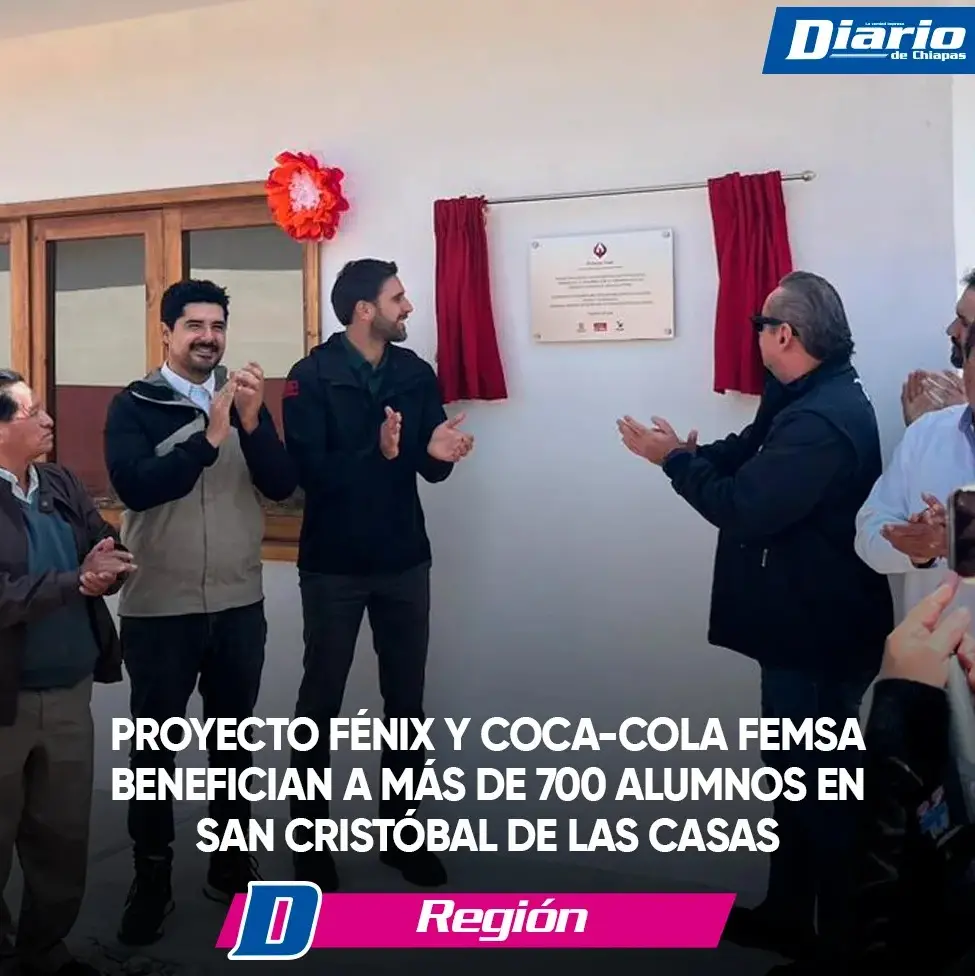

More than 700 students from three elementary schools in the municipality benefited from the construction and rehabilitation of educational infrastructure as part of the Coca-Cola FEMSA Phoenix Project 2025, an initiative promoted by Fundación Toledo A.C. and Un Hogar para Chiapas A.C., with the goal of strengthening learning conditions in vulnerable communities.
During 2025, a computer lab equipped with 21 computers, two classrooms, 18 school cafeterias, and six waste containers were built at the “Justo Sierra,” “31 de Marzo,” and “Emiliano Zapata” elementary schools, contributing to improved learning spaces and student well-being.
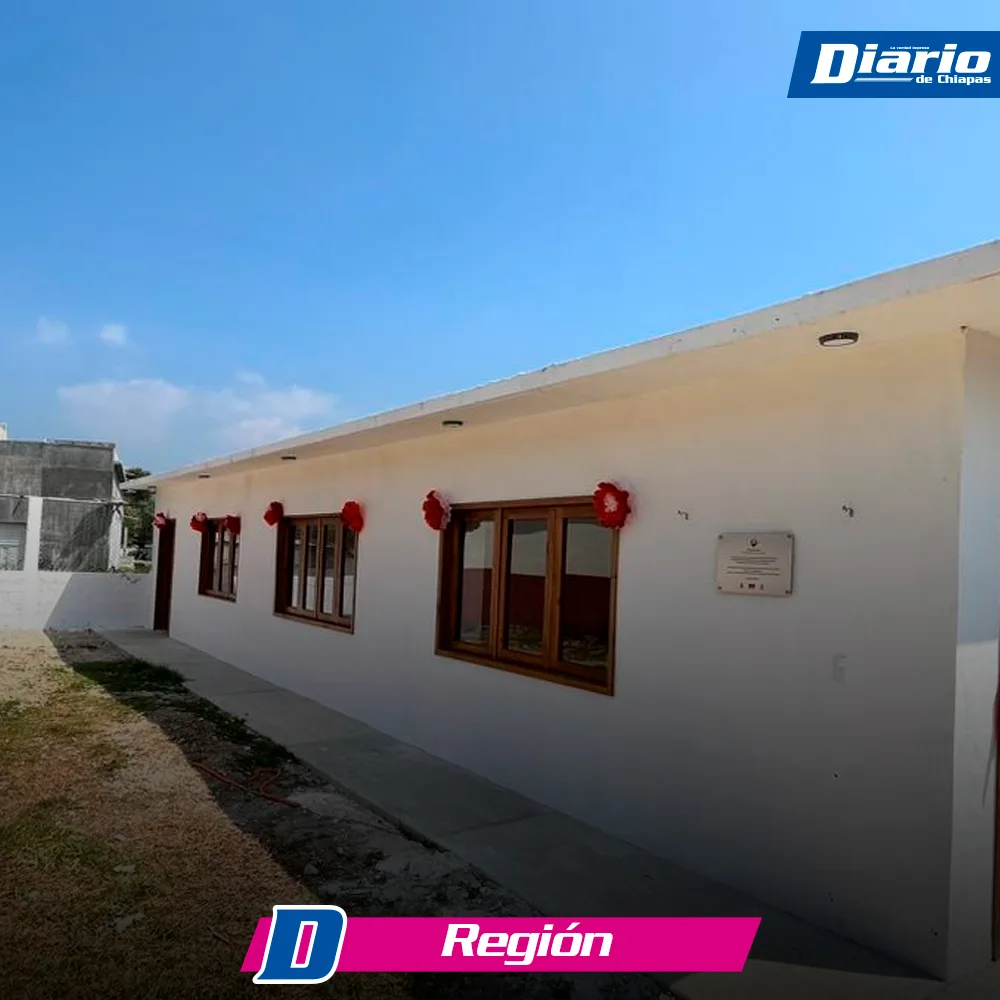
At the “Justo Sierra” Elementary School, a 15 by 6 meter concrete slab was constructed, allowing for the reconstruction of two classrooms, as well as the installation of six school cafeterias and two waste containers, benefiting more than 250 students.
At the “31 de Marzo” Elementary School, a media center was built, the flagpole was relocated, an access ramp for people with disabilities was constructed, and six school cafeterias and two waste containers were installed, benefiting more than 280 students.
At the “Emiliano Zapata” Elementary School, six school cafeterias were built and two waste containers were installed, positively impacting more than 180 students.
Gerardo Toledo Coutiño, president of the Toledo Foundation, emphasized the importance of collaboration between civil organizations, businesses, and the community to promote education as an engine of social transformation.
“We have been working diligently in coordination with other civil associations such as Un Hogar para Chiapas and Coca-Cola FEMSA, fostering the possibility of a better quality of life for young people and students through education, which is something that will shape them for life,” he stated.
For his part, José Manuel Orantes Jasso, Corporate Affairs Manager for Coca-Cola FEMSA in Chiapas, emphasized the company’s commitment to generating social value in the communities.
“At the company, we always strive not only to generate economic value in the communities, but also social value. By rehabilitating a classroom, you’re not just building infrastructure, you’re rehabilitating people’s dreams, the dreams of children,” he stated.
Meanwhile, Erick Ordóñez Alfaro, Vice President of Un Hogar para Chiapas A.C. (A Home for Chiapas), explained that the work included foundations, structure, walls, roofs, electrical installations, and furniture, to guarantee dignified spaces for learning.
“The roof and some walls had collapsed; we rebuilt the structure, the electrical installation, the windows, the doors, and the furniture so that the children can receive classes in a dignified manner,” he explained.
As part of the continuation of Project Phoenix, a digital training program was announced in San Cristóbal de Las Casas and Chiapa de Corzo, which will take advantage of the media classroom to train students, teachers and parents in the use of technological tools, strengthening the digital skills of the educational community.
Source: diariodechiapas