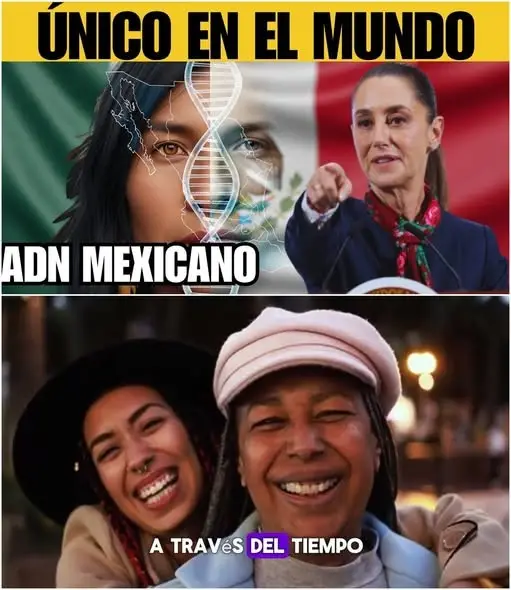

It’s not an exaggeration or a nationalist myth. It’s a scientific fact that has baffled geneticists worldwide. Today, we’re going to unravel this fascinating genetic mystery that makes Mexico a living laboratory of human diversity.
Get ready to discover why Mexican DNA is literally unique anywhere else in the world. To understand the uniqueness of Mexican DNA, we must first travel back in time. Imagine the territory we know today as Mexico more than 3,000 years ago. Here, not one civilization arose, but dozens.
The Olmecs, Maya, Aztecs, Zapotecs, Mixtecs, Purépechas, and hundreds of other ethnic groups, each developing their own genetic identity over millennia. But Mexico’s genetic history doesn’t begin there. The first inhabitants arrived in these lands approximately 15,000 years ago, crossing the Bering Strait during the last Ice Age.
These groups dispersed across the continent, but something extraordinary happened in Mesoamerica. Geographic isolation combined with diverse ecosystems created unprecedented genetic fragmentation. Mountains, deserts, jungles, and valleys not only divided the territory, they divided entire populations for thousands of years, allowing each group to develop unique genetic characteristics and specific adaptations to their environment.
Each isolated valley, each mountainous region, each impenetrable jungle became a natural laboratory where human evolution took slightly different paths. The Maya in the jungles of Yucatán developed distinct characteristics from the peoples of the central highlands. The inhabitants of the coasts evolved differently from those of the mountains.
This pre-Columbian genetic diversity was already extraordinary before any external influence arrived. Then came 1492. Contact with the Spanish was not just a historical event; it was a genetic event of cataclysmic proportions. For the first time in human history, three continents mixed their genetic material in a massive and accelerated process.
The Spanish brought European genes, of course, but they were not genetically homogeneous. Spain itself was the result of centuries of mixing between Iberians, Celts, Romans, Visigoths, Arabs, and Jews. This European genetic cocktail encountered the already incredibly diverse Indigenous American population.
But the story gets even more complicated. The Spanish brought African slaves with them, primarily from West and Central Africa. These Africans contributed a third, crucial genetic branch, especially in coastal regions of Mexico such as Veracruz, Guerrero, and Oaxaca.
What followed was a process of mestizaje (racial and cultural mixing) that scientists describe as unique in human history. It wasn’t simply a mixing of two populations. It was a three-dimensional fusion that occurred simultaneously in multiple regions, with varying proportions and under different social, geographic, and cultural circumstances.

Source: culturaytradicion