

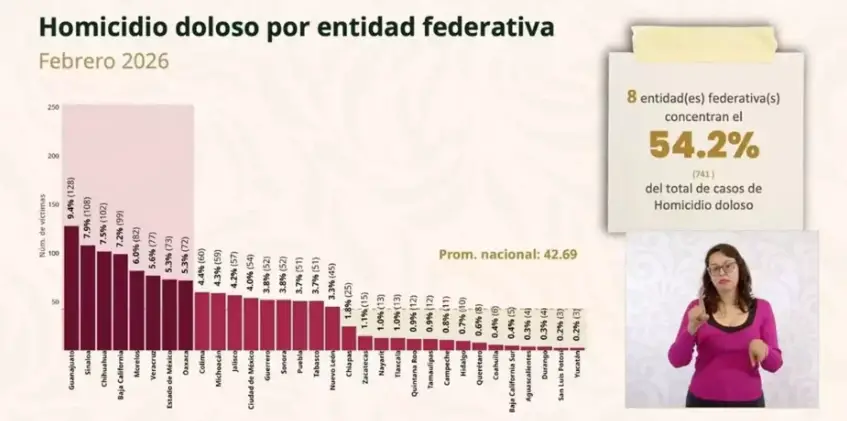

According to the most recent data from the Executive Secretariat of the National Public Security System (SESNSP), Mexico has managed to lower its average number of violent deaths from 86.9 to 48.8 per day between October 2024 and February 2026. This trend, highlighted by Claudia Sheinbaum’s administration, places February 2026 as the month with the least violence in years. However, this statistical relief is uneven.
Oaxaca now shares the top spot for violence with crime giants like Guanajuato, Sinaloa, Chihuahua, Baja California, Morelos, Veracruz, and the State of Mexico, and these eight states account for 54.7% of the country’s murders. What is critical is that, while northern states show declines (like Guanajuato with a year of sustained decreases), Oaxaca continues its bloody resistance to pacification.
The vulnerability of the security strategy was dramatically exposed on March 4, 2026. Outside the usual monthly statistics, that day placed Oaxaca as the most violent state in the country, surpassing even Chihuahua, Baja California, and Morelos.
Although official figures only acknowledged four cases, the record of events documented at least seven executions in a single day. This discrepancy between the official narrative and the body count in the Central Valleys, the Sierra Sur, and the Coast regions suggests a worrying gap in the transparency of state data.
On March 4, Oaxaca registered seven homicides, in one of its most violent days.
Violence in the state is not a phenomenon isolated to urban areas; it is a cancer that has spread throughout the territory.
Sierra Sur: In Santa María Zaniza, an ambush ended the lives of a father and his son, Silvestre and Daniel. The attack, which occurred in the area known as “El Potrero,” reignites the embers of historical agrarian conflicts with Santiago Amoltepec that the state has been unable to extinguish. Meanwhile, in Miahuatlán de Porfirio Díaz, the mayor’s first cousin was murdered, raising serious concerns about the safety of those in local power.
Coast: The violence also reached the coastal region, where a man was shot to death in the community of Nuevo Progreso, in the municipality of San Juan Colorado.
Central Valleys: The area near the capital was no exception. In Tlacolula, a missing young man was found bound, while in Etla, a motorcycle taxi driver was gunned down in broad daylight. Furthermore, in Ocotlán de Morelos, impunity reached cynical levels with the murder of José Benito V. P., “El Cachorro,” just meters from the police station.
Despite the optimism of the federal security cabinet, these three regions are preventing Oaxaca from joining the national trend of a 44% reduction in homicides.
Residents of the coast have reported that, despite the deployment of the National Guard, surveillance is concentrated in tourist centers (Puerto Escondido, Huatulco), leaving inland municipalities completely defenseless.
According to the National Public Security System (SESNSP), homicides on the coast are linked to the “cleaning up” of territories due to disputes over illicit activities such as drug dealing and extortion. As a landing and transit zone, the violence manifests itself in targeted killings and armed attacks in broad daylight.
Unlike in the north of the country, where violence affects industry, on the coast insecurity directly impacts tourism and local businesses, sectors that lack the private security infrastructure that exists in states like Baja California.
The Isthmus is, for the federal government, the most important economic project of the six-year term. However, crime statistics from the National Public Security System (SESNSP) reveal that it is also the most violent region in the state:
It is the primary driver of homicides. The national system reports preventing 88% of extortion crimes, but in cities like Juchitán, Matías Romero, and Salina Cruz, the reality is one of closed businesses and attacks on transporters. Added to this are drug dealing, human trafficking, and fuel theft.
A large portion of the 24,000 weapons seized, as mentioned by Omar García Harfuch, circulate through this area due to its nature as an interoceanic corridor.
Here, the violence is both political and social. The executions recorded in Ocotlán, Etla, and Tlacolula demonstrate that the capital and its surrounding areas suffer from “proximity violence.”

Source: imparcialoaxaca


