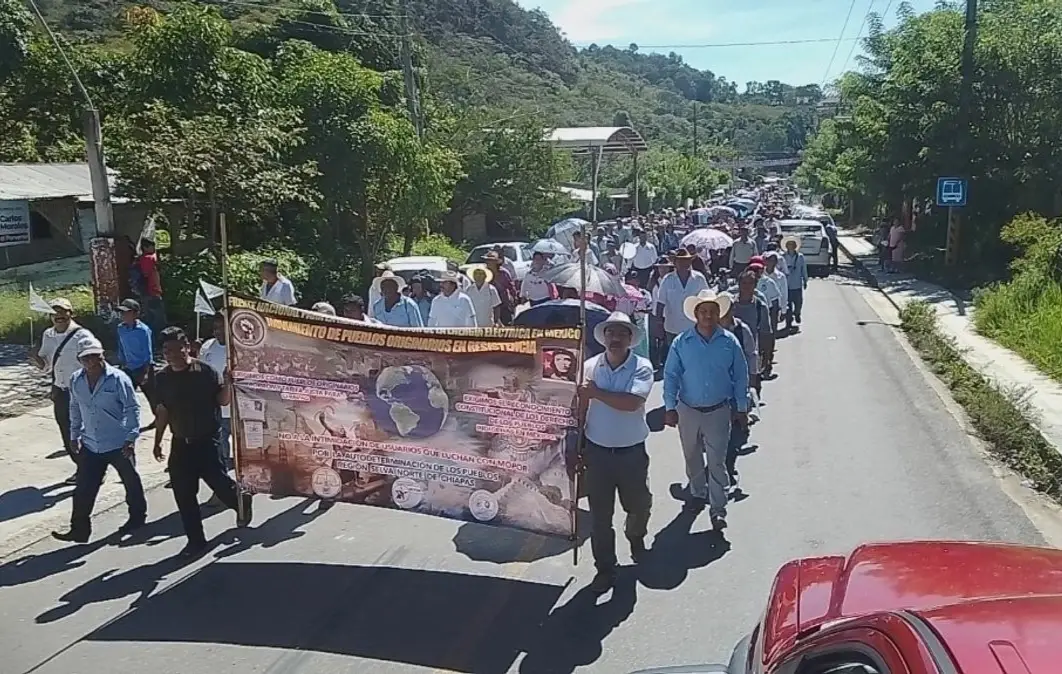

This project is part of the highway infrastructure works proposed in 2001 by the Inter-American Development Bank (IDB) to “promote sustainable development and integration in the region,” known as the Puebla-Panama Plan and later the Mesoamerica Project. Since then, the communities of the region have opposed it, and it was suspended at that time. However, in February 2025, the current government of Chiapas published two agreements to conduct a consultation on the highway. The public consultation of March 23, 2025, did not consider the people of Indigenous communities who would be directly affected, as the communities along the highway’s route were not consulted; the consultation was limited to the municipal seats, where there would be no impact, and it was there that the population voted. The consultation also failed to specify where the highway would be built or the complete route. Despite this, the project was officially launched on June 8th of the same year, and it wasn’t until October that the Environmental Impact Statement (EIS) for the first and second sections was approved. The second section runs from Palenque to Tzinte’el and Saquil-Ulub, towns located north of the municipality of Chilón. The EIS failed to consider the territory’s conditions, such as the large number of sacred sites, springs, streams, and rivers that will be affected, and consequently, the health of the people and Mother Earth.
For all these reasons, legal injunctions have been filed to demand respect for the rights to information, self-determination, and prior consultation, arguing that a decision made arbitrarily by people outside the affected communities, without information or dialogue, does not consider the voice of the people. However, the courts have denied the requested suspensions and have allowed the project to continue without fully guaranteeing their already recognized rights.
On February 28th, in San Cristóbal de las Casas, the report of the caravan documenting the aforementioned project was presented at a forum. This led to a statement detailing their journey through the territory that will be affected by the project, which the Chiapas government currently refers to as the “Mayan Cultures Route Highway,” between San Cristóbal de Las Casas and Palenque. Participants in the caravan included members of the Indigenous Rights Center AC, the Economic and Social Development of Indigenous Mexicans AC, the Common Brigade Collective, the Fray Bartolomé de Las Casas Human Rights Center AC, and the Movement in Defense of Life and Territory. They denounced the “fragmentation strategy aimed at destroying the social fabric of communities and limiting the organization and resistance of the people, who face threats, harassment, and coercion from local, municipal, and state authorities, as well as representatives of the companies carrying out the construction.” They emphasized the conditioning of access to social programs. The Sembrando Vida (Sowing Life) program has been used for purposes other than combating poverty and environmental degradation. In the communities, there are threats of incursions by the Pakal Immediate Reaction Forces or of the Mexican Army itself carrying out the construction work on the plots or sections where there is opposition.
In the municipalities of Palenque, Salto de Agua, and Chilón, the highway has a significant environmental impact. Deforestation is the primary impact and will affect areas of forest that are already scarce, such as the montane cloud forest. It also affects endangered species, such as the Chiapas catfish, the Lacandon shrew, and plants like the Lacandon shrub, as well as springs that supply water to the communities. The extraction of stone material destroys the hills and endangers the lives of people living nearby; in recent months, landslides and flooding have been observed in towns due to the construction work. The distribution of fertilizers and agricultural tools is also contingent upon the signing of blank documents or the delivery of agricultural certificates and documents proving land ownership, in order to access social programs.
Lekil kuxlejal is a way of being-in-the-world that prioritizes harmonious and respectful relationships with Mother Earth (nantic lumquinal), as well as integration among the inhabitants of the community, placing the common good at the center, rather than the culture of individual enrichment. As we can see, the customs and practices of the State are reproduced in this project and others underway in the country. As for global geopolitics, there’s no need to say anything more, but we must defend the territories that sustain the lives of our peoples. This must be done without forgetting Cuba, Venezuela, and especially Gaza and Iran in the face of the virtual genocide perpetrated by a magnate who is president of our northern neighbor.

Source: jornada