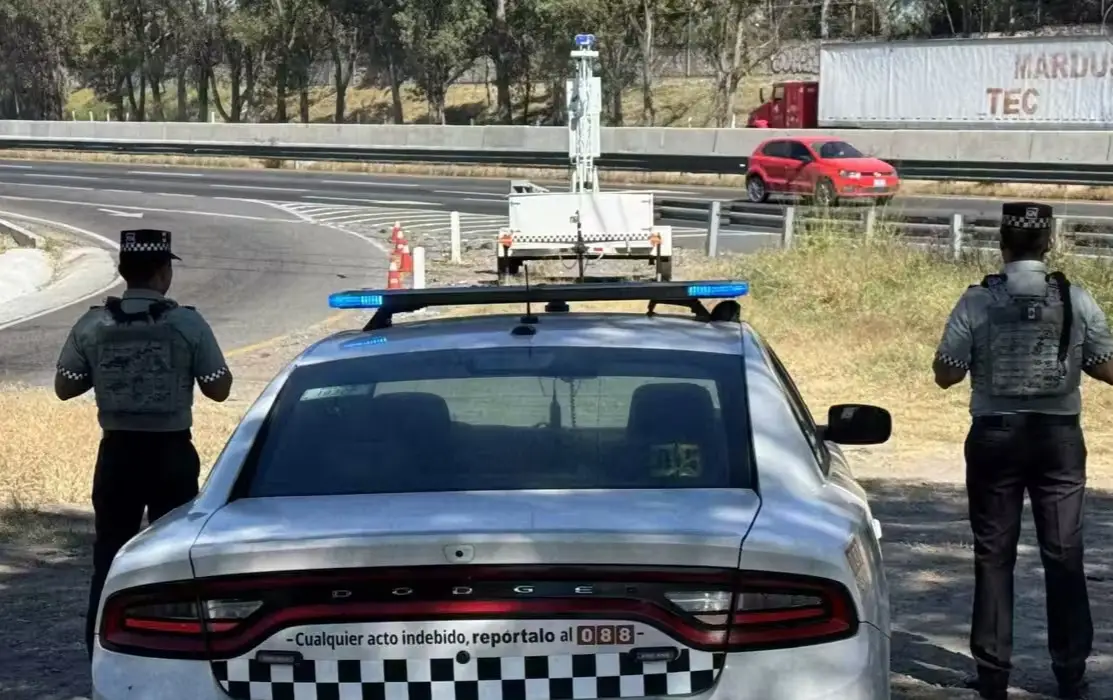

With an average of three accidents per day, 417 documented collisions, and 42 fatalities in 2024, the Mexico-Querétaro highway remains one of the six most dangerous federal highways in Mexico.
The Querétaro sections of Federal Highway 57 concentrate the highest-risk points along the entire route, according to figures from the Statistical Yearbook of Collisions on Federal Highways, prepared by the Ministry of Infrastructure, Communications and Transportation (SICT) using data from the National Guard.
The accident rate on this highway has been constant over the last decade. According to the Mexican Transportation Institute (IMT), between 2020 and January 2026, the Querétaro sections accumulated more than 1,388 accidents, 183 fatalities, and material losses exceeding $2.7 million.
The rehabilitation work begun by the National Bank of Public Works and Services (Banobras) in February 2020—which should have been completed by December of that same year—has been ongoing for almost six years, and the lane reduction persists on the El Sauz-Cuesta China section, exacerbating the already hazardous conditions.
The 2024 figures showed a spike. The SICT Yearbook reported 417 accidents on the Querétaro sections of the highway, 97 of which were collisions with fatalities: 42 people died at the scene and 100 were injured.
The estimated cost of property damage reached $4.1 million, the highest recorded in the last ten years. In 2023, 313 collisions with 43 deaths had been documented, demonstrating that despite enforcement operations, the trend is not being reversed.
Three locations account for the highest number of fatalities in Querétaro state.
The most dangerous stretches of highway identified by the SICT (Secretariat of Infrastructure, Communications and Transportation) and the National Guard over a five-year period are the Northeast Bypass of Querétaro, near Chichimequillas, with 445 accidents and 45 deaths; the T.I. Galindo section, between the borders of the State of Mexico and Querétaro, with 424 accidents and 41 deaths; and the Jurica interchange, which, despite registering fewer collisions (323), has the highest number of fatalities with 61 deaths.
The Mexico-Querétaro highway registers an average of three accidents per day, according to data from the SICT and the National Guard. rotativo.com.mx
In terms of mileage, the segment between kilometer 155 and 169, corresponding to San Juan del Río, has had the highest frequency of accidents for at least the last six years, with up to 100 accidents in a single year, according to data from the IMT (Mexican Transportation Institute).
The second most critical point is the stretch from kilometer 200 to 209, where the highest number of fatalities from accidents have been recorded.
Ongoing roadwork on the highway exacerbates the risk. Motorists traveling from Mexico City to Querétaro faced lane reductions from the community of El Sauz to Cuesta China, where traffic jams cause delays of up to an hour or more, according to CAPUFE (Federal Roads and Bridges Agency) reports.
As alternative routes, the agency recommends the Arco Norte (Northern Ring Road), the Tepeji del Río-Jilotepec-Palmillas free highway, or the Circuito Exterior Mexiquense (Mexico State Outer Loop).
What are the main causes of accidents?
According to the National Guard, the three leading causes of accidents on the Mexico-Querétaro highway are rear-end collisions, following too closely, and speeding.
Buses and cargo trucks top the list of vehicles responsible for accidents, followed by motorcycles and articulated trucks. Driver fatigue is behind 48% of the accidents, according to the federal agency.
The breakdown of driver-related causes in Querétaro during 2024, according to the SICT Yearbook, recorded 237 cases of reckless driving, 56 of following too closely, 30 of lane invasion, 10 of excessive speed, 9 of falling asleep at the wheel, and 6 of driving under the influence, among other factors.
Regarding vehicle-related causes, six mechanical failures and four tire failures were reported. Road conditions caused 13 collisions, including those caused by objects in the road, wet pavement, and damage to the asphalt surface.
The maximum speed limit on the highway is 110 kilometers per hour, according to CAPUFE (Federal Roads and Bridges Agency), although the National Guard’s Radar Operation penalizes cargo vehicles exceeding 95 kilometers per hour and issues fines of between 60 and 70 UMAs (Units of Measurement and Update)—equivalent to between 5,773 and 6,735 pesos—to those who exceed the established limits. In case of emergency, motorists can call 074 to request roadside assistance.
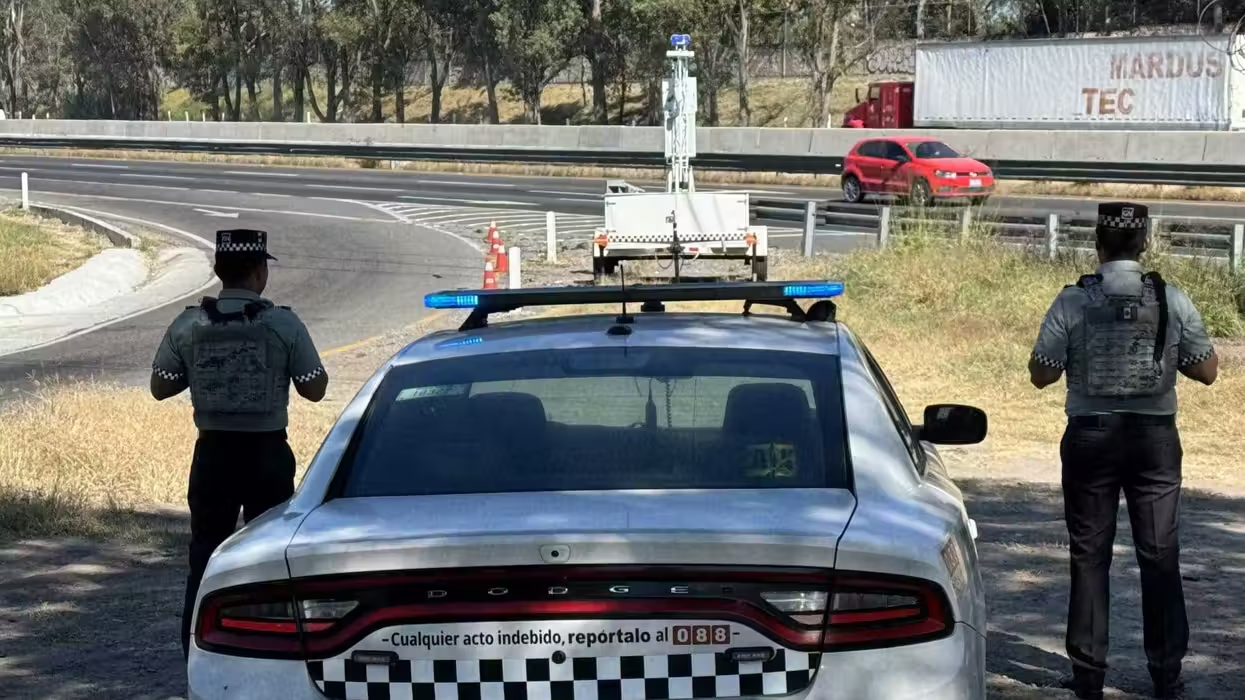
Source: rotativo