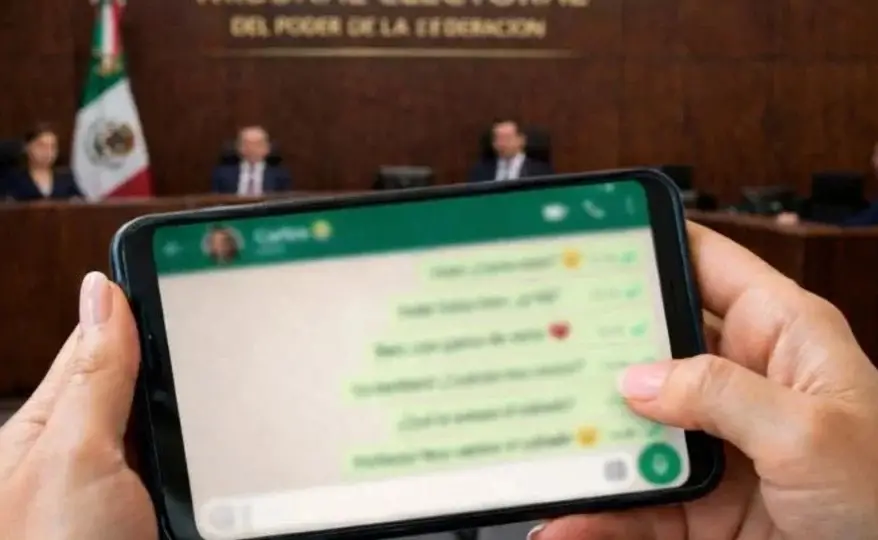

Judge Felipe de la Mata Pizaña of the Electoral Tribunal of the Federal Judiciary presented a new draft ruling proposing to overturn the decision of the Guadalajara Regional Chamber, which ordered the Sinaloa Electoral Tribunal to impose sanctions against Emma Zermeño for gender-based political violence, based on evidence derived from private WhatsApp conversations.
In the 20-page document, the judge also upholds the Sinaloa Electoral Tribunal’s ruling, issued last November, which the complainant appealed to the Guadalajara Regional Chamber.
Among the arguments used by Judge De la Mata Pizaña to overturn the Regional Chamber’s ruling is the lack of proof regarding the authenticity of the communications considered by the responsible party, “because their origin was not verified, much less were they checked, through appropriate means of evidence, to ensure they had not been manipulated, so that they could be assessed comprehensively,” the draft states.
With this, the Superior Chamber of the Electoral Tribunal of the Federal Judiciary (TEPJF) would consider, should the draft ruling be approved by the full court on March 18, that the Regional Chamber failed to apply any minimum standard for admitting and evaluating evidence consisting of private communications.
“This violates the rights of the accused, since the private communications via WhatsApp are the primary evidence the responsible party considered to determine the existence of gender-based political violence, without any proof of their illicit origin or the veracity of their content.”
The draft ruling also argues that the exception to the inviolability of private communications was not proven.
“The accused’s right to privacy was violated, since the messages were sent with the expectation that they were in a private setting, without any indication that the communications would be made public.”
People must be judged based on constitutional evidence.
This also violated an essential requirement for due process in electoral matters, which is that people must be judged based on evidence obtained in accordance with constitutional and legal requirements. The analysis of the conversations carried out through a WhatsApp chat by the responsible party suffers from a fundamental flaw, as they lack probative value and cannot be considered to determine the existence of gender-based political violence.
On February 25, the Guadalajara Regional Chamber overturned the ruling of the Sinaloa Electoral Tribunal from last November, which had found inadmissible the complaint of gender-based political violence filed against Zermeño by the local congresswoman on leave, Almendra Negrete.
The Regional Chamber gave the Sinaloa Electoral Tribunal until March 12 to issue a new ruling that considers gender-based political violence and the use of evidence such as the private WhatsApp conversations, and to sanction Zermeño.
Following the Regional Chamber’s ruling, Zermeño filed an appeal with the Electoral Tribunal of the Federal Judiciary (TEPJF). Magistrate De la Mata Pizaña had already drafted a proposal, which was submitted on March 11, recommending the dismissal of the appeal filed by the accused citizen.
The Electoral Tribunal did not wait for the deadline and, in an emergency session on March 11, issued the new ruling ordered by the Guadalajara Regional Chamber.
The tribunal prohibited the accused from approaching, intimidating, or harassing the complainant in any way or by any means, including electronic means, as well as from engaging in any conduct in the public or private sphere that could involve actions or expressions of denigration, marginalization, intimidation, violence of any kind, or by any means, whether directly or through an intermediary, against the complainant.
Furthermore, given the proven existence of symbolic gender-based violence, the protective measures included an order prohibiting the defendant from engaging in any conduct or disseminating, through any medium, expressions that perpetuate gender stereotypes or roles or that affect the complainant’s political and electoral rights.
Also, since Zermeño is an employee of the Sinaloa Women’s Secretariat, this agency was notified, as she works there. Additionally, the local Transparency and Accountability Secretariat was notified, “given the offender’s status as a public servant.”

Source: lasillarota