
The undersigned civil society organizations express our deep concern regarding the actions of the Quintana Roo Ministry of Ecology and Environment (SEMA) in various Environmental Impact Assessment Procedures (EIAs), in which repeated irregularities have been observed. These include practices of opacity, conduct that systematically inhibits citizen participation, and, particularly worryingly, the encroachment upon federal powers by assuming the evaluation of projects that, according to the General Law of Ecological Balance and Environmental Protection (LGEEPA), fall under the jurisdiction of the Federal Government.
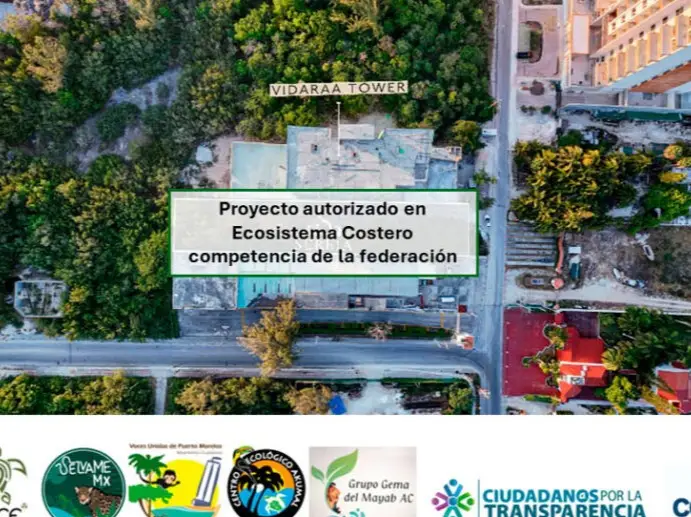
In several cases, SEMA has analyzed and even authorized environmental impact statements for projects that, due to their nature, magnitude, location, or the regional impacts they generate, clearly fall under federal jurisdiction, specifically that of the Ministry of Environment and Natural Resources (Semarnat). This action by SEMA is legally questionable, as it encroaches upon federal powers, weakens environmental control mechanisms, and sets a worrying precedent of fragmentation and a relaxation of environmental protection standards.
A recent example of this is the beach rehabilitation and restoration work in various municipalities of Quintana Roo. Social organizations, citizen groups, and academics requested that the Ministry of Environment and Natural Resources (Semarnat) deny the extension or modification of an environmental permit issued in 2009 and demanded that a new, comprehensive, regional, and updated Environmental Impact Statement (EIS) be prepared. This is because the works involve cumulative, synergistic, and regional impacts whose evaluation should not be carried out at the state level.
The Ministry of Environment has also engaged in administrative practices to inhibit citizen participation through the use of excessive formalities, restrictive criteria, and improper or malicious interpretations of state law and its regulations. All of this has prevented public consultations, even in cases where environmental legislation permits or even expressly requires them.
It is particularly concerning that environmental permits have also been issued in an expedited or “express” manner, even before the monthly lists of projects subject to evaluation are published. This has prevented the public from learning about projects in a timely manner and from requesting public consultations. This, in turn, impedes the exercise of the right to participation, which is recognized in national environmental law and international human rights standards.
This pattern of behavior is neither isolated nor recent. Virtually no public consultations have been held regarding Environmental Impact Assessments in the state, despite the submission of more than one hundred formal requests. Only the public consultation for the “Izgra Crushing and Extraction Plant” project was partially opened. However, the decision was not made public, so it is impossible to verify whether the consultation was effective. This demonstrates a systematic administrative policy aimed at closing off spaces for citizen participation, which contravenes federal environmental legislation and the Regional Agreement on Access to Information, Public Participation and Access to Justice in Environmental Matters in Latin America and the Caribbean (Escazú Agreement).
Environmental Impact Assessment is not a discretionary procedure or a power interchangeable between levels of government, but rather an instrument that helps prevent negative environmental impacts. Its application must strictly adhere to the principles of legality, competence, maximum transparency, and effective citizen participation. The fact that the Quintana Roo Ministry of Environment (SEMA) improperly assumes powers that belong to the Federal government and directly or indirectly obstructs citizen participation weakens the rule of law in environmental matters, increases the risk of environmental damage, and erodes public trust in institutions.
Therefore, the undersigned organizations respectfully request that the Ministry of Environment and Natural Resources (Semarnat):
Comprehensively review the actions of SEMA Quintana Roo, particularly those procedures where there is evidence of encroachment on federal powers, opacity, undue acceleration of deadlines, and systematic obstruction of citizen participation.
To carry out a thorough investigation in order to verify if, in addition to the above, SEMA – in conjunction with the State Environmental Protection Agency (PPA) – is illegally carrying out the inspection and surveillance of projects that strictly correspond to the Federal Government and, if so, to stop it immediately.To fully exercise its powers as a federal environmental authority, ensuring that projects that, according to the General Law of Ecological Equilibrium and Environmental Protection (LGEEPA), must be evaluated at the federal level are not improperly processed or resolved by state authorities.
To guarantee effective access to environmental information and the genuine opening of public consultations, avoiding restrictive or malicious interpretations of environmental legislation that have the effect of inhibiting citizens’ rights.
To require the submission and evaluation of new Environmental Impact Statements when the magnitude, scope, modification, or cumulative impacts of projects so warrant.
The undersigned organizations reiterate our willingness to contribute technical and legal elements that help strengthen environmental governance in Quintana Roo. The protection of the state’s and the country’s natural heritage requires authorities that act with legality, transparency, accountability, and full respect for the public interest.
Signing Organizations:
Mexican Center for Environmental Law, A.C. (CEMDA)
Caribbean Turtle Group
Cozumel Conservation, Research and Environmental Management (CIMAC)
Defending the Right to a Healthy Environment, A.C. (DMAS)
Selvame MX
MOCE Yax Cuxtal
GEMA Group of the Mayab
Citizens for Transparency
United Voices of Puerto Morelos
Akumal Ecological Center
Wayuu House

Source: cemda.org