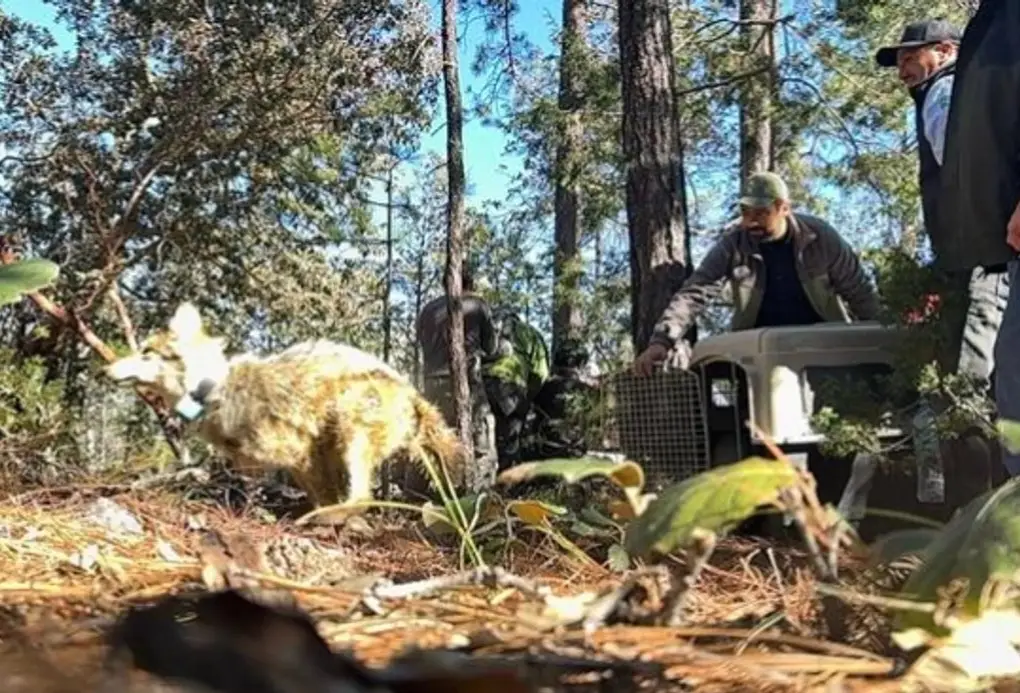

Mexican wolves (Canis lupus baileyi) were reintroduced to a pre-release site located in a forest community in Durango, marking a historic step for the return of this species to the Sierra Madre Occidental after more than 50 years of absence from the wild, reported the Ministry of Environment and Natural Resources (Semarnat).
This action is part of the efforts to recover one of the most emblematic animals of North American wildlife.
The animals will remain temporarily at a new adaptation site located in the forest community of El Tarahumar and Bajíos del Tarahumar, in the municipality of Santa Catarina de Tepehuanes. In this area, the wolves will be able to acclimate to their surroundings before being permanently released into the wild.
They were previously subjected to health checks and evaluations by environmental authorities, and subsequently transferred to the pre-release enclosure where they will begin their adaptation process.
As part of the protection program, specialists will conduct constant monitoring using radiotelemetry and camera traps, tools that will allow them to analyze the wolf’s behavior, movements, and habitat use. In addition, close work will be carried out with rural communities to promote coexistence between productive activities and wildlife conservation.
The reintroduction of the Mexican wolf represents a significant step forward in the binational conservation program that Mexico has maintained with the United States since the 1970s. Participating institutions include government agencies, academic institutions, and organizations from both countries, such as the General Directorate of Wildlife (DGVS) of the Ministry of Environment and Natural Resources (Semarnat), the Federal Attorney for Environmental Protection (Profepa), the National Commission of Natural Protected Areas (Conanp), the government of Durango, the National Autonomous University of Mexico (UNAM), and the Metropolitan Autonomous University (UAM). From the U.S., the Arizona Game and Fish Department, the New Mexico Department of Game and Fish, and the U.S. Fish and Wildlife Service are participating.
This effort opens a new chapter for the recovery of a species that was considered extinct in the wild for decades.

Source: jornada