The Pasta de Conchos Family organization in Coahuila, with the support of other organizations, has undertaken a social and community project to give new meaning to the land, known primarily for coal and the miners who died. It is a community garden project.
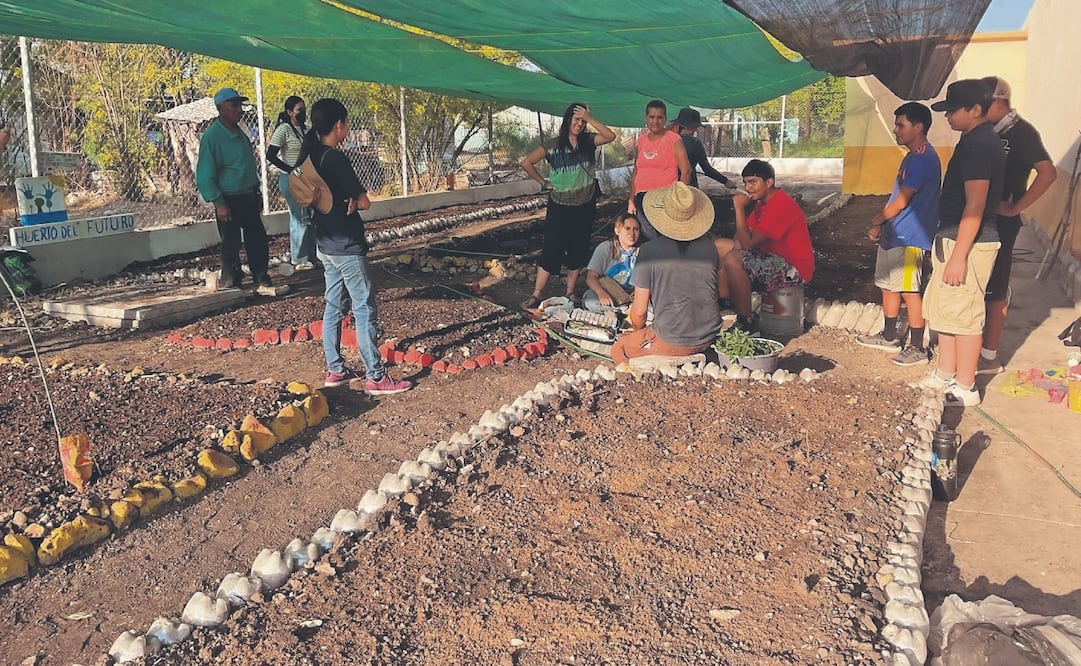
Since the summer of 2022, 14 gardens have been established in different communities throughout the region, where young people and women, mainly, now gather to cultivate life.
Cristina Auerbach, activist and representative of the Pasta de Conchos Family, recalled that the project arose from workshops held in coordination with Climate Connections and women affected by the coal mines. She mentioned that when women in the coal region are discussed, they are often referred to as widows or mothers of deceased miners. Otherwise, the women are simply not considered, she said.
“We have to take a step toward life. We’ve spent too many decades in this region talking only about death. It’s the only thing that defines us: death, and we should do something that connects us to life,” one of the women explained.
That’s how the decision was made to create a garden as a way to contrast that. To date, 14 gardens have been established by the Pasta de Conchos Family and the surrounding communities.
For Cristina Auerbach, the community gardens have had an impact in various areas, such as improving the mood of the families and showing that the region is not solely defined by coal mining.
The 14 gardens are located at schools or chapels. They began at schools like the College of Scientific and Technological Studies of the State of Coahuila (CECyTEC), and since then, the communities themselves have requested additional spaces.
The region has historically been linked to coal mining. This year, it is estimated that nearly 8 million tons of coal will be extracted, according to the contract announcements made by the Federal Electricity Commission (CFE) and the state government.
This economic activity has left its mark on the landscape of the area, where open pits that are never covered and mountains of waste can be seen.
Activist Cristina Auerbach noted that although the land has been stigmatized as only suitable for coal, it has now proven successful for growing all kinds of crops: basil, tomatoes, onions, carrots, flowers, squash, melons, watermelons, chili peppers, cilantro, herbs, and parsley.
At the Technological Institute of San Juan de Sabinas, they are working to create a “living pharmacy,” where shrubs, plants, and flowers will be planted for uses such as home remedies.
It’s not just about the symbolism of giving the land a new meaning. In the communities, it has been observed that, for example, bullying has decreased and the school environment has improved, Auerbach stated.
“The young people take great care of the gardens. It makes them rethink their own lives and the future they want, because just as this land is not condemned to be mined for coal, they are not condemned to be laborers in dangerous mines. There are students who want to go to university instead of going to the coal mines,” he explained.
Omar Ballesteros, a member of the Pasta de Conchos Family organization, believes that after so many tragedies and deaths in the region, where extractive activities have destroyed the landscape and brought mourning to the communities, a change in thinking is now evident. “It’s about recovering little by little from the damage,” he commented.
The success of the gardens has motivated the communities to want to do more. The plan is to start with a sheep farm to help clear the grass and use the manure to make compost for the gardens, and from there begin developing their own soil production system.
Omar Ballesteros mentioned that the organization and development of the gardens represent a collective effort because everyone participates, from students to administrative staff.
While previously communities gathered to mourn mining tragedies, now they get involved and come together to plant and bring life to the land.
The gardens, Auerbach added, have led people to reconsider the idea that coal mining shouldn’t continue so that a few can get rich at the expense of so many.
Source: eluniversal