Cipactli is the name of the new marine dinosaur discovered in Coahuila. This reptile inhabited what is now the municipality of Linares, in the state of Nuevo León. Seventy million years ago, it was a deep sea inhabited by relentless hunters.
This Tuesday, March 17, a team of specialists presented to the world a new species of mosasaur, a discovery that redefines what was known about the evolution of the ancient rulers of the oceans.
The discovery was announced in Saltillo, where it was explained that, during the Cretaceous period, what is now northeastern Mexico was part of a vast tropical ocean dominated by colossal creatures.
From the depths of the ancient Tethys Sea emerged in 2001, near Linares, Argentina, the Prognathodon cipactli, a marine reptile that, after 25 years of phylogenetic research and meticulous analysis of its evolutionary lineage, was confirmed as a unique species in the world.
This specimen stands out not only for its rarity but also for its physical characteristics and behavior, which are closer to modern marine predators than to other known mosasaurs.
“Modern whales, like the orca, are killer whales because they were hunters. (…) And something very interesting about this particular species is that it is one of the first mosasaur species to become carnivorous, preying on large animals.”
According to Rivera, the cipactli represents a key point in the evolution of these marine reptiles. The analysis of its remains, particularly its teeth and the upper part of its skull, revealed an unusual structure; This was due to a fusion between the front of the skull and the lacrimal bone, which gave it the ability to attack large prey.
“Mosasaurids were generally carnivores, but they preyed on small animals. Their teeth were thinner and sharper, and in this species, they began to have larger teeth to be able to take down much bigger prey.”
With an estimated length of between 5 and 6 meters, this predator was an exceptional swimmer. The study, published in a German scientific journal, positions it as the “Prognathodon of Mexico.”
Its name pays homage to Cipactli, a creature from Nahuatl cosmology described as a sea monster with fish-like and reptile-like features, endowed with powerful jaws.
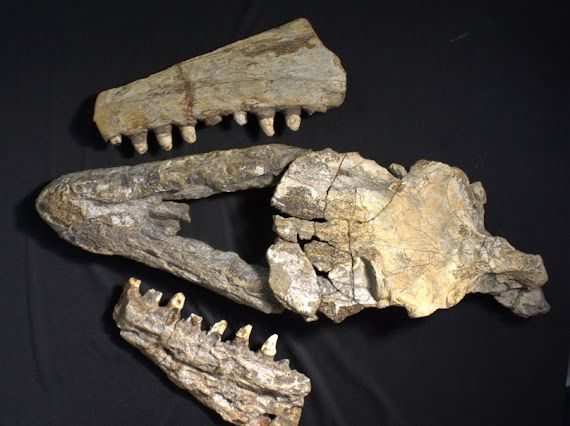
Source: unotv