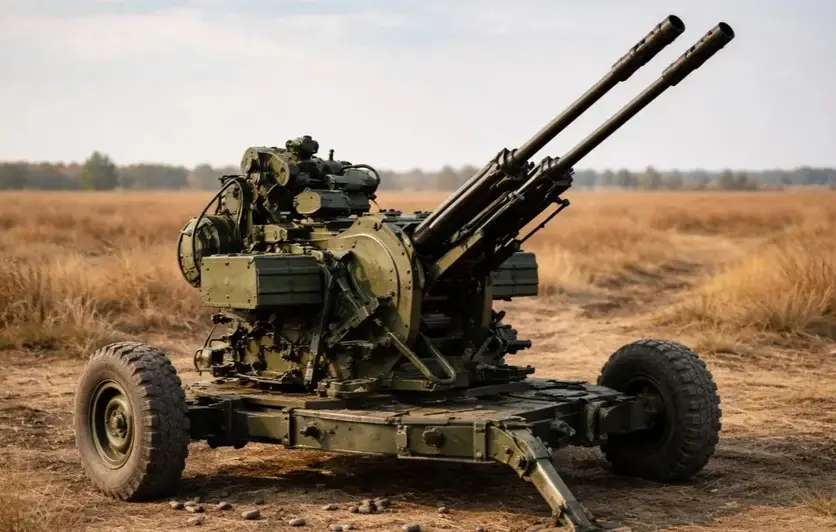

In the 1960s, the Soviet Army incorporated the ZU-23, a twin-missile anti-aircraft gun capable of hitting targets at an altitude of two kilometers, into its arsenal. It was used during the war in Afghanistan and the Russian-Chechen conflict. More than half a century after its adoption, this weapon appeared on a list of offers for the Jalisco New Generation Cartel (CJNG).
According to documents from the U.S. Department of Justice, the catalog was compiled by Peter Dimitrov Mirchev, a Bulgarian arms trafficker who intended to supply the cartel with a batch of weapons valued at approximately $58 million.
According to investigations by U.S. authorities, Peter Dimitrov Mirchev and his group of accomplices conspired to supply weapons to various criminal groups, including the CJNG, using falsified documents and alleged connections with corrupt officials.
In October 2024, Mirchev stated he was able to sell missiles, drones, and the ZU-23 air defense system to the CJNG cartel. The ZU-23 fires high-caliber ammunition (23 x 152 mm) and is designed to shoot down low-flying targets, such as helicopters.
U.S. prosecutors’ investigations revealed that, during negotiations, Mirchev boasted that the ZU-23’s key feature was its ability to automatically detect targets.
The indictment states that each ZU-23 had a unit cost of €589,339, and the plan was to deliver four to the Mexican cartel, totaling €2.35 million—equivalent to nearly 48.7 million pesos—for this anti-aircraft artillery.
Among the weapons that Mirchev and his group proposed selling to the CJNG was a batch of 68 RPG-7 anti-tank rocket launchers—in their most modern version—at a total cost of 389,096 euros, or just over eight million pesos.
The origins of the RPG-7 can be traced back to the early 1960s, when the Soviet Union was inspired by a German grenade launcher from World War II to create a version that was easier to transport and operate.
In recent times, Mexican authorities have confirmed the CJNG’s access to RPG-7 rocket launchers. On February 22, 2016, during the operation that resulted in the death of Nemesio Oseguera Cervantes, “El Mencho,” Army agents seized one that cartel members were unable to use during the confrontation.
More than a decade ago, on May 1, 2015, hitmen from this same organization used an RPG-7 to shoot down an Armed Forces helicopter in Villa Purificación, Jalisco, preventing El Mencho’s capture.
In addition to the anti-aircraft gun and rocket launchers, the list included 2,000 AK-47 rifles and 60 PKM machine guns, both weapons designed by military engineer Mikhail Kalashnikov in the 1940s and 1960s, respectively.
Similarly, the Bulgarian trafficker and his accomplices raised the possibility of supplying the CJNG with 16 Dragunov sniper rifles, known for being the first semi-automatic rifle designed for precision shooting.
According to the investigation, Mirchev led a group of traffickers that also included Elisha Odhiambo Asumo (from Kenya), Michael Katungi Mpeirwe (from Uganda), and Subiro Osmund Mwapinga (from Tanzania).
“In a series of meetings with individuals claiming to be representatives of the CJNG, Mirchev allegedly agreed to organize, coordinate, and participate in illegal arms transactions, avoiding detection by international and U.S. law enforcement agencies,” reads a statement from the Department of Justice.
Peter Dimitri Mirchev was arrested on April 8, 2025, in Madrid, Spain, the same day that two of his accomplices were arrested in different countries: Elisha Odhiambo Asumo in Morocco, and Subiro Osmund Mwapinga in Ghana. Both Mirchev and Asumo have since been extradited to the United States. As of March 2026, Mpeirwe remained at large.
The indictment against the traffickers alleges that they conspired to distribute military-grade weaponry to drug cartels at least since September 2022. To do so, they obtained false documents that concealed the true destination of the weapons, according to prosecutors.

Source: milenio