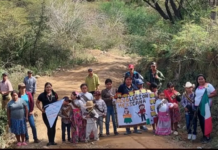
In conservation areas of Mexico City, women farmers are climbing onto tractors for the first time to learn how to operate agricultural machinery, a skill historically associated with men.
This training, promoted by the government’s Commission of Natural Resources and Rural Development, has allowed female producers from boroughs such as Milpa Alta, Tláhuac, Xochimilco, and Tlalpan in the Mexican capital to acquire knowledge to strengthen their technical skills, leadership, and economic autonomy in the rural sector.
“When they arrive to learn, they are nervous and afraid because most of them have never operated heavy agricultural machinery like tractors,” said one woman.
The training process includes constant support during practical sessions to reinforce the participants’ learning. They begin by recognizing the fundamental parts of the tractor and later learn how to attach and remove implements. “I feel very grateful to life for allowing me to meet such wonderful women who are leaders in their communities. Thanks to this training, they are gaining new skills for their lives and their learning, and they can promote food sovereignty from within the conservation area,” expressed the social worker.
For Galicia Arvizu, this initiative seeks to reduce the gender gap in agriculture and set a precedent with the support of the recently established “Women Tractor Drivers Network,” which provides a tractor for training and to support the work on these producers’ plots.
“So, they themselves are already being recognized and given visibility by their ejidos (communal landholdings) so that they themselves can take on these jobs, which are often traditionally considered masculine,” concluded the Mexican woman.
The program consists of approximately 36 hours of training distributed across seven learning modules. Instructor Javier Molotla, a tractor driver with nearly four decades of experience, also participates, sharing his knowledge and experiences in the field with the participants.
One of the project participants is producer Gisselle Nieves Medina, originally from the town of Santa Ana Tlacotenco, in the Milpa Alta borough, where she cultivates prickly pear cactus, in addition to planting corn, beans, and broad beans.
Nieves Medina is part of the first generation of the course for women tractor drivers, which she decided to join despite facing comments and stereotypes about the role of women in agricultural work.
After taking the classes, she learned to drive a tractor, demonstrating that women can also perform these tasks.
“I proudly tell you that I am happy to have been a part of this, to have learned to drive a tractor. The land gives us so much, so it is a source of pride to have learned not to settle for something so small,” said the farmworker.
Another producer who has benefited from this program is Gabriela Ortega Rodríguez, who, motivated by the opportunity to acquire new skills for her work, enrolled in the course with the conviction that this knowledge can help empower more women and strengthen their participation in the rural areas of Mexico City.
“I was so pleased to see how much we learned in the group I was in. There were women even a little older than me who didn’t know how to drive a car, whose husbands owned tractors but wouldn’t let them use them. Through this experience, they were able to overcome their fear and wanted to learn,” she added.
In this way, more and more women are making their way into jobs that for decades were considered exclusively for men, demonstrating that their work and leadership are fundamental to the development of agriculture in Mexico City.

Source: udgtv