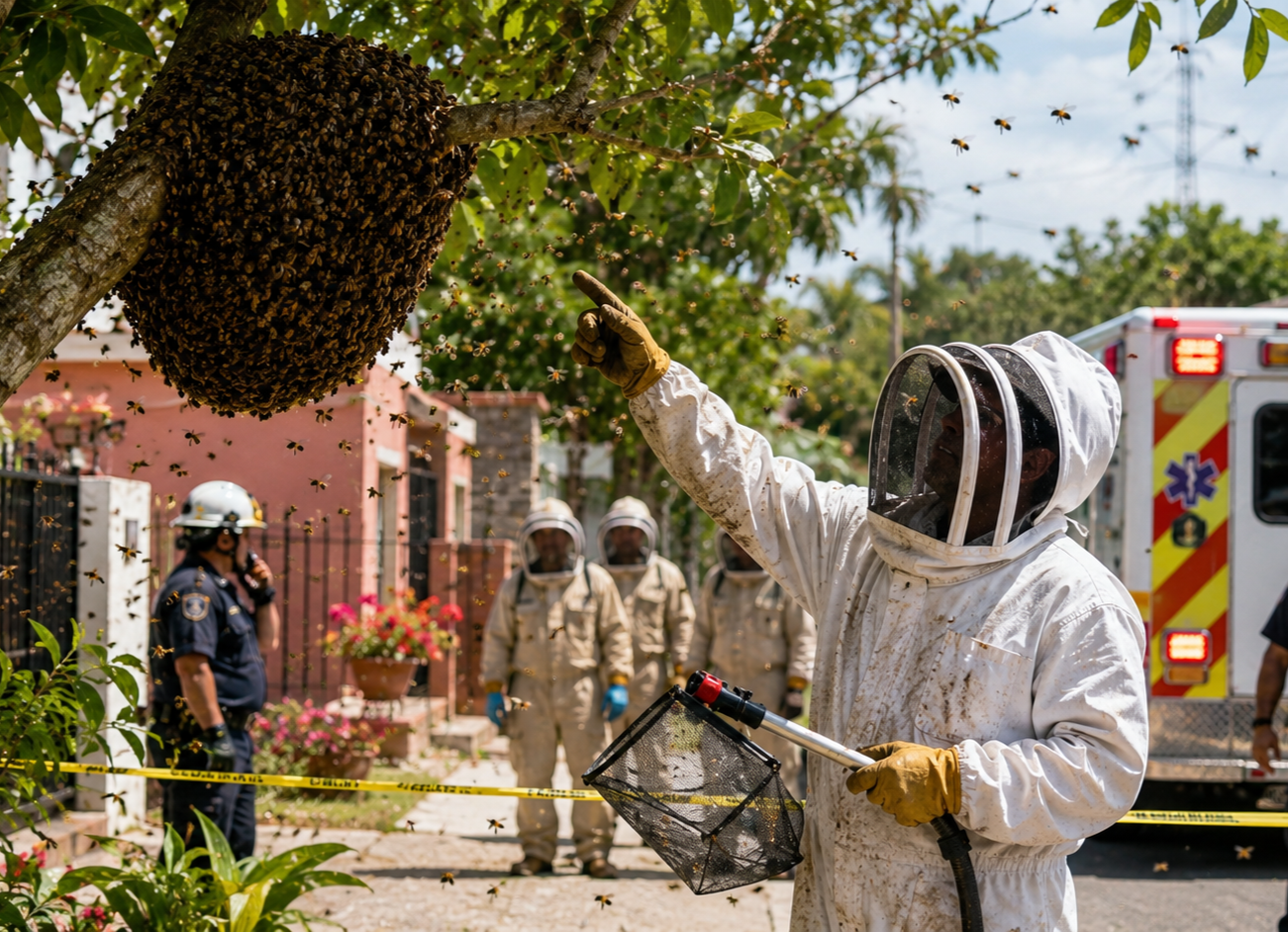

Bee attacks in Yucatán have become a growing concern in 2016.
In just five months, several municipalities in the state have reported incidents ranging from multiple stings to deaths, a phenomenon that specialists attribute to climate factors, urban sprawl, alteration of natural habitats, and changes in colony behavior patterns.
Recent cases in Mérida, Umán, Tizimín, Maxcanú, and Temax show that these events are no longer as isolated as in previous years.
Furthermore, the increase in reports has raised concerns among emergency services, beekeepers, and environmental experts.
They also warn that interactions between humans and swarms have become more frequent due to adverse environmental conditions.
Although Yucatán maintains a long beekeeping tradition and a close relationship with these pollinators, the combination of high temperatures, drought, colony migration, and the expansion of human settlements has created risk scenarios that demand prevention and greater civic awareness.
A surge in incidents in various municipalities
During 2026, reports of bee attacks have shown unusual behavior in different regions of the state.
Among the most relevant cases are:
March 11, Mérida: a child was hospitalized with multiple stings and a fracture while trying to escape an attack in the Lázaro Cárdenas neighborhood.
March 20, Umán: a 63-year-old man was attacked after accidentally hitting a beehive inside his home.
March 26, Tizimín: a motorcyclist suffered multiple stings after parking under a tree with a swarm of bees.
April 5, Umán: a minor was attacked by bees from an abandoned property.
April 8, Mérida: six people were affected in the Non-Polluting Industries Zone.
These events confirm that Africanized bee swarms in Yucatán represent an increasingly visible risk in both rural and urban communities.
Why are bee attacks becoming more frequent in Yucatán?
Experts indicate that the increase in bee attacks in Yucatán is due to multiple environmental and human factors.
Climate Change
High temperatures, abrupt climate changes, and prolonged periods of drought cause stress in bee colonies.
When bees face a scarcity of water, nectar, or shade, they modify their defensive behavior and react more aggressively to any disturbance.
Migration in Search of Food
During dry seasons, swarms migrate to urban areas in search of gardens, water sources, and ornamental vegetation.
This explains why entire colonies appear in patios, on rooftops, in urban trees, on boats, or in abandoned structures.
Urban Expansion
The growth of housing developments and the occupation of formerly natural areas reduce the areas where bees establish their colonies.
As a result, encounters between people and swarms increase.
Accidental Handling of Beehives
Many attacks occur when a person prunes trees, clears weeds, damages structures, or attempts to remove beehives without specialized equipment.

Bee-related deaths recorded in 2026
So far, Yucatán has recorded at least two confirmed deaths from bee attacks in 2026.
Temax: the first tragedy of the year
On January 13, an elderly man died after being attacked while collecting firewood in a wooded area.
The incident highlighted the risks of entering areas with wild bee colonies.
Maxcanú: a fatal attempt to scare away a hive
On May 2, another man, 74 years old, died after entering a room to try to scare away a swarm.
The attack was massive, and despite the arrival of paramedics, he showed no vital signs.
Recommendations for preventing bee attacks
Authorities, beekeepers, and emergency services are urging the public to reinforce preventive measures.
Among the main recommendations are:
Do not attempt to remove beehives yourself.
Avoid sudden movements near a swarm.
Do not throw objects or use smoke or fire to scare them away.
Report immediately to 911 or specialized agencies.
Keep yards clean and check trees, roofs, and abandoned structures.
If an attack occurs, run in a straight line and seek shelter.
Do not jump into the water or hide in vegetation.
In addition, if a person experiences multiple stings, difficulty breathing, severe swelling, or loss of consciousness, they should receive immediate medical attention.
Although attacks cause alarm, specialists remind us that bees play an indispensable role in the environmental balance of Yucatán.
They are responsible for key pollination processes that sustain agricultural production and regional biodiversity.
Therefore, the challenge is not to eliminate them, but to strengthen management, rescue, and relocation protocols.
Experts agree that many incidents could be avoided with ongoing information campaigns.
In a state with a strong beekeeping tradition, where the presence of bees is part of everyday life, understanding their behavior is fundamental.
The increase in bee attacks in Yucatán during 2026 offers a clear lesson: prevention, immediate attention, and respect are essential actions to reduce risks and avoid further tragedies.

Source: yucatan