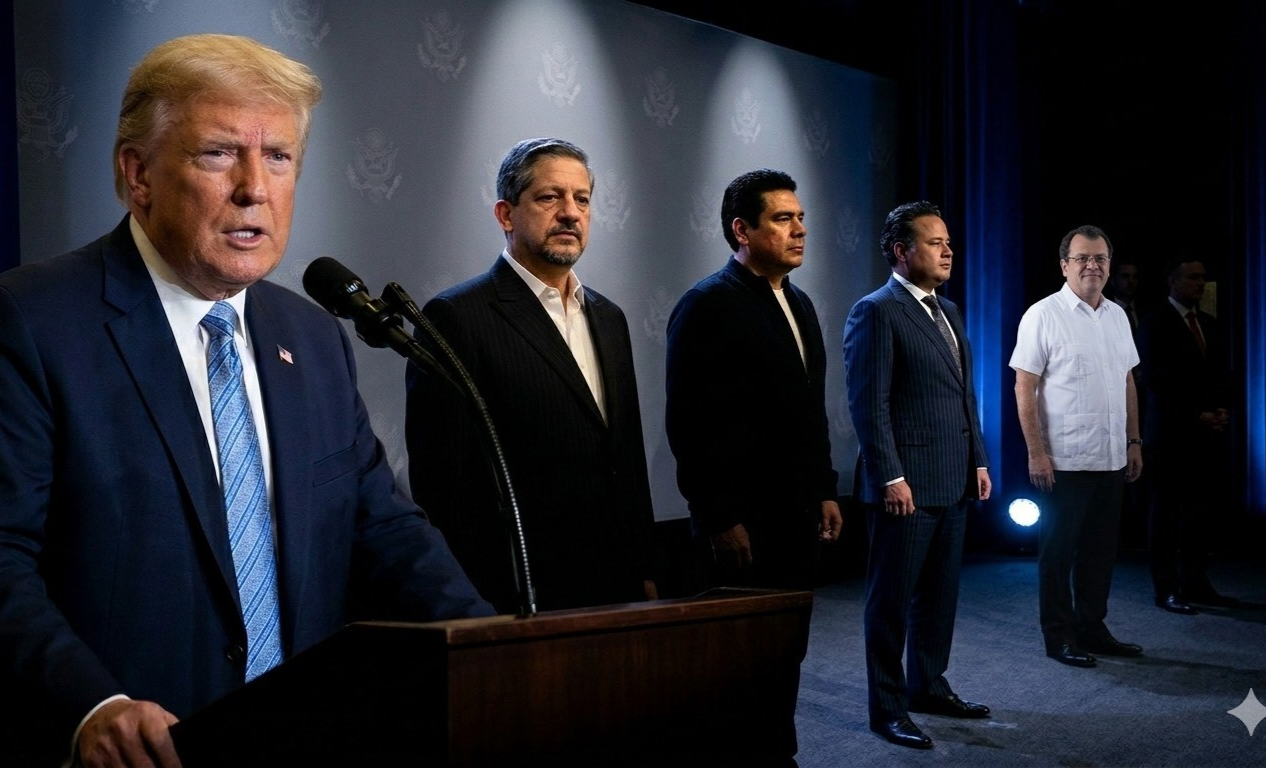

In recent months, the relationship between public perception and foreign policy has once again taken center stage in the national debate. Statements and positions emanating from the United States, particularly from figures like former President Donald Trump, have revived a sensitive narrative for Mexico: the possible infiltration of organized crime into state structures.
Although these assertions have not resulted in formal legal proceedings or conclusive evidence presented publicly, their impact on public opinion has been immediate, especially in states where the ruling party faces adverse conditions, such as Querétaro.
Presidential Approval vs. Party Strength
According to various national polls conducted between March and May 2026, President Claudia Sheinbaum maintains approval ratings that fluctuate between 60% and 70%.
For example:
Lorena Becerra’s poll for Latinus (May 2026) places her approval rating at 59%.
Polls such as those conducted by El Financiero and GobernArte place Morena’s approval rating between 67% and 68%.
Other surveys, such as Enkoll, have reported levels exceeding 70% in previous months.
However, this support does not translate uniformly into electoral support for Morena.
In the case of Querétaro, various polls agree that the party is in a competitive position, but still behind the main opposition force:
QM Poll (March 2026): Morena with 27%, compared to 35% for the PAN.
GobernArte (March 2026): Morena with 30.1%, compared to 41.5% for the PAN.
Rubrum (May 2026): Morena consolidated in second place, without overtaking the ruling party.
This difference highlights a significant gap between the presidential figure and the party brand at the local level.
The Effect of International Accusations
Public opinion specialists agree that narratives originating from abroad can influence public perception, particularly when they are associated with sensitive issues such as security.
In this context, accusations promoted by political sectors in the United States—including those linked to Donald Trump—have placed the discussion about the relationship between the government and organized crime on the media agenda.
Although the federal government has not acknowledged these accusations and has reiterated its rejection of any such link, the issue has been taken up by political and media actors in Mexico, generating an environment of heightened scrutiny.
Analysts consulted agree that these types of narratives, even without legal basis, can influence the perception of specific sectors of the electorate.
Querétaro: A Politically Sensitive Terrain
The case of Querétaro is particularly relevant due to its political and sociodemographic characteristics.
This is a state with:
A tradition of PAN-led governments
A high proportion of urban middle class
Perceived safety levels above the national average
Strong exposure to national and international media
In this context, issues related to governance, security, and the rule of law tend to have a decisive impact on voting intentions.
According to electoral analysts, any narrative suggesting institutional weakness or possible links to organized crime can have a greater impact on this type of electorate.
Narrative, Perception, and Voting
Several studies in political communication indicate that the perception of risk or distrust can influence voting behavior even more than the direct evaluation of government performance.
In other words, a government can maintain acceptable approval ratings but face difficulties in transferring that support to its party if a dominant negative narrative exists.
This could partly explain Morena’s current situation in Querétaro:
A president with majority approval
A party that fails to capitalize on that support
An environment where external narratives gain local relevance
Heading towards 2027
Although the electoral process in Querétaro is still some time away, current data suggests that the competition is already taking shape.
For Morena, the challenge lies not only in improving its electoral standing but also in containing the effects of narratives that could negatively impact its public perception.
For the opposition, on the other hand, the context represents an opportunity to reinforce messages related to stability, security, and governance.
Source: ciudadypoder