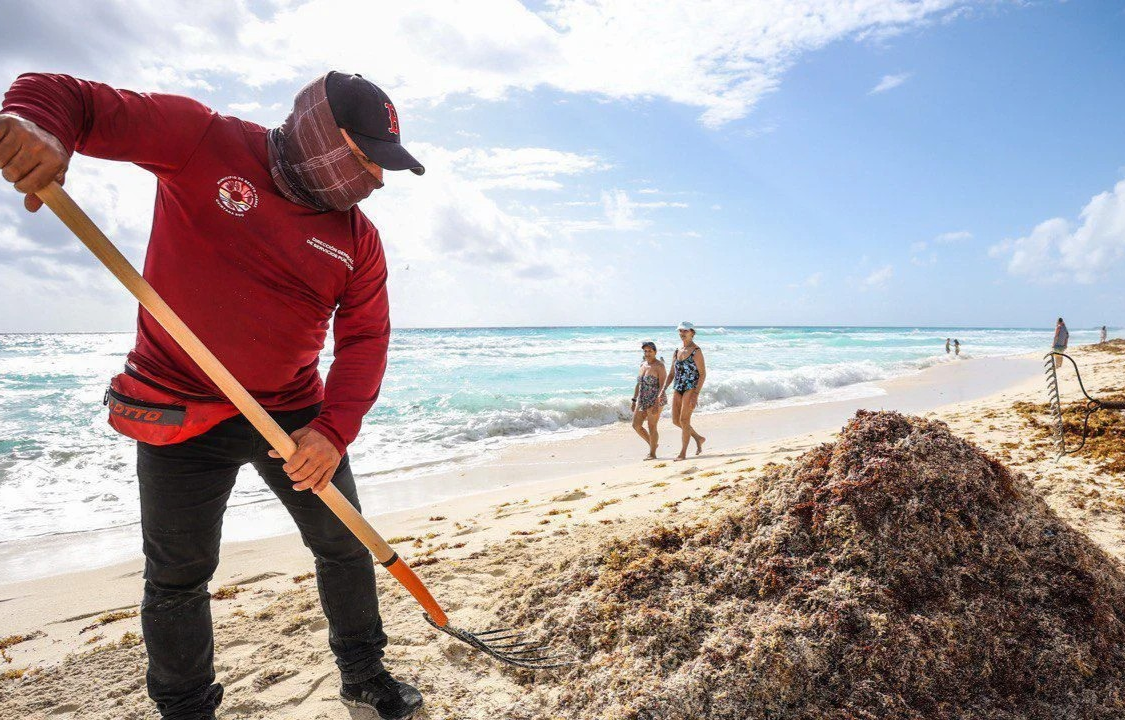

The massive influx of sargassum has once again intensified along the coast of Cancún, compelling the municipal government of Benito Juárez, Quintana Roo, to reinforce its monitoring, cleanup, and inter-agency coordination efforts. These measures aim to mitigate the environmental, tourism-related, and economic impacts of the 2026 season—a season that specialists are already forecasting as one of the most severe in recent years.
José Antonio de la Torre Chambé, Director of Municipal Public Services, reported that in this municipality alone, approximately 8,000 tons of the seaweed have already been collected so far this year. Collection efforts have focused primarily on Delfines and Coral beaches, which are considered the areas most heavily impacted due to their exposure to the open ocean.
The outlook for the current year is a source of concern for authorities, specialists, and tourism industry stakeholders, as various national and international monitoring reports anticipate a record-breaking sargassum season for the Mexican Caribbean.
The official explained that the municipality maintains daily surveillance—beginning in the early morning hours—to identify areas with the heaviest accumulation and to immediately deploy cleanup crews.
“Every day, between 5:00 a.m. and 6:00 a.m., we dispatch supervisors to our public beaches to assess their condition at daybreak and determine the specific work that needs to be carried out,” he noted.
He specified that these patrols cover public beaches such as Las Perlas, Del Niño, Ballenas, Chac Mool, Marlín, Delfines, and Coral, where coastal conditions are evaluated daily to define the operational strategy.
De la Torre Chambé indicated that, depending on the magnitude of the sargassum influx, the municipal government activates additional support from various state and federal agencies—primarily the Secretariat of Ecology and Environment (SEMA). Furthermore, in extraordinary circumstances, assistance from the National Guard may be requested to accelerate cleanup operations. You may also be interested in: Acamoto concludes with 8 arrests in Acapulco.
In addition to damaging the tourism image of the beaches, sargassum causes environmental harm as it decomposes along the coast, resulting in foul odors, the deterioration of marine ecosystems, damage to coral reefs, and sand loss on some beaches in the Mexican Caribbean.

Source: 24=horas