
The state of Oaxaca became the first entity in the South-Southeast region and the third in the country to have a State Plan for the Search for Missing Persons.
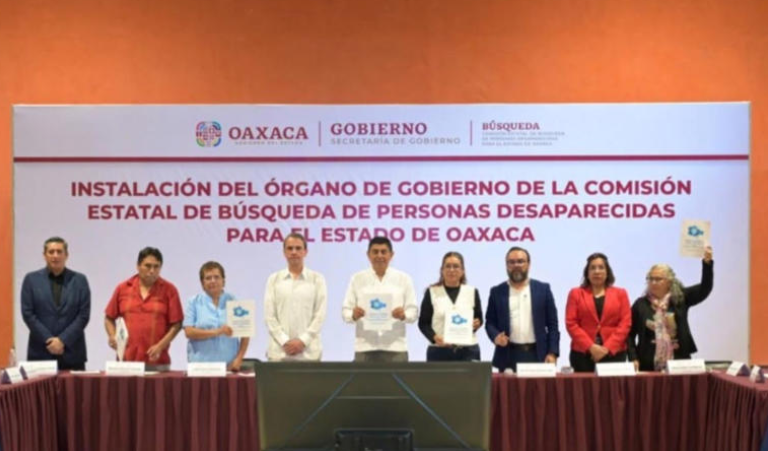
In this regard, during the installation of the Governing Body of the State Commission for the Search for Missing Persons for the State of Oaxaca, headed by Governor Salomón Jara Cruz, this instrument, which will govern public policies for locating missing persons, was approved.
In the presence of search collectives, state and federal agencies, as well as autonomous bodies with responsibility in this area, the governor stated that this Plan contributes to building a more just Oaxaca, where families feel the support of a government that guarantees human rights and assumes with seriousness and sensitivity the obligation to strengthen the institutions in charge of the search for missing persons.
The establishment of this body represents a very important step in coordinating inter-institutional collaboration, so that actions are carried out effectively and results are achieved. In Oaxaca, we are not indifferent to the pain of families; “We are committed to providing care to victims and working to ensure the full respect of human rights,” he stated.
For his part, the Office of the United Nations High Commissioner for Human Rights in Mexico, Alan García Campos, emphasized that this is an important day, recognizing the political will and leadership of the state authorities involved, as this is the third program of its kind nationwide.
He added that this effort is even more significant because it stems from the participation and dialogue between families, collectives, and authorities, and highlighted that citizen participation is a fundamental instrument that becomes the seed of trust in institutions.
Meanwhile, the head of the Oaxaca State Commission for the Search for Disappeared Persons, Michel Julián López, affirmed that this document will serve as the roadmap for institutions to address the problem of disappearances in the state.
She explained that its development was carried out through working groups with members of collectives, the Citizens’ Council, and families of disappeared persons, which provides
Source: msn