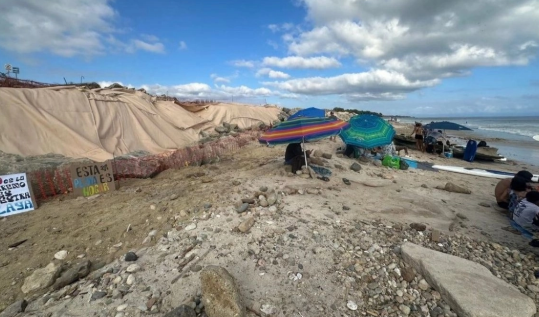

The federal government has rejected the real estate project of the company Cantiles de Mita on Las Cocinas Beach in Nayarit, where it intended to build luxury homes in a critical nesting habitat for leatherback, olive ridley, and hawksbill sea turtles.
This decision came after the Ministry of Environment and Natural Resources (Semarnat) revoked the Federal Maritime Terrestrial Zone (Zofemat) concession granted to the company, citing “non-compliance” with the terms of the concession due to the execution of unauthorized works and installations, outside the bounds of the relevant legislation.
The agency stated that, as a result of this decision, it will redesign the project “through a new course of action that addresses the identified environmental impacts,” as well as strengthen the protection of coastal ecosystems and guarantee free access to the beach.
The “Montage” resort complex, planned for Punta Mita, Nayarit, became the second megaproject canceled by the current federal administration in just two months. Last May, the Ministry of Environment and Natural Resources (Semarnat) also denied authorization for the Perfect Day development, which Royal Caribbean intended to build in Mahahual, Quintana Roo.
Since last April, residents of the communities of Punta de Mita and Emiliano Zapata, along with environmental activists, have held intense demonstrations against the Cantiles de Mita company, part of the Dine Group. They accused the company of privatizing Las Cocinas Beach, considered the last public and unrestricted beach in the area, and of causing environmental damage.
The protests were marked by arbitrary arrests and accusations of repression by the state police. In recent days, residents have reiterated their complaints that the Dine Group has failed to remove construction work and has not respected the 20-meter setback required by law.
The project was being developed on a 209,000-square-meter site and will include 145 hotel rooms, more than 60 luxury residences, spas, and restaurants. Its opening was originally planned for 2027.
The Ministry of Environment and Natural Resources (Semarnat) reported that a dialogue process was carried out with community members and local authorities, whose proposals were incorporated into the technical analysis “to define an alternative that reconciles environmental protection, the safety of the area, and the public interest.”
It added that, as part of this new strategy, authorities are evaluating the most appropriate restoration procedure from a technical standpoint.
The plan includes the recovery of coastal vegetation and the rehabilitation of the site as part of a comprehensive environmental restoration program, prioritizing nature-based solutions and ensuring free transit in the area, it explained.
Source: jornada