
During the 2006 elections, Sergio Villarreal Barragán, alias “El Grande,” a former member of the Beltrán Leyva Cartel, allegedly gave then-candidate Andrés Manuel López Obrador (AMLO) half a million dollars for his presidential campaign. The former drug trafficker himself told journalist Anabel Hernández that he met with the left-wing candidate at a hotel to deliver the money.
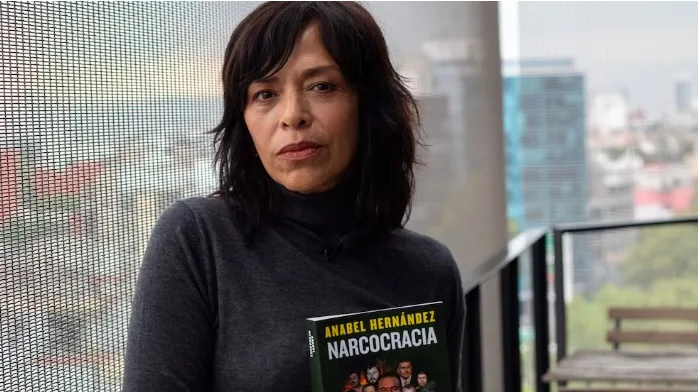
In the book “Narcocracia: El Grande revela cómo los cárteles conquistaron México,” the renowned journalist recounts a series of meetings she held with the former member of the Beltrán Leyva organization.
In an interview with Infobae México, Anabel Hernández stated that Mexico is currently experiencing the climax of “Narcocracy,” which, she says, has been gradually incorporated into the political and governmental system over the years and became consolidated during López Obrador’s administration, in a process through which all institutions became contaminated.
“It was a gradual process. This narco-conquest took place plaza by plaza, institution by institution, official by official. It was a process. We are at the climax, not only because Andrés Manuel López Obrador was already colluding with the cartel (of Sinaloa) from the beginning of his political movement, but because all institutions, with or without López Obrador, were already contaminated.”
Anabel Hernández described López Obrador as a “Trojan Horse” and pointed out that he was a pioneer in maintaining a pact with a criminal group that lasted for years.
“He is a Trojan horse; he made a pact that was maintained for many years. When he comes to power (AMLO), everything reaches a crisis point, it is the perfect storm, because he has institutions penetrated (by drug trafficking), plazas controlled, and municipal presidents (involved).”
For Hernández, these factors created “a perfect storm” and “the cherry on top of the cake,” which is why she considers it “the climax of narco-government.”
She said that what we are seeing today is that this support from organized crime for politicians to win governorships or presidencies is no longer an isolated case, but rather the rule.
“And that is why we could count all the investigations that the United States government has opened against several governors from Morena who came to power in this way. In other words, having an alliance with drug trafficking to reach power is no longer an exception, but a rule.”
Sheinbaum, Product of “Narcocracy”
The journalist stated that Mexico’s current president, Claudia Sheinbaum, is a product of this “Narcocracy,” and that the criminal pact allegedly made by AMLO from the beginning of his political movement remains in place to this day.
She recalled that Sheinbaum has defended members of her party accused of having ties to organized crime, such as Governor Rubén Rocha Moya, who was accused by the United States government of having ties to the Los Chapitos faction of the Sinaloa Cartel.
The writer claimed that, instead of arresting and extraditing Rocha Moya, the president defended him against the accusations and pointed to an inconsistency between this action and the fact that she, AMLO, and Morena as a whole applauded Genaro García Luna’s prosecution in the United States.
“In other words, this is not about sovereignty; this is about protecting your own, because if one falls, they all fall,” she concluded.
Half a Million Dollars: The Price of Drug Trafficking’s Infiltration Into Politics
Sergio Villarreal Barragán confirmed what DEA agents and reports from official investigations had already anticipated: that during the 2006 campaign, he delivered money from the Sinaloa Cartel to Andrés Manuel López Obrador to finance his presidential candidacy for the PRD.
The conditions of the alleged pact were four: blocking the operations of the United States Drug Enforcement Administration (DEA) in Mexico, suspending the extraditions of drug traffickers, allowing Arturo Beltrán Leyva to operate without state interference, and, in exchange, reducing levels of violence.
Hernández explained that she was the person who brought this allegation to worldwide attention in January 2024, based on a DEA investigation supervised by the U.S. Attorney’s Office for the Southern District of New York. Various testimonies —including members of López Obrador’s campaign team— had reportedly confirmed the arrival of that money to prosecutors.
“They are the ones who say who was at meetings A, B, C, and D, and one of those who was at the meetings was precisely El Grande,” the journalist explained.
When seeking confirmation from sources within the then-Attorney General’s Office (PGR), she obtained information indicating that Villarreal had made these allegations as early as 2010, during the first hours of his joint interrogation with the DEA in Mexico City.
According to Anabel’s investigation, major Sinaloa Cartel kingpins allegedly contributed millions of dollars to López Obrador —more than $25 million, according to El Grande. However, one of the most significant payments was $500,000 at the Hotel Campestre in Gómez Palacio, where the former president allegedly promised to be at Arturo Beltrán Leyva’s service.
From then on, he allegedly financed his subsequent political campaigns.
“When El Grande talks about this meeting, about how he handed the money to Andrés Manuel López Obrador at the roadside motel, it was already an issue that the prosecutors at the time were not interested in,” Hernández stated. “They had already decided to put it in a drawer, not discard it. That investigation remains open. They simply decided not to proceed at that moment, not to advance any further.”
Source: elsoldechiapas