
At the El Villarín horse track, in the town of Santa Fe, Veracruz, it felt like a village festival: the shouts of people cheering for their favorite mixed with the music of an old banda coming from dusty speakers and the smell of dirt kicked up by the horses’ hooves. It was spring, and the sun beat down hard on the back of people’s necks. Even so, no one seemed willing to move. The bettors stood beside the railing, crumpled tickets in their hands and their eyes fixed on the track, waiting for luck to finally run in their favor in the next race.
It was March 3, 2007. There was José Francisco Mendoza Gómez, who came from Tamaulipas and was known as Yiyo. At 38 years old, and with plenty of dollars in his pocket, he had become a fan of buying horses and race cars, and those who knew him said he was already well positioned within the Los Zetas cartel.

Some time earlier, he had met Marisela Flores Torruco, La Dama de Hierro, who moved drugs for the Sinaloa Cartel and would eventually become his wife and the mother of one of his children. El Yiyo was responsible for transporting merchandise through Veracruz and Tamaulipas on its way to the United States, managing alliances and collecting payments for passage rights. This was how he built a criminal empire that reached the highest levels of power: governors, politicians, military personnel, and public security authorities in northern Mexico.
That day, beside him was Efraín Teodoro Torres, known in the criminal world as La Chispa or El Z-14, who was identified by authorities as one of the fourteen original army deserters who founded Los Zetas. He was also one of the closest associates of Heriberto Lazcano and the regional leader of the cartel’s operations in Veracruz.
But the race was interrupted. Suddenly, the shouts of the bettors and the music of the banda stopped abruptly when what sounded like gunshots began to ring out. Those who were there said that, once they recovered from the shock, they saw Efraín lying on the ground. One of the most powerful criminals was lying on his back, with several bullet wounds. He was still alive.
José Francisco El Yiyo** managed to carry Efraín** and, with the help of others, put him into a pickup truck. There was no time to lose. With the noise and confusion still behind them, he drove toward Millenium Hospital in the port, about forty minutes from the racetrack. There, Efraín was registered under another name: Roberto Carmona Gasperín. It was a precaution, a way of preventing anyone from recognizing him and finishing him off. Even so, that day El Z-14** died in the operating room** while doctors attempted to remove the bullets.
No one was ever able to confirm who killed him. However, the media reported that it was **revenge by Miguel Ángel Treviño, **El Z-40, then leader of Los Zetas, who allegedly ordered his execution because he was no longer satisfied with him. His body remained for two days in the port morgue. On March 5, a woman who said she was his mother came to claim it. Hours later, his relatives buried him in a cemetery in Poza Rica, Veracruz.
But the story did not end there. That same day, shortly before midnight, the cemetery guard saw an armed group of at least five men arrive. They approached him and asked directly: “Where is Teodoro’s body buried?” The guard quickly pointed out the grave. It was easy to identify because the freshly placed flowers still had a strong scent. The men tied him up and, after exhuming the body, took it away. To this day, the body of Z-14 remains missing.

Finally, on September 4, the then Attorney General’s Office of Mexico (PGR) announced that the criminal figure, feared for coordinating and carrying out violent actions and confrontations against rival cartels, had died at a ranch party in March, and reported that it had arrested five men who participated in the clandestine exhumation: Francisco Javier Villarreal, Eduardo Lagunes, Sergio Humberto, Hugo Francisco Barona, and El Yiyo.
The PGR brought the name of this previously unknown drug trafficker to the attention of the country’s media. The friend of Z-14 had been one of the men who took Efraín’s body away.
After his arrest, El Yiyo** was transferred from Veracruz to the maximum-security Altiplano prison**, in Almoloya de Juárez, where he shared the facility with other high-profile drug traffickers. At that prison, he was surrounded by Jesús Vicente Zambada Niebla, El Mayo’s son; Alfredo Beltrán Leyva; and Miguel Ángel Félix Gallardo, El Jefe de Jefes, the old founder of the Guadalajara Cartel.
In 2010, after three years behind bars, José Francisco heard his name in a ruling that gave him a new lease on life. The PGR, following a deficient investigation, failed to prove the charges of organized crime or the theft of the body, and he was ultimately released. But his time behind bars came at a high cost. Part of the wealth he had accumulated through his illegal activities disappeared: he paid his lawyers with luxury cars, armored trucks, properties, and, according to people who knew him at the time, even aircraft.
Eventually, his extravagance attracted the attention of the United States government. His name became part of the judicial history of both countries: he was one of the 26 drug traffickers handed over by Claudia Sheinbaum to Donald Trump in August 2025, the second major transfer of cartel leaders during the administration, in an effort to ease Washington’s pressure on organized crime.
This is the story of José Francisco Mendoza Gómez: a man raised among horses and dusty roads in the Santa Cruz de Llera ejido in Tamaulipas, who went from betting fortunes at drag-racing tracks to moving cocaine across borders, from building racetracks to establishing companies with dirty money, from being acquitted after his time in Altiplano to ending up extradited on the most uncomfortable flight of his life. It is the story of how a man can win everything… and lose it twice.

El Yiyo’s involvement with the Sinaloa Cartel
Little is known about his childhood. The only confirmed information is that he was born in Santa Cruz de Llera, Tamaulipas, a small town an hour from Ciudad Victoria, on a day in February 1969. By the beginning of the new millennium, his life had taken turns that no one could have imagined. From the child who ran among animals, trees, and rivers in the rural area, he had transformed into a man with money, power, and connections that crossed international borders.
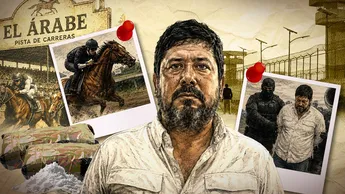
In 2005, José Francisco built in Güémez, a small town twenty kilometers from the capital of Tamaulipas, a horse-racing track called El Árabe. The construction was remarkable for the region, which was quite rural: it had an underground tunnel connecting both ends of the lanes, modeled after the Hipódromo de las Américas in Mexico City. The land had belonged to an Arab merchant who had settled in the area decades earlier. According to local accounts, its origin inspired the name of the equestrian center.
Around that time, another of José Francisco’s hobbies was speed. A fan of quarter-mile drag racing, he traveled to different parts of the country to participate in competitions. He did so with an unusual display: trailers for the race cars, a bus for the drivers, and part of the staff who accompanied him. According to acquaintances, El Yiyo** could spend more than thirty thousand dollars in a single day of competition**. Two years later, that world of luxury and speed would be interrupted by his arrest.
In 2016, José Francisco was part of the Flores-Torruco organization, which was investigated for trafficking cocaine destined for the United States. The network consisted of Marisela Flores Torruco, La Dama de Hierro; José Francisco Mendoza Gómez; Alfonso Padilla Flores, Poncho-CR7; José Padilla Flores, Pepe-Goni; and Qiyun Chen, La China. The organization operated from Mexico as a logistical and financial mechanism: it supported maritime and air shipments originating in Colombia and heading to Panama, where the drugs changed hands before continuing toward Mexican territory. Once in Mexico, the network transported the cocaine overland toward the north until it reached the U.S. border. At the same time, they carried out financial operations in several countries to ensure a constant flow of dollars.
Court documents state that José Francisco was at the center of the trafficking and profits that crossed borders between Mexico and the United States. He did not only move merchandise and money. Kidnappings and murders were part of his routine for dealing with competitors, leaving a trail of intimidation and power that strengthened the organization’s influence and his own reputation within it.

However, **the first to fall was **La Dama de Hierro. On July 8, 2017, Colombia’s National Police closed in on her after several days of investigation, operations in that country, and analysis of information. Marisela had entered Colombia months earlier as a tourist, but international agencies already knew about her connections to the cartels. The U.S. District Court for the Eastern District of Virginia sought her extradition for coordinating drug trafficking from Panama, Mexico, Colombia, and Guatemala to the United States.
She had gained the trust of dangerous drug traffickers—including El Chapo—and carried out kidnappings and targeted killings against rivals in the drug trade upon request. It is believed that before her arrest she was seeking to establish an alliance with the Gulf Clan. Interpol had issued a red notice against her. When she was arrested, Guzmán was already serving his sentence in Manhattan. For El Yiyo, her downfall was also his: without knowing it yet, the clock was already counting down.
Her arrest not only shook the organization they were both part of, but also broke the emotional structure that had accompanied him for years. According to people who knew them, they shared a bond as deep as it was dangerous: a mixture of loyalty, passion, and ambition that could sustain them or destroy them with equal intensity. According to sources close to them, Marisela allegedly told him a phrase that he took as a warning and perhaps as a provocation: “Wherever I go, I will take you with me.” Over the years, the promise became a prophecy. When the United States requested his extradition, her shadow caught up with him once again.
How he went from drug trafficker to businessman with the Tamaulipas government

To try to legitimize himself and conceal his illegal businesses, through his latest partner, Yasmín Quintanilla, José Francisco founded Megamax. The company generated approximately 47 million pesos between 2022 and 2023 through contracts with the Tamaulipas government, headed by Américo Villarreal Anaya, and with the mayor of Ciudad Victoria, Eduardo Gáttas.
Formally, the construction company was registered under his partner’s name, with her listed as its legal representative. But her role went far beyond signing documents: she worked side by side with him, negotiating directly between the government and Mendoza. While she represented the company, José Francisco handled political contacts, moving with such confidence that he even attended the mayor of Ciudad Victoria’s first government report in 2022.
In official Tamaulipas government documents, José Francisco Mendoza Gómez’s signature and name appeared in his own handwriting. With striking boldness, he did not remain in the shadows: he also personally participated in the contracting procedures, moving between government offices and officials as if his influence were natural and unquestioned.

Megamax received contracts that included paving and hydraulic and asphalt rehabilitation of streets in municipalities such as Gómez Farías, Llera, Aldama, and Nuevo Laredo; road maintenance in Ciudad Victoria, Güémez, and Hidalgo; as well as the rehabilitation of an elementary school in Ciudad Victoria.
José Francisco’s power reached me unexpectedly. After I published the investigation into his business relationship with the government on August 14, 2025, my cellphone was flooded with hundreds of calls and messages repeating a simple but disturbing “regards.” According to a journalist-protection organization, this was an attempt to take control of my phone.
During the hours following the publication of my investigation, my voter identification card, including my address, appeared leaked on internet pages and various social networks. Shortly afterward, death threats began arriving through my own accounts, with messages that bluntly warned: “your hours are numbered.” While all this was happening, Marisela was appealing her sentence before the U.S. District Court for the Eastern District of Virginia, seeking to reduce the sixteen-year-and-eight-month sentence imposed on her in 2019. She was doing so after having turned over her great love, whom she had decided to “take with her” as an act of revenge after discovering that he had started another relationship.
**The downfall of José Francisco Mendoza **El Yiyo

In December 2024, agents from the Attorney General’s Office of Mexico arrived at the private Villarreal residential complex in Ciudad Victoria, where José Francisco lived surrounded by comforts: a huge garden with a swimming pool and a pine-lined path leading to the front of his home. From there, they took him to the Southern Men’s Preventive Detention Center in Mexico City, where he remained for eight months before being extradited. Eight years had passed since his first accusation in the United States.
In August 2025, his name appeared among the twenty-six inmates handed over by the Mexican government to Washington. For U.S. authorities, the agreement was not only intended as punishment: it was a key to opening a box of secrets that had circulated for years across borders, among associates, and through silence. For him, it meant the possibility of receiving a shorter sentence. For those who had once bet alongside him at El Árabe racetrack, it was the unmistakable sign that the days of betting were over.
The charges he faced in the United States could have left him imprisoned for life in a federal prison in Virginia. Life imprisonment was not a distant scenario: it was a real and tangible possibility. Cornered by the weight of the evidence and the pressure of an unforgiving judicial system in international drug-trafficking cases, José Francisco chose the only option that offered a glimmer of hope: pleading guilty to conspiracy.
The agreement required him to expose his financial life to the U.S. government: to disclose every one of his assets and financial interests, from bank accounts to properties hidden through trusts, companies, or nominees. He had to provide tax returns from the previous five years and, if required, undergo exhaustive financial examinations and polygraph tests to demonstrate the truthfulness of his information. He also had to detail any asset worth more than five thousand dollars that he had transferred to third parties since the date of the first offense underlying his case, conspiracy to distribute five kilograms or more of cocaine: names, amounts, locations, and dates. Nothing could be left out.
Following his sentencing, José Francisco Mendoza remains imprisoned in the United States, serving a ten-year sentence; it has yet to be determined whether he will serve his sentence at a maximum-security federal facility in North Carolina or Florida. I, meanwhile, remain in exile from my own state, carrying the shadow of his power and the collusion he exercised over authorities.
Source: milenio