
The Mexican Victims of 9/11: Five Died at the Twin Towers While 11 Others Were Never Identified
Tuesday, September 11, 2001. Five Mexicans were preparing to receive guests at Windows on the World, the renowned restaurant located on the 106th and 107th floors of the North Tower of the World Trade Center in New York.
At 8:46 a.m., American Airlines Flight 11 crashed into the North Tower. The five Mexicans—Antonio Javier Álvarez, Antonio Meléndez, Leobardo López Pascual, Martín Morales Zempoaltécatl and Juan Ortega Campos—had begun their working day when the attacks occurred.
The five had traveled to New York in search of employment opportunities. Three were from Puebla, one from Tlaxcala and one from Morelos. Their names became part of the list of people who died in the attacks and are now included in the memorial at the site where the Twin Towers once stood.
The Mexican consular records also included the names of 11 other Mexican nationals considered possible victims. Unlike the five officially identified cases, their remains were never located among those recovered from the World Trade Center.
The Mexicans Who Worked at Windows on the World
Martín Morales Zempoaltécatl was 22 years old and originally from Santa Catarina Ayometla, Tlaxcala. He arrived in New York in 1998 and, after working several jobs, was hired in 2000 as an assistant chef at Windows on the World.
His goal was to learn English and save enough money to build a house when he returned to his community.
After the attacks, relatives and friends distributed posters bearing his photograph at hospitals and other locations in an attempt to find him among the survivors. One of those documents was preserved by the National September 11 Memorial & Museum and records that he worked on the 106th floor of Windows on the World.
Antonio Javier Álvarez, Antonio Meléndez and Leobardo López Pascual had also left Puebla to seek employment opportunities in the United States. All three worked at the restaurant.
Álvarez was 23 years old and worked as a grill cook. Meléndez, originally from Acatlán, Puebla, was 29 years old and worked as a cook. López Pascual was 41 years old and also worked at Windows on the World. Contemporary victim records identify López Pascual as a cook at the restaurant.
Juan Ortega Campos, from Morelos, worked as a delivery worker within the World Trade Center complex. His job required him to move throughout the complex while the towers housed offices, restaurants and other services.
Windows on the World was located on the upper floors of the North Tower. When Flight 11 struck the building between floors 93 and 99, escape routes above the impact area were destroyed or blocked. Everyone who remained inside the restaurant ultimately died.
The Other 11 Mexicans Whose Remains Were Never Located
Following the attacks, the Mexican Consulate in New York collected information from relatives and members of the Mexican community about people who might have been inside the World Trade Center that morning.
The search extended beyond employees of the major companies occupying the towers. The complex also contained restaurants, businesses and service operations where people worked in cooking, cleaning, maintenance, delivery and other occupations.
Information collected by authorities and relatives eventually resulted in a record of 16 Mexican nationals associated with the victims of the attacks. Five were officially identified. In the other 11 cases, remains could not be recovered that would allow their deaths to be confirmed through identification procedures.
The list of possible victims included Arturo Alba Moreno, from Mexico City; José Manuel Contreras, from Jalisco; Germán Castillo García, from the State of Mexico; José Guevara González and José Antonio Santos Anaya, from Aguascalientes; Fernando Jiménez Molina, from Oaxaca; Alicia Acevedo Carranza, Víctor Antonio Martínez Pastrana and Juan Romero Orozco, from Puebla; as well as Margarito Casillas and Norberto Hernández, whose state of origin was not established in the cited records.
The distinction between the two groups is important. The five identified victims were officially recognized among those who died, while the other 11 remained in records as possible victims whose remains were never recovered or identified.
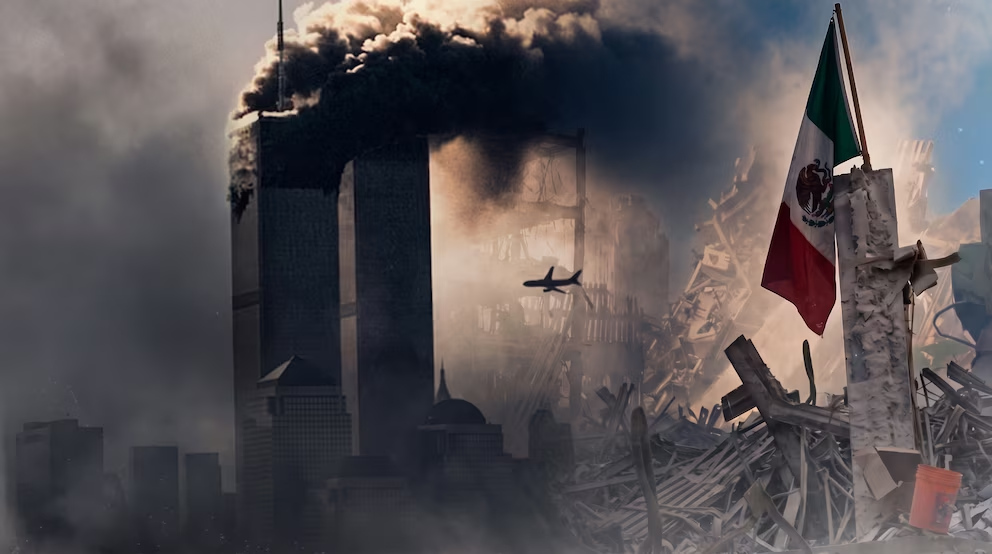
The Mexican Flag Recovered From the World Trade Center Rubble
Fifteen years after the attacks, a Mexican flag recovered from the rubble at Ground Zero became another symbol of remembrance.
On September 11, 2016, the flag was placed on the first floor of the Mexican Consulate General in New York, accompanied by a commemorative plaque honoring the victims of the September 11 attacks.
The ceremony coincided with the 15th anniversary of the attacks. Then-Consul General of Mexico in New York Diego Gómez Pickering met with relatives of Mexican nationals who died during the destruction of the World Trade Center.
According to the Mexican consulate, the flag had been recovered from the area affected by the collapse of the Twin Towers and was subsequently displayed permanently at the diplomatic mission as part of the memory of Mexicans affected by the attacks.
25 Years Later, 1,099 World Trade Center Victims Remain Unidentified
The official number of people killed in the September 11 attacks in New York is 2,753, with 2,606 deaths occurring at the World Trade Center.
The identification process has continued for a quarter of a century. On August 24, 2026, the New York City Office of the Chief Medical Examiner announced the identification of another World Trade Center victim using forensic investigative genetic genealogy (FIGG).
The newly identified victim was an adult woman whose name was withheld at the request of her family. She became the 1,654th person identified among those killed at the World Trade Center.
With that identification, approximately 1,099 victims—about 40% of those killed at the World Trade Center—remain unidentified. The Office of the Chief Medical Examiner continues to analyze remains recovered after the attacks and apply increasingly advanced DNA and genealogical techniques in an effort to establish the identities that remain unknown.
The forensic work has continued since 2001. New genetic technologies have allowed authorities to revisit unidentified remains decades after the attacks, keeping open the possibility that additional families may eventually receive answers.
Twenty-five years after September 11, the stories of the Mexican victims remain part of the broader history of the attacks—not only through the names recorded at the memorial, but also through the families who spent years searching for information about loved ones whose remains were never recovered.
Source: infobae