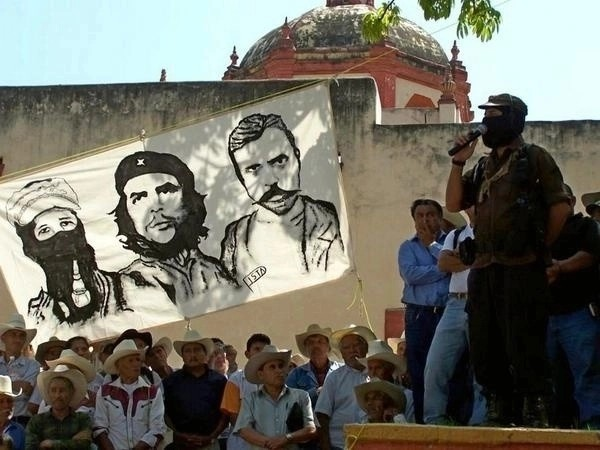


Faced with violence and criminalization, communities, peoples and organizations from Chiapas, Guerrero and Oaxaca agreed to strengthen their processes of resistance and organization.
In a statement released by the Fray Bartolomé de Las Casas Human Rights Center (Frayba), at the end of the Second Regional Meeting: Conflict, Violence and Criminalization against Human Rights Defenders and the Social Movement, they agreed to create committees for territorial protection against threats, the strengthening of their collective processes and historical memory, mobilization, visibility of their problems and the construction of broad alliances and articulations at national and international level.
They stated that “the greatest presence of organized crime is concentrated in the regions where extractive projects are imposed: mining, wind power, gas pipelines, road expansions (in Guerrero, Chiapas and Oaxaca). Those of us who are in opposition to these projects are murdered, disappeared, criminalized and delegitimized. This practice has been systematically carried out by federal, state and municipal governments.”
They stated that “there is a failed security strategy, militarization has not reduced the rates of conflict, violence and insecurity; on the contrary, it has served business interests and organized crime. The disappearance of young people and women, murders, collection of fees, forced displacement, lack of conflict resolution and greater presence of armed groups and organized crime in the communities are examples of this situation.”
They stated that “communities forcibly displaced by violence are not a scandal for organizations and movements. From various reports, the shameful figure of 21 thousand displaced indigenous people in Chiapas in the last two years, the murder of 176 human rights defenders during this six-year term, the recruitment of young people, the violence generated in the last electoral process, in addition to the criminalization against members of the social movement have been documented.”
They argued that “the consequences of the imposition of this model, the negligence of state and federal governments and impunity have been the normalization of violence, irreversible contamination of the environment, a deep water crisis in the southeast region, the loss of flora and fauna, territorial control by companies and organized crime, citizen apathy, widespread fear in our communities, community fractures, in addition to serious effects on our social fabric.”
In the framework of the international day of indigenous peoples, they affirmed that “despite defamation, criminalization and violence, indigenous peoples continue to defend the territories in the south-southeast of Mexico.”
They reiterated that “the peoples, communities and movements of the southeast of the country are committed to a different model of society, in which our common goods are a priority, the social ownership of the land, the integrity of our territory, the strengthening of our social fabric, the promotion of Internal Regulations and Communal Statutes. This model is in clear conflict with the neo-developmentalist model, marked by violence, murders, criminalization, obstruction by agrarian authorities to the recognition of the Statutes and internal regulations of the communities (specifically in Guerrero) and the militarization of our territories.”
In addition to Frayba, the statement was signed by the Human Rights Center of the Tlachinollan Mountain, the Tepeyac Human Rights Center and the Center for Studies of the Cuicateca Region-CEREC, as well as the Union of Indigenous Communities of the Northern Zone of the Isthmus (UCIZONI).
Source: jornada