
:quality(75)/media/pictures/2024/08/13/3162029.jpg)
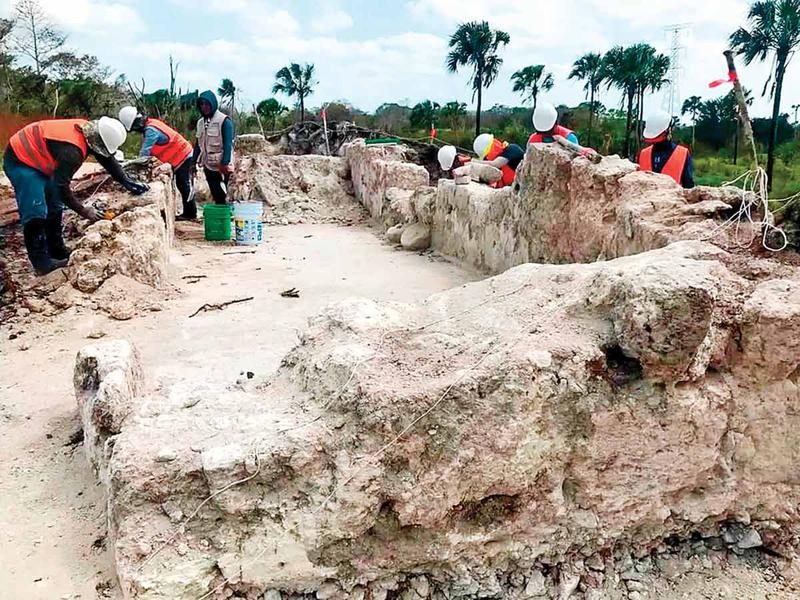
The pre-Hispanic population that inhabited the archaeological site of Río Bec, in Campeche, did not correspond to the poor Mayans, as a French research mission suggested, but to a super elite that is yet to be discovered and that will renew the historical discourse of the site, based on the findings in section 7 of the Mayan Train. In addition, it revealed that one of the complexes located in that region, called Los Monjes, had to be dismantled and will be moved to an archaeological park in Escárcega.
This was expressed yesterday by archaeologist Luis Alberto Martos López at the 35th International Book Fair of Anthropology and History (FILAH). “The French mission is very much in favor of the idea that the Río Bec area, in theory, was inhabited by ‘poor Mayans’, who lacked an elite king and, although they had some centers (of power), everything else corresponded to a rural area, with a dispersed population and minor settlements.
“However, all this concentration had complex residential units, they were not roofed buildings like palapas, but with vaults and, in addition, in many of them funerary urns with deities appeared,” said the expert.
He even highlighted that the distance between one construction and another was between 80 and 100 meters, which would demonstrate a significant concentration.
“We had the opportunity to do the photogrammetry and the plans, and the site had a terracing system (walls and terraces) to channel the water and deposit it in hollows, to form waterholes or cisterns,” which would also indicate that there was intensive agriculture in the region,” he said.
So after reviewing and recording the concentrations and confirming the importance of the structures found in the last three years “this entire system tells you of a very strong economic control and a highly organized high population concentration.”
And this would explain why, despite the fact that the inhabitants of Río Bec lived between Calakmul and Dzibanché, they were never assimilated by either enclave.
LOS MONJES
A special case, Martos López highlighted, is the space known as Los monjes, “a very large complex, which had a patio with lattices and a council room at least 26 meters long, which does not indicate a rural settlement.”
However, he acknowledged that it had to be dismantled and will be rebuilt at the Xpujil site, also in Campeche. “It had to be moved along the route of the Mayan Train, which indicates that it was a residential complex for a super elite.”
How was the process? “Once the exploration was over, the entire building was cleaned, stone by stone was numbered, photos were taken, photogrammetry was done and then we moved them to a piece of land to later take them to Escárcega.”
Why is it Escárcega? “Because an archaeological park is being built there and, possibly, at the end of this year, the placement of the complex will be finished. There is also another park in Chetumal and in some stations (of the Mayan Train) some of these monuments will be erected.”
How much did the complex cover? “It had a zigzag shape, but I estimate that it could reach 80 or 100 meters.”
Is the transfer of piece by piece something new? “No, in Abu Simbel, Egypt, the colossi of Ramses II were going to remain under water because they built a dam and they also numbered them piece by piece and raised them higher up, out of the water. There is also an Egyptian temple that was going to remain below in the same dam and today it is in Madrid, in a park. Yes, that of moving buildings has been done.”
Río Bec is a region located in the south of Campeche and is part of the municipality of Calakmul, where more than a century ago a series of architectural structures belonging to the Mayan society of the Classic period were located. However, Martos believes that “there are new elements to analyze the site from a different perspective and to conduct new studies on political integration, economic development and the environment,” which will provide new hypotheses about its inhabitants.
Source: excelsior