
Human rights organizations denounced “the serious situation of violence and humanitarian crisis that is being experienced in different indigenous regions of Mexico,” especially in the states of Chiapas, Chihuahua and Michoacán, as well as the “systematic omission” of the authorities and security elements “to coordinate with those who have bravely requested their presence.”
The conflicts and territorial disputes of organized crime in the territories have caused that, so far this year, more than 8,190 people were displaced from the Chiapas municipalities of Frontera Comalapa, Chicomuselo, and Siltepec; while in Michoacán this Tuesday alone 110 displaced indigenous people were assisted, and 251 in the municipality of Guadalupe y Calvo, in Chihuahua.
“It has been difficult to document in detail what happened, because in all cases there is a dynamic that forces the victims of violence to remain silent; those who dare to provide information about the situation have received death threats. Even so, we have been able to document the lack of access to basic food and the uncertainty in which all these people find themselves, who are mostly women, girls and boys,” the organizations warned in a statement, including the Fondo Defensores, the Red Nacional de Organismos Civiles de Derechos Humanos “Todos los Derechos para Todas, Todos y Todes” (Red TDT) and the Grupo Núcleo de Indigenous Peoples Rights International-IPRI in Mexico.
They specified that the response of the armed forces has been one of “systematic omission” to protect the inhabitants who, they indicated, have expressly requested their presence to guarantee their safety. “In Chihuahua, for example, it was repeatedly requested over several days that the number of elements be increased and that help be provided to create a humanitarian corridor that allows the movement of families to safe places or to access food. Regrettably, the state response was to reduce the presence of elements and in some cases to criminalize those who asked for help,” they explained.
In the case of Michoacán, they added, a request was made weeks before the peak of violence and as a preventive measure for the installation of a command composed of the armed forces in the area where the attacks against the civilian population would later be unleashed; “however, we are reported to have been obstructed by state authorities in blocking any request to address security needs.”
Given the “extremely serious” situation, the networks and organizations urged the federal government to coordinate inter-institutional efforts to protect the civilian population with preventive measures, build a humanitarian corridor that guarantees the exit of the civilian population held captive by organized crime groups, implement routes for the disarmament of armed groups, search for victims of disappearances and protect the defenders “who have had the courage to denounce what happened and who are working to address humanitarian emergencies.”
The full statement follows:
Call from Civil Organizations to the Federal Government
to protect the Civilian Population at Risk.
September 17, 2024
To the Indigenous Peoples of Mexico and the world
To the public in solidarity
To the media
To the Federal Government
With great concern, we address the public to share with you the serious situation of violence and humanitarian crisis that is being experienced in different indigenous regions of Mexico. At the time of publication of this statement, the signatory organizations and other solidarity entities are assisting around 110 displaced indigenous people in Michoacán and 251 in the municipality of Guadalupe y Calvo, Chihuahua, who after several days continue to wait for humanitarian aid from the government. From Chiapas, they report that, so far in 2024, they have registered 8,190 displaced people in the municipalities of Frontera Comalapa, Siltepec and Chicomuselo alone, among whom there is an undetermined number of indigenous people.
In a span of just three weeks, since August 25, we have recorded 7 affected communities in the Baborigame region, in the municipality of Guadalupe y Calvo, Chihuahua, and an as yet undetermined number of affected communities on the coast of Michoacán; 1 person victim of homicide in the community of Cinco Llagas in Chihuahua, 1 person murdered in the municipality of Chenalhó in Chiapas and two people murdered in the community of El Coire on the coast of Michoacán, who also report 7 missing persons, among whom are 2 minors.
It has been difficult to document in detail what has happened, because in all cases there is a dynamic that forces victims of violence to remain silent; those who dare to provide information about the situation have received death threats. Even so, we have been able to document the lack of access to basic food and the uncertainty in which all these people find themselves, who are mostly women, girls and boys.
As organizations, we have accompanied the communities in their request for the presence of members of the Armed Forces to be strengthened so that they can sufficiently inhibit the commission of crimes. However, we have seen with concern a systematic failure by these forces to coordinate with those who have bravely requested their presence. In Chihuahua, for example, there were repeated requests over several days to increase the number of members and provide help to create a humanitarian corridor that would allow families to move to safe places or to access food. Regrettably, the state’s response was to reduce the presence of members and in some cases to criminalize those who asked for help. In the case of Michoacán, a request was made weeks before the peak of violence and as a preventive measure for the installation of a command composed of the armed forces in the area where attacks against the civilian population would later be unleashed; however, we are reported to have been obstructed by state authorities in blocking any request to address security needs.
This lack of an assertive and coordinated response with the indigenous authorities themselves promotes mistrust and damages a relationship that should be one of respect. The perception that has been shared with us from the territories is that criminal groups are not being prevented from perpetrating serious crimes, such as prolonged armed attacks, house raids, forced recruitment especially of minors, and rape of girls and women.
Faced with this extremely serious situation, we call on the Federal Government to, in compliance with its obligations to the population, coordinate the necessary inter-institutional efforts to:
Protect the civilian population with preventive measures that guarantee the individual and collective human rights of indigenous peoples who are currently under siege.
Build a humanitarian corridor that guarantees the exit of the civilian population held captive by organized crime groups, in order to safeguard the life and physical and psychological integrity of those affected.
Launch routes for the disarmament of armed groups.
Coordinate efforts with state prosecutors to investigate criminal acts with due diligence and present progress in investigations that guarantee access to justice for human rights defenders and the general population.
Search for the victims of disappearances while alive, using specific protocols for the search for minors.
· That in those indigenous communities where military presence has been requested, the authorities at all three levels of government respect the right to autonomy of indigenous peoples, as well as the channels, protocols and procedures defined by each community, respecting their legal institutions and traditional laws.
That protective measures be generated for human rights defenders who have had the courage to denounce what happened and who are working to address humanitarian emergencies.
The events we have described constitute serious violations of human rights, the integrity and the very existence of the indigenous peoples who are now victims of them. The State at all three levels has the obligation to protect, defend and seek justice for these communities.
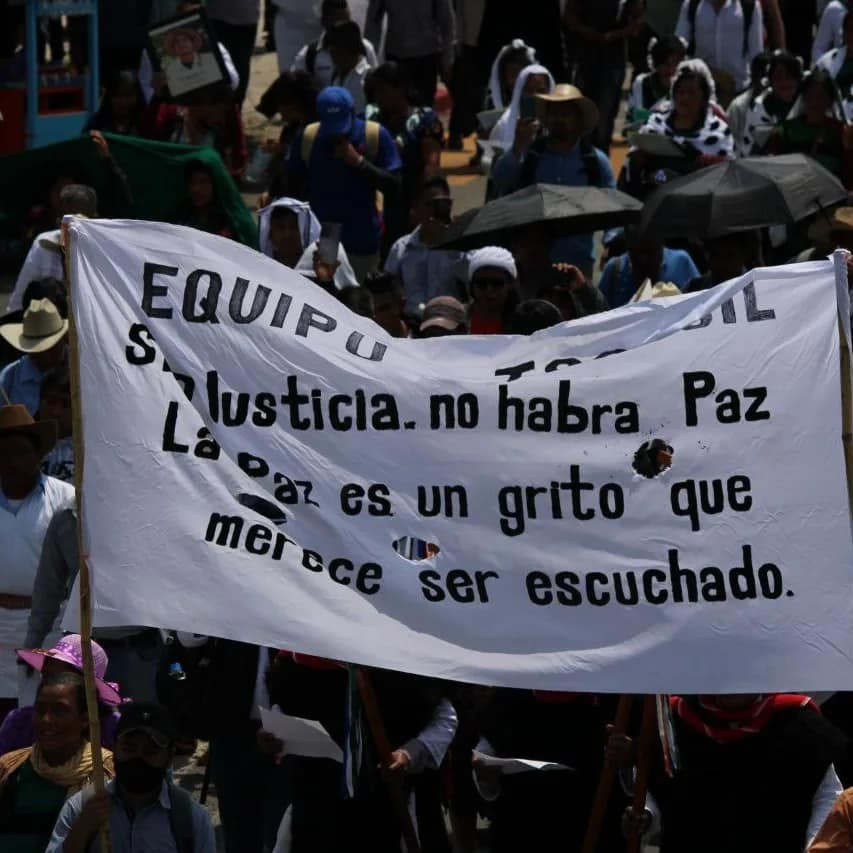
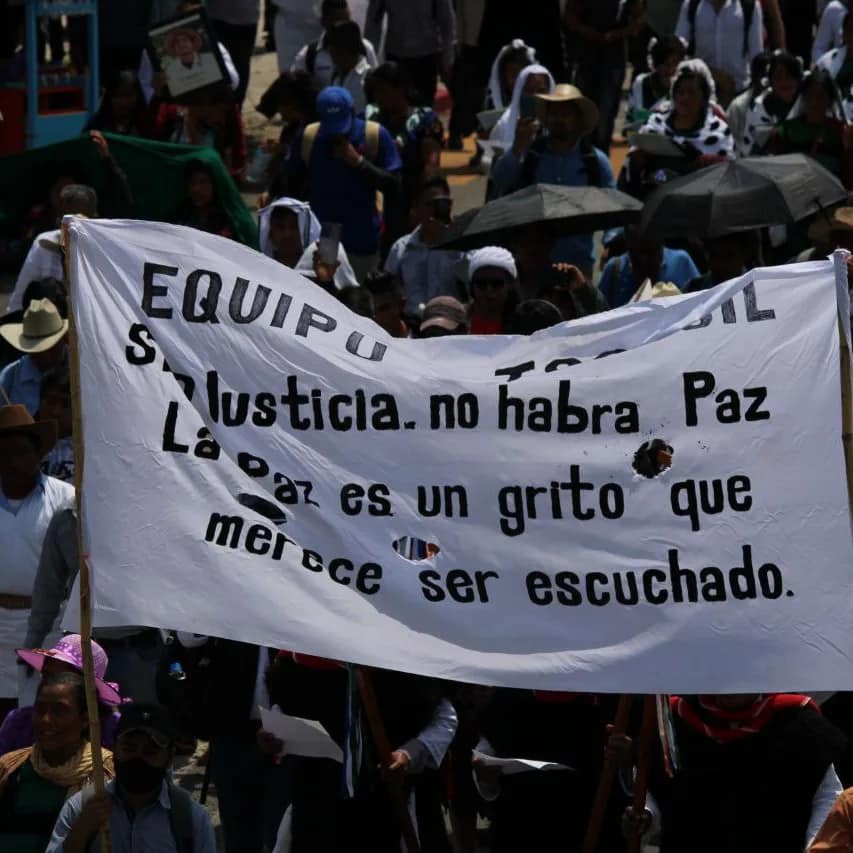
Finally, from the organizations that signed this statement, we give our full support to the indigenous community Tsotsil de Tzajalchen that on August 24 declared that their community is and will be the “Civil Camp for Peace, The Pilgrims of Tzajalchen, Chenalho Chiapas, Mexico.” We demand that all three levels of government respect this decision in order to protect this camp as a safe space for those fleeing violence.
Source: desinformemonos