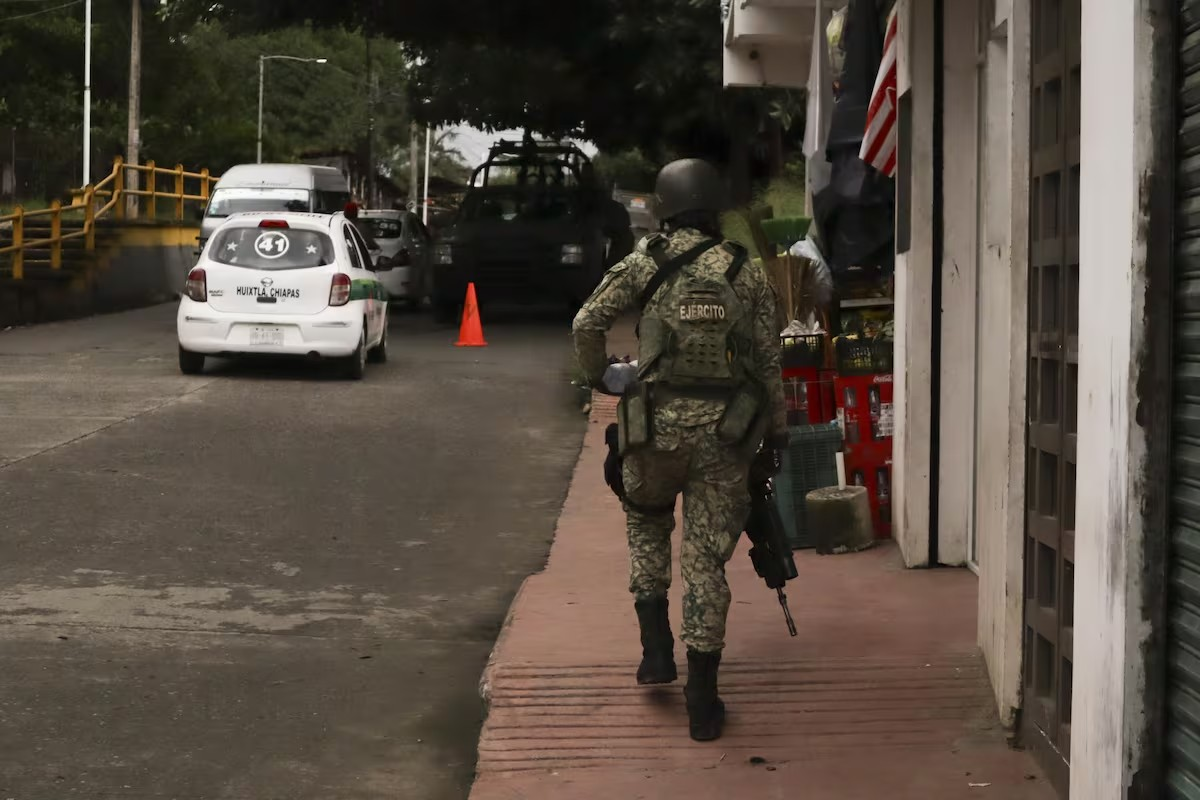

After two days of silence, the Attorney General’s Office (FGR) has closed ranks with the Army. The Public Ministry has supported, in a statement with hardly any new information released this Thursday, the version of the Ministry of National Defense (Sedena) on the massacre of six migrants committed by the military on Tuesday in southwest Chiapas. According to the account of both agencies, the soldiers were patrolling the rural highway that connects the municipalities of Villacomaltitlán and Huixtla in search of possible drug and human traffickers when they spotted three vans packed with people from Asia, Africa and Latin America who, upon seeing the soldiers, fled. In the first statement, published almost 24 hours after the massacre, the Sedena claimed that its troops heard “two explosions,” without further explanation, and therefore opened fire on the vehicles. Six people were shot.
The Prosecutor’s Office has expanded on the Army’s original account and argues that the soldiers were attacked first during the chase and for that reason they fired at the trucks: “The Sedena was alerted about armed people; for which reason it went to federal highway number 200, near the city of Tapachula, where they found three vehicles, whose people on board, upon seeing the authority personnel, fled, despite having been ordered to stop, ignoring said order that is mandatory in the face of an act of authority. In the pursuit of said vehicles, the military personnel report that they were attacked by their crew members; and, therefore, they repelled the attack, stopping a green pickup truck, while the other two vehicles fled [SIC].”
The president, Claudia Sheinbaum, has assured this Thursday that the two soldiers accused of the massacre were placed under the control of the FGR. However, the organization has qualified the president’s statements hours later: “The military personnel are currently under arrest and investigation by their own authorities. For its part, the Specialized Prosecutor’s Office for Human Rights (FEMDH), of the FGR, immediately sent a contingent of agents of the Public Ministry, police, experts and psychologists to Tapachula, to carry out all the necessary procedures. The Sedena elements will be interrogated by the Federal Public Ministry (MPF), in the course of this day [Thursday].” Hours later, Sheinbaum appeared before the Army, which has sworn loyalty to the new head of state, sworn in on the same day the massacre occurred.
A group of 33 migrants were travelling hidden in the back of cattle trucks. According to the Sedena, they were of “Egyptian, Nepalese, Cuban, Indian, Pakistani and Arab nationality.” A military spokesman told this newspaper that “Arab nationality” (which is not a nationality, but a language) was referring to citizens of Saudi Arabia, an oil-rich country not accustomed to using Mexican migration routes. Sheinbaum later said that the victims came from Egypt, El Salvador and Peru: the last two, nationalities that did not appear in the original count by the military. The FGR statement adds that three of the victims came from Egypt, another from Peru and one more from Honduras, without clarifying the citizenship of the sixth. “Most of the injured and unharmed people have been identified as citizens of Cuba, Nepal, Pakistan, India and Egypt; “For this reason, the corresponding consulates are being asked for their presence and support for this investigation, as well as for the assistance of the victims,” says the agency.
Images taken with a mobile phone of the crime scene reveal a massacre: human bodies piled in the back of a blood-stained truck, covered by black garbage bags that they used to protect themselves from the rain. The coyote who was driving the vehicle had fled when the soldiers arrived, who found four dead (two more would die in the hospital later) and dozens of people in shock, between tears and cries for help. “The National Institute of Migration (INM) has been urgently requested for all the information it has on the matter; and the corresponding authorities have been asked to identify the license plates of the State of Mexico that the stopped truck carried,” said the FGR, which has also requested collaboration from Interpol and “international legal assistance from the Republic of Guatemala, to obtain data from that country, which can be linked to this investigation.”
The Prosecutor’s Office has also maintained that “consultative” and psychological assistance will be provided to the migrants who were injured and those who emerged “unharmed.” The statement from the Public Prosecutor’s Office barely provides new information about the massacre, beyond the correction of the identity of the victims and the fact that one of the trucks in which they were traveling had a license plate from the State of Mexico. Sheinbaum, who took two days to comment on the massacre, has declared that it was a “regrettable event and it has to be investigated and sanctioned”: “A situation like this cannot be repeated. Measures are being taken.”
Morena, the party of the new president and her predecessor until Tuesday, Andrés Manuel López Obrador, has been harshly criticized in recent years for granting more power to the Army in civil tasks, such as immigration control at borders and airports, in the face of repeated criticism from the opposition, academia and various civil society groups. On September 25, the Senate also approved that the National Guard, which was born as a civilian body, would be placed under the control of the Sedena, a controversial measure achieved in the last minute of the López Obrador government thanks to the majority obtained by Sheinbaum on June 2.
The new massacre of migrants committed by the Army has once again sparked criticism against the ruling party. The Sedena, an institution famous for its opacity in the management of internal affairs, has barely provided information. Reports and studies in recent years have already argued that the use of military personnel at the borders to contain migration results in human rights violations.
Source: elpais