
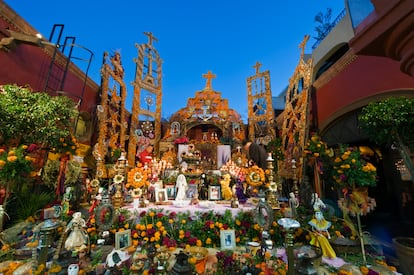
Mexico has a new star export product. The Day of the Dead and the multi-sensory storm that accompanies it, where cempasúchil flowers, papel picado and pan de muerto abound, has crossed borders and is gaining more and more popularity abroad. Although the phenomenon is more evident in the United States and Western Europe, countries such as Australia celebrate festivals and exhibitions dedicated to Mexican tradition. Year after year, global fashion and footwear brands launch special collections alluding to the Day of the Dead, while the painted faces of catrinas and skulls sneak in among the costumes in those latitudes where Halloween is celebrated.
For Ana María Salazar, a tourism anthropologist at the UNAM Institute of Anthropological Research, the rise of the Day of the Dead dates back a couple of decades, when the tourism promotion campaigns promoted by the State began to pay special attention to historic centers and thus, to “activate these cultural assets as economic resources for tourism.” With the focus on promoting traditional festivities as an attraction for visitors, the tourist promotion of the Day of the Dead was an almost natural step. “The way we develop, express and signify the Day of the Dead draws the attention of the rest of the planet,” explains the expert, emphasizing that Mexico “is not the only place where acts of memory about ancestors are carried out.” During the last years of the 20th century, places such as the island of Janitzio (Michoacán) or the town of Mixquic (Mexico City) were positioned as ideal destinations to experience the Day of the Dead festivities up close.
Spectre and the scene that inspired a tradition
The next big leap after the promotion of tourism came from the entertainment industry. In March 2015, the production of the new 007 film, Spectre, chose the Historic Centre of Mexico City to film the opening sequence of the film. For five minutes, James Bond (Daniel Craig) sneaks between giant skeletons and a crowd with painted faces that festively walks through the streets of the centre of the capital. The fictional festival, presented on screen as a typical Day of the Dead parade, jumped from fiction to reality after a year: in October 2016, the capital’s Tourism Secretariat announced the first Day of the Dead parade.
The mass event, openly inspired by the scene from Spectre, brought together 250,000 people among floats and models made for the filming of the film. Since then, Paseo de la Reforma has been the scene of a carnival broadcast on open television every year. According to the capital’s government, the last edition of the parade, held in October 2023, attracted more than a million attendees.
Formula 1 and the whim of the calendar
The inertia of Spectre was compounded by the return of Formula 1 to Mexico after 23 years of absence. The logistics of the calendar forced the Mexican Grand Prix to be scheduled during the final stretch of the season, when the top category of motorsport lands in America for its few races on the continent. The edition that marked the return of Formula 1 to the country was therefore scheduled for November 1, 2015.
Faced with an event of such magnitude held in the country’s capital, both sponsors and organizers found in the Day of the Dead an unbeatable opportunity to present Mexico’s traditions to the eyes of the world. The first helmet of Checo Pérez, host driver at the Mexican Grand Prix, was inspired by sugar skulls. Two years later, in 2017, the theme of the opening ceremony was the Day of the Dead and for the 2018 edition, a group of giant alebrijes paraded around the Hermanos Rodríguez Racetrack before the race. Nine editions later, cempasúchil, charros dressed as skulls and catrinas are recurring motifs at the Mexican Grand Prix, always held on the last weekend of October.
The Coco Effect
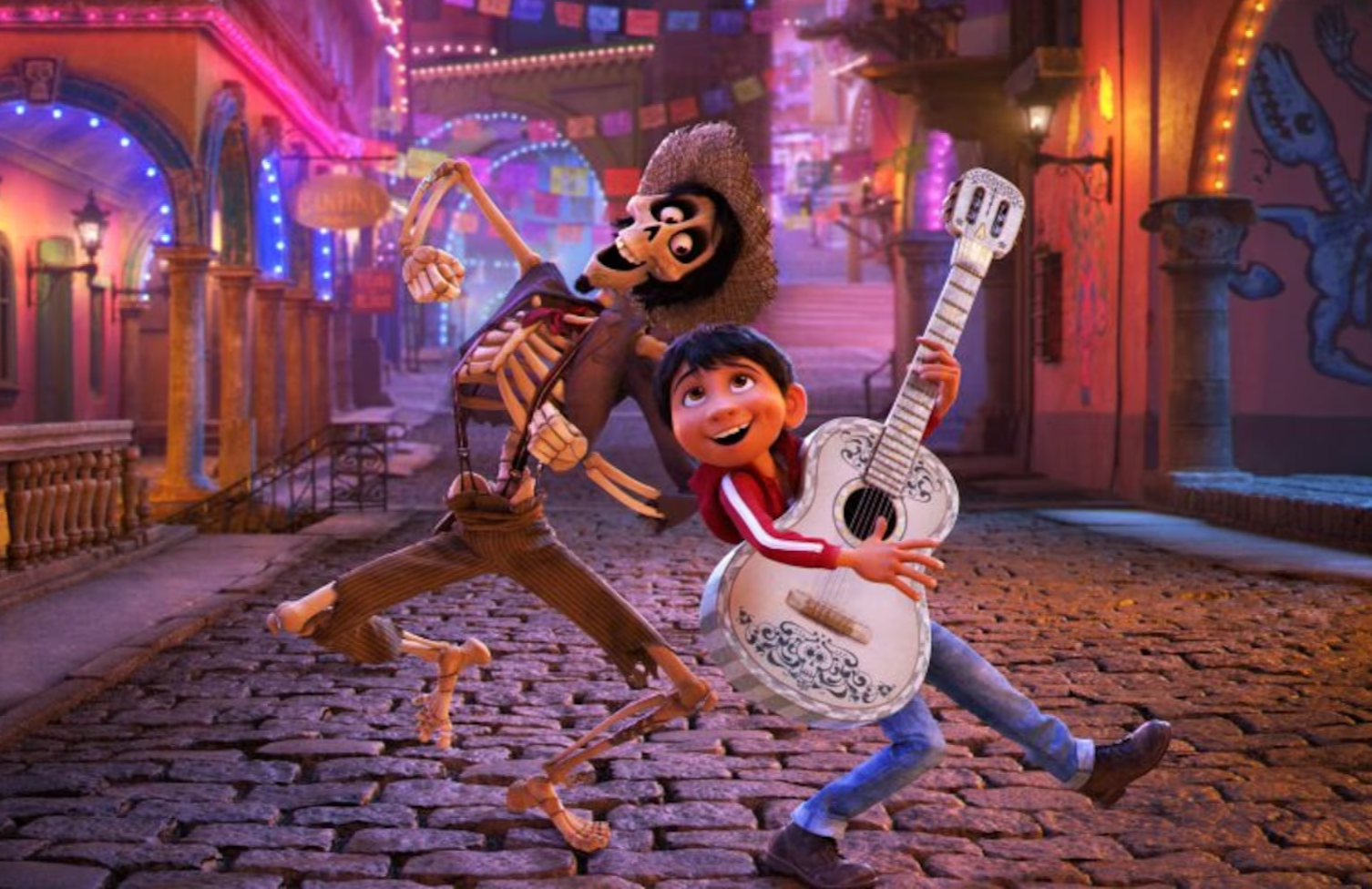
The definitive push to position the Mexican tradition worldwide came from Disney with the release of Coco in October 2017. The Pixar film inspired by the Day of the Dead, one of its most ambitious projects and the first from the animation studio to tell a story beyond the American cultural horizons, brought papel picado, cempasúchil flowers, alebrijes and the Day of the Dead to thousands of movie theaters around the world. The film, which faced a timid boycott during its premiere at the Morelia International Festival in 2017, became the most viewed in the history of the country.
The Coco effect also accelerated the adoption of the Day of the Dead in the United States, a process that began in the 1970s with the help of Chicano artists and activists, who introduced this commemoration in cities with the largest population of Mexican origin. In 2021, the Joe Biden administration placed the first ofrenda installed in the White House in commemoration of the Day of the Dead. One of the most notable effects of the animated film is the adoption of ofrendas and costumes related to the film during Halloween celebrations in the United States. “Our celebrations have also influenced those of Halloween in the global north. Now we are being ourselves, exporting our culture to all those spaces where our migrants, our compatriots also carry the local culture and reproduce it there,” explains Salazar.
Day of the Dead fever conquers the market
In 2024 alone, Adidas, Converse, Puma and Timberland launched shoe collections related to the Day of the Dead, as did the American fashion firms Levi’s and American Eagle. This fall, Starbucks also launched a collection of glasses and cups introduced in 2019 in America and Western Europe; as did the Swiss watchmaker Swatch and the French luxury brand Vilebrequin.
“Day of the Dead celebrations lend themselves to being activated for the consumption of visitors and recreating scenes from films such as Spectre or Coco; even going from fiction to reality through the invention of traditions such as the Day of the Dead parade,” explains Salazar in this regard. The anthropologist highlights that although there are no completely pure and authentic traditions, since “everything in culture is dynamic and changing,” the global fame of the Day of the Dead also brings with it a risk inherent to its popularization: the homogenization of a tradition that since pre-Hispanic times has varied according to the region where it is commemorated, with demonstrations that combine ritual acts of memory with a vast production of popular art. “We must sensitize the national population and visitors that they are before an important cultural expression,” she asserts. “We have a very rich heritage to safeguard for future generations.”
Source: elpais