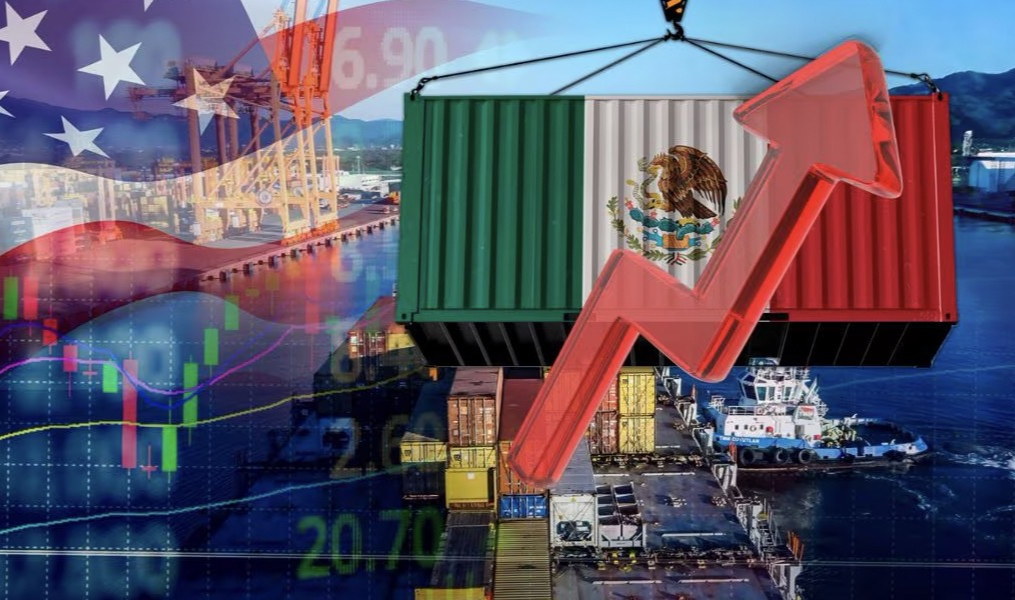

The depreciation of the peso is due to two factors:
A correction, after gaining for four consecutive sessions, accumulating an appreciation of 29.5 cents or 1.43% in that period. Low liquidity is expected in today’s session, since the financial markets in the United States will be closed for President’s Day.
The Mexican peso is the most depreciated currency today, since the risk persists that the United States will: 1) impose tariffs on steel and aluminum imports starting March 12, 2) implement tariffs on general imports from Mexico and Canada starting March 4, and 3) announce tariffs on automotive imports.
Although these threats are seen mainly as a negotiating strategy by Trump, they are still a risk for Mexico. Just last Friday, Donald Trump indicated that tariffs on automotive imports could begin on April 2. It is worth remembering that 26.7% of Mexico’s GDP is explained by exports to the United States.
The Japanese yen rose 0.54% and is trading at 151.48 yen per dollar, ranking as the most appreciated currency today, due to the fact that yesterday, Sunday, the GDP for the fourth quarter was published at an annualized rate of 2.8%, far exceeding the expectation of 1.1 percent. Although growth for the entire year was only 0.1%, the fourth quarter’s boost increases the probability that the Bank of Japan will raise the interest rate again. The next monetary policy announcement by the Bank of Japan will be on March 18. It is worth remembering that, by raising the interest rate in Japan, the attractiveness of maintaining carry trade positions in favor of the Mexican peso is reduced, generating upward pressure on the exchange rate.
The dollar remains stable and shows an advance of 0.05% according to the weighted index, after losing 0.97% in the previous week. The most depreciated currencies are: the Mexican peso with 0.37%, the Russian ruble with 0.33%, the Chilean peso with 0.29%, the Czech crown with 0.27%, the South African rand with 0.23% and the Swiss franc with 0.20 percent. The most appreciated currencies today are: the Japanese yen with 0.54%, the Indonesian rupiah with 0.28%, the Taiwanese dollar with 0.21%, the Australian dollar with 0.19%, the New Zealand dollar with 0.17% and the pound with 0.07 percent.
Other risks persist that could generate volatility in the exchange rate. Over the weekend, reports began to circulate in the media that on Wednesday, February 19, the United States Department of State could declare Mexican cartels as terrorist organizations. This could intensify tensions with the Mexican government.
The capital market shows gains among the main stock market indices globally. In the Asian session, the Japanese Nikkei registered an increase of 0.06%, gaining in 4 of the last 5 sessions. For its part, the CSI 300 in Shanghai showed an advance of 0.21%, linking 2 sessions on the rise, closing at its highest level since December 30, 2024. In Europe, the STOXX 600 registered a gain of 0.46%, reaching a new historical high in the session of 554.99 points. The German DAX shows an advance of 0.89%, also touching a new historical high of 22,725.54 points. For its part, the French CAC 40 gained 0.06% and the London FTSE 100 advanced 0.22 percent. In the US futures market, the Dow Jones recorded a gain of 0.17%, the Nasdaq 100 advanced 0.23% and the S&P 500 gained 0.20 percent. However, these markets will remain closed today.
During the week, the market will be attentive in the United States to the Federal Reserve’s monetary policy minutes on Wednesday the 19th. In Mexico, tomorrow Tuesday the timely indicator of economic activity for January will be published, which will allow us to know the growth in the first month of the year. This is relevant, since in the last quarter of 2024 a quarterly fall in GDP was recorded and the INEGI cyclical indicators suggest that Mexico is in a recessionary phase of the business cycle. On Wednesday, February 19, the Bank of Mexico’s quarterly inflation report will be published, and on Thursday, February 20, the monetary policy minutes will be published. Finally, on Friday, February 21, the revision of the GDP for the fourth quarter of 2024 and the IGAE for December will be published.
Moving on to economic indicators, the Monthly Survey of the Manufacturing Industry (EMIM) for December 2024 was published in Mexico, showing that the number of personnel employed in manufacturing industries grew by 0.01% monthly, after four consecutive months of contraction. At an annual rate, the number of people employed in manufacturing industries showed a decrease of 1.66%, accumulating 22 consecutive months of annual contractions, something that had never happened since the series began in 2007.
At an annual rate, the number of people employed in 13 of the 21 subsectors of the manufacturing industry showed contractions, highlighting: manufacturing of textile inputs and textile finishing (-8.91%), manufacturing of furniture, mattresses and blinds (-7.45%), manufacturing of clothing (-7.16%), tanning and finishing of leather and skin, and manufacturing of leather, skin and substitute materials products (-6.63%), basic metal industries (-4.46%) and manufacturing of transport equipment (-4.36%, the highest since October 2020).
As regards the indicator of real wages per man-hour worked, in December there was an increase of 4.69% annually, accelerating compared to the rate of 3.53% recorded in November, according to original figures.
Finally, the capacity utilization (CPU) in the manufacturing sector had a decrease of 3.40 percentage points (pp) in December, the largest monthly drop since June 2024. Since the series is not adjusted for seasonality, the most informative calculation on the trend is the annual variation. The CPU shows a decrease of 0.60 pp in December compared to December 2023, accumulating two months of contractions. The sectors that showed the greatest contraction in their CPU from December 2023 to December 2024 were leather and skin tanning and finishing, and manufacturing of leather, skin and substitute materials products (-7.10 pp), manufacturing of computer equipment (-4.80 pp), manufacturing of textile products, except clothing (-4.00 pp), basic metal industries (-4.00 pp), and manufacturing of products based on non-metallic minerals (-2.70 pp).
During the session, the exchange rate is expected to trade in a range between 20.31 and 20.49 pesos per dollar.
Money Market and Debt
In the United States, the rate on 10-year Treasury notes remains unchanged due to the commemoration of President’s Day.
Derivatives Market
To hedge against a depreciation of the peso beyond 21.50 pesos per dollar, a call option with an exercise date within 1 month has a premium of 0.79% and represents the right, but not the obligation, to buy dollars at the aforementioned level.
On the other hand, the interbank forward for sale is at 20.4390 at 1 month, 20.8564 at 6 months and 21.3157 pesos per dollar at one year.
Source: realstatemarket