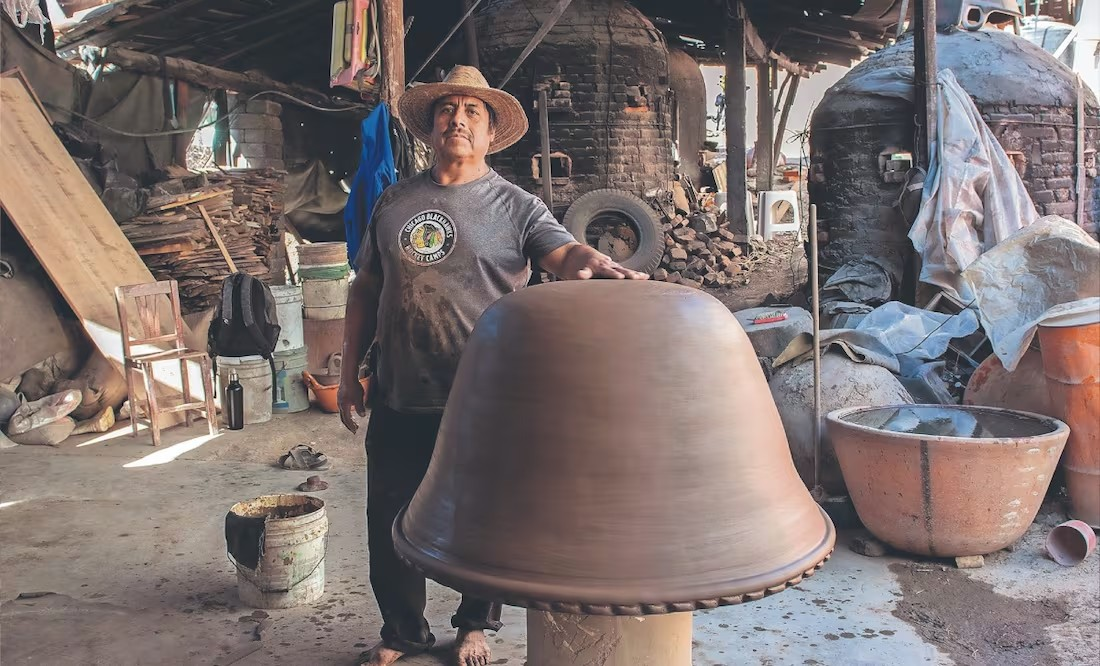

A clay pot made by Abdías Solano can hold up to 40 kilos of mole. The potter, originally from La Trinidad Tenexyecac, in the state of Tlaxcala, has dozens of pieces of different sizes ready to be fired. In the process, which is done twice, he must join forces with his wife Luisa Juárez and children because of the exhausting days; together they are in charge of loading their traditional oven and feeding it with firewood for a period of between eight and 12 continuous hours, enduring the high temperatures and the smoke that darkens their family workshop.
This is what all the artisans of this community have done for 150 years, who have losses in each firing, suffer burns in their eyes and hands, breathe for long periods of time the fumes of the lead with which they enamel and of the flammable materials – such as scraps of fabric and petroleum derivatives – that some use as fuel.
“For years we have asked for support to improve our health and the quality of our work—which is what sustains 120 families in La Trinidad—because it is from clay that we have survived, from which we have food and shelter, but we had never been given it.”
The National School of Ceramics (ENC) arrived at the Solano Juárez workshop with a technical innovation that promised to change that reality: a non-polluting wood-burning oven to encourage the social, environmental and economic development of the town, in order to raise the quality of life of the potters.
“Almost three years ago we came to La Trinidad for the first time to visit the workshops, learn about their problems and evaluate the viability of the project, at the invitation of the doctor Cuauhtémoc Juárez, who seeks to help the artisans eliminate the use of lead in the glazing of the pots,” says David Aceves Barajas, director of the ENC.
The project did not materialize, but thanks to the collaboration of Industrias Tajín, the Diez Morodo Foundation and the National Council of Humanities, Sciences and Technologies (Conahcyt) in December of last year the first kiln of this type was built in the state.
“The design is Japanese and has been adapted by the ENC to the needs of Mexican pottery,” adds Aceves Barajas.
Its main characteristic, he explains, is that it eliminates smoke inhalation and the exposure of artisans to direct fire; its structure will allow them to use half the wood required in a normal burn and have a better distribution of internal heat, which reduces the number of pieces that are damaged during firing.
After the construction, in which potters from Españita and Tzompantepec were also trained —where two more kilns were inaugurated in February of this year—, the ENC offered workshops on costs, design, marketing and packaging, as well as lead-free glazes, to more than 25 people to strengthen the artisanal development of the state.
Albadelia Solano, 30 years old, hopes that this kiln represents a real change in the pottery process and that it increases the initiative in young people to continue working in the trade, since, she assures, most have dropped out due to the low cost of crafts.
“Everyone knows a pot, a jar, but no one knows the effort that goes into making a piece, from the smallest to the largest. It is a very long and heavy process due to the physical work involved. I dream of being paid fairly,” says Abdelia.
Source: eluniversal