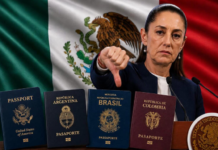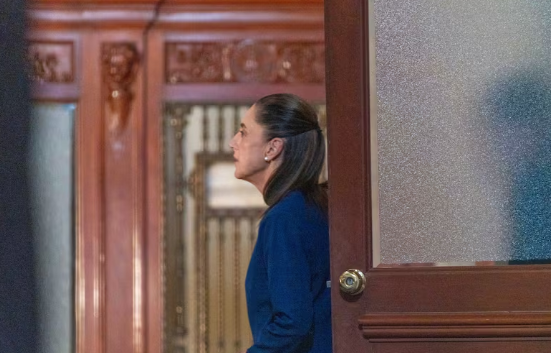

President Claudia Sheinbaum stated that it is very difficult for the far right to establish itself in Mexico, even as the geopolitical landscape in Latin America shifts toward conservatism following the recent victories of right-wing presidential candidates in Peru and Colombia.
The president said it is important to pay attention to developments in other parts of the world and to work hard in order not to disappoint the people. She made these remarks in response to a question about whether she sees a risk of Mexico following a path similar to that of Colombia, Ecuador, Argentina, and other countries where the far right has returned to power.
“Mexico’s history is unique. It is very difficult for the far right to take root in our country,” declared the left-wing politician during her morning press conference.
The Legacy of López Obrador and the “Mexican Humanism” Project
Sheinbaum argued that the advance of the right in Mexico is unlikely because, with the arrival of Andrés Manuel López Obrador to the presidency in December 2018, the country reclaimed its history, and the people identified with Morena’s political movement, which AMLO called “Mexican Humanism.”
Sheinbaum said there is now a “brotherhood” between the government and the people that she can “never” betray, and therefore her actions will continue to be guided by honesty and by the transformation program.
“We must continue the revolution of consciousness,” said the president, who won the June 2, 2024 presidential election with 35.9 million votes (59.75%) as the candidate of the “Sigamos Haciendo Historia” coalition, made up of Morena, the Green Party, and the Labor Party.
Political Shift in Colombia
Right-wing candidate Abelardo De la Espriella won Colombia’s presidential election in a very close runoff on June 21, defeating left-wing Senator Iván Cepeda, who had been chosen by the governing coalition as the political successor to President Gustavo Petro.
The day after the election, during her morning conference, Sheinbaum did not immediately recognize De la Espriella’s victory and instead preferred to wait for the final vote count. On June 23, Petro called for an evaluation of whether the election should be annulled due to public support from U.S. President Donald Trump. However, on June 24, Cepeda officially recognized De la Espriella as Colombia’s new president.
The arrival of “The Tiger,” as De la Espriella is known, is part of the broader advance of a conservative wave in the region, supported by Trump, stretching from Argentina under President Javier Milei to Peru’s president-elect Keiko Fujimori.
Concerns About Social Media and Algorithms
During her morning conference, Sheinbaum also announced that after the 2026 World Cup she intends to open a “serious discussion” about social media platforms and “the famous algorithms,” arguing that these systems can confuse citizens through information manipulation.
Following his refusal to initially accept the election results, Petro posted on X about the use of algorithms during the electoral process, alleging that they could be used to compromise software systems and replace the voices of Colombian citizens.
Morena Expresses Support for Cepeda
Ariadna Montiel, national president of Morena, wrote on X on June 24, 2026, that the party stands in solidarity with Cepeda and condemned what she described as “alarming and blatant” foreign interference in the Colombian election.
“We are deeply concerned about the dangerous advance of a far right that comes with promises to dismantle hard-won social rights, threaten peace, deepen inequalities, and surrender sovereignty,” she stated.
Morena’s National Assemblies and the Road to 2027
On June 7, 2026, Morena launched a series of informational assemblies called “In Defense of Transformation and National Sovereignty.” The goal is to hold 2,600 assemblies across the country aimed at countering what the party describes as misinformation and narratives against the Fourth Transformation, amid accusations from the United States linking some Morena politicians to drug trafficking.
Mexico will hold federal midterm elections on June 6, 2027, which will be a key test of strength between Morena and the opposition ahead of the 2030 presidential election.
In the 2027 elections, all 500 seats in the Chamber of Deputies will be renewed. Additionally, 17 states will elect new governors, local legislatures, and more than 1,000 municipal governments.
Source: bloomberglinea