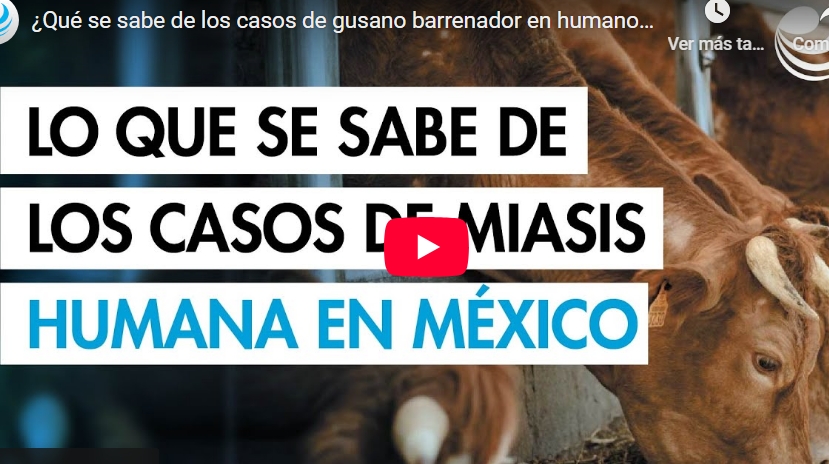

The Ministry of Health confirmed two cases of human myiasis caused by the screwworm (Cochliomyia hominivorax) in Chiapas, while no human infections have been reported to date in Oaxaca.
The screwworm is a larva of the fly Cochliomyia hominivorax, which lays its eggs in open wounds of animals and, rarely, in humans.
The larvae feed on living tissue, causing an infection known as myiasis. Although the plague was eradicated in Mexico in 1991, it reappeared two years ago in Panama and has spread to other Central American countries and southern Mexico.
Infections in Chiapas
The first human case was detected in March of this year, in a 77-year-old woman from the municipality of Acacoyagua, who suffered a fall that caused a head injury. She did not receive immediate medical attention and, days later, after developing a fever, she was diagnosed with myiasis. For treatment, she was transferred to the Ciudad Salud Regional High Specialty Hospital in Tapachula.
The second incident involved a 50-year-old man, a resident of the municipality of Tuzantán, who was bitten by a dog on his left leg. The wound was not treated promptly, and four days later, the patient noticed the emergence of larvae, accompanied by intense pain, redness, and fever. He was treated at the Huixtla Health Center, where six larvae were removed.
Case in Oaxaca
To date, no cases of human myiasis have been reported in Oaxaca. However, health authorities are maintaining active epidemiological surveillance after detecting an infection in an equine located in the municipality of Matías Romero Avendaño.
Preventive Measures
Between November 2024 and April 2025, the National Service for Health, Safety, and Agrifood Quality (Senasica) confirmed 869 cases of myiasis in animals in southeastern Mexico, with Chiapas being the most affected state with 487 cases, followed by Tabasco, Campeche, Quintana Roo, Yucatán, and Oaxaca.
In response, health authorities recommend:
Maintain proper personal and pet hygiene.
Promptly treat any wounds.
Report suspected cases of myiasis in humans or animals to health authorities.
Avoid direct contact with infested animals or those with open wounds.
Source: eleconomista