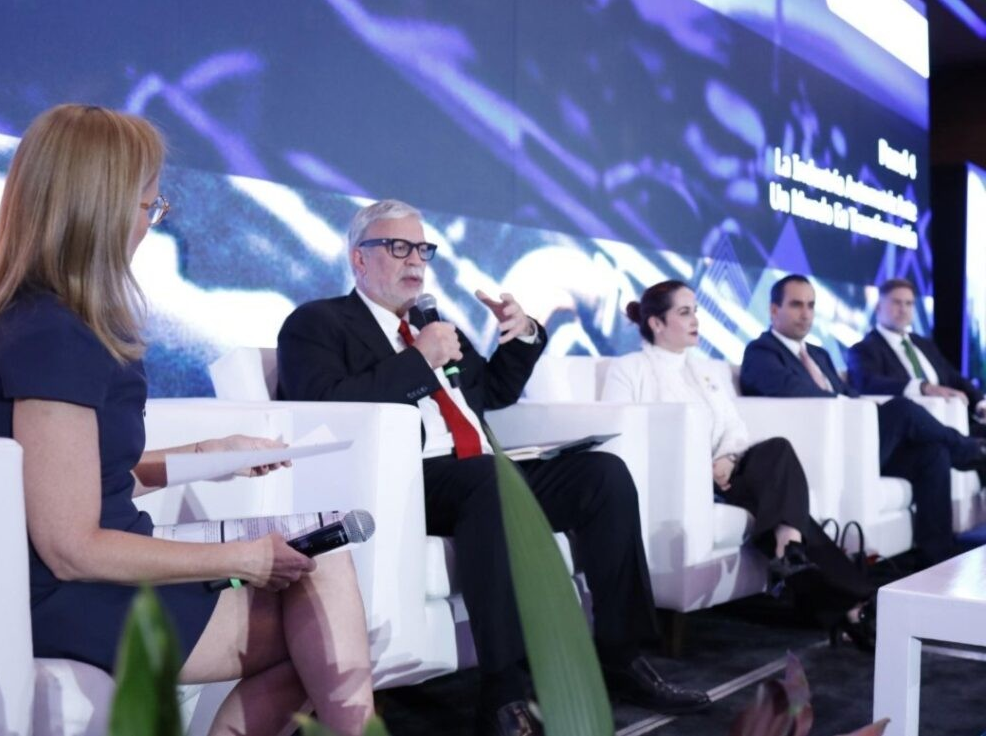

Industry Leaders Warn of Structural Challenges at Mexico-EU Business Summit
During a panel at the Mexico-European Union Business Summit, automotive industry representatives warned that while the modernized trade agreement opens new doors, Mexico still faces deep structural challenges to fully capitalize on this momentum.
“This Agreement Provides Certainty and Allows for Long-Term Planning”
Joaquín Álava Quintanilla, Director of Public Affairs for Stellantis Mexico, noted that the current international landscape is forcing companies to rethink their production chains and diversify markets due to technological shifts and geopolitical conflicts.
He pointed out that the company—born from the merger of Fiat Chrysler and Peugeot—sees clear opportunities to both strengthen the domestic market and expand its export footprint from Mexico.
“The geopolitical context directly influences investment decisions. This agreement provides certainty and allows for proper planning,” he stated.
BMW: Stability and Energy Supply Are Crucial for Growth
Carlos Juan Molker, CEO of BMW Mexico, recalled that the German automaker bet on Mexico a decade ago because of its industrial expertise, skilled workforce, and preferential access to multiple international markets.
He detailed that BMW has invested over $2 billion in its Mexican plant, currently generating more than 3,700 direct jobs and thousands of indirect positions across its supply chain. However, he warned that maintaining competitiveness will require:
- Regulatory stability to secure long-term investments.
- Guaranteed access to energy and strategic resources.
- Increased development of specialized talent to support the transition to sustainable mobility.
Talent, Rule of Law, and Clear Rules: Sector Demands
The panel concluded with a consensus that signing the agreement is just the beginning of a new chapter in global competition for the automotive sector. Industry leaders stressed the urgent need to strengthen the rule of law, streamline commercial dispute resolution mechanisms, and bolster technical training for youth to meet the rising demand for highly skilled personnel.
A representative from the Ministry of Economy assured that the government aims to drive innovation, technological development, and human capital training to sustain the country’s manufacturing leadership.
Reducing Dependence on China
| Strategic Goal | Action Plan |
| Supply Chain Relocalization | Position Mexico as an advanced manufacturing hub as the US and Europe look to decouple from China-linked supply chains (specifically in EVs and batteries). |
| Alignment with ‘Plan México’ | Integrate these efforts with President Claudia Sheinbaum’s “Plan México” to attract high-value-added investments. |
| Import Substitution | Transition production of vehicles like the General Motors Aveo (currently imported) to local manufacturing, aiming to substitute up to 80,000 imported units by 2029. |
Auto Parts and Electromovility: The Next Big Frontier
Francisco González, representing the national auto parts industry, highlighted that Mexico remains a global powerhouse in component exports, with sales exceeding $106 billion.
He explained that aligning regulatory and safety standards with Europe will streamline Mexican exports and deepen integration into EV value chains.
“The strongest growth will come from components for electric vehicles, batteries, and advanced technological systems,” González noted.
He concluded by emphasizing that mastering traceability, sustainability, circular economy practices, and access to strategic minerals will be the ultimate prerequisites for Mexico to compete in the next era of the global automotive industry.

Source: revistafortuna