
The white sand stretches for miles where the Pacific Ocean waves crash against the shore. Nearby, bicycles lean against beachfront cabanas, highlighted by banana and palm trees. A rickety wooden pier offers spectacular views of pink sunsets over the water.
The Times A daily selection of stories in Spanish you won’t find anywhere else, with ñs and accents. Get it sent to your inbox.
At first glance, Imperial Beach, California, is an idyllic beach town, a playground for both tourists and residents of Southern California, on the southern border with Mexico.
But lately, the view has been spoiled by the sea breeze, which reeks of rotten eggs. The surfers who once prepared for big-wave competitions are gone. Nor are the tourists who built intricate sandcastles and licked ice cream cones on the pier.
Imperial Beach is now the center of one of the country’s worst environmental disasters: every day, 189 million liters of raw sewage, industrial chemicals, and trash flow from Tijuana, Mexico, to southern San Diego County.
This transnational problem dates back at least a century. But it has worsened significantly in recent years, as Tijuana’s population has exploded and wastewater treatment plants in both countries have deteriorated.
“It’s a public health time bomb that isn’t being taken seriously,” said Paloma Aguirre, mayor of Imperial Beach. “We need help.”
The Imperial Beach coastline, which has attracted tourists for more than a century, has been closed for more than 1,200 consecutive days due to health concerns.
Several surfers leaning on their boards above the ocean and waves. A beach, several buildings, and palm trees are visible in the background.
At first glance, Imperial Beach is an idyllic coastal town, a playground for both tourists and residents of Southern California, on the southern border with Mexico.
A river runs alongside a busy freeway.
Every day, 189 million liters of raw sewage, industrial chemicals, and trash flow down the Tijuana River from Tijuana, Mexico, to southern San Diego County.
A growing body of research suggests that even breathing the air can be harmful, as toxic particles in the water can become airborne. There are no immediate solutions, and officials on both sides of the border say it will take years of wastewater treatment plant expansions to stem the pollution.
More than 1,100 Navy recruits have contracted gastrointestinal illnesses after training in waters south of San Diego, the Office of the Naval Inspector General has determined. And nearly half of the region’s 40,900 households have experienced health problems, including migraines, rashes, and shortness of breath, most likely attributable to the sewage, according to the U.S. Centers for Disease Control and Prevention.
The situation has become so desperate that when Lee Zeldin, President Donald Trump’s new Secretary of Environmental Protection and a former Republican congressman, arrived last month, even local Democrats applauded him. On Earth Day, Zeldin came to Imperial Beach and promised to urgently address the sewage problem, which he said was a “priority” for Trump.

“We’ve run out of patience,” Zeldin said.
The crisis has upended life in southern San Diego County—what locals call South County—which has an unusual mix of coastal tourist towns and industrial warehouses. The region is defined by its border with Mexico, where Spanish and English flow interchangeably and the densely populated hillsides of Tijuana loom in the distance.
But South County residents have felt powerless in the face of the complex international dynamics that have allowed so much raw sewage to flood their neighborhoods.
“We want to be able to survive,” said Jesse Ramirez, 60, who has owned a skate and surf shop on Imperial Beach’s main drag for three decades. On a recent morning, typically the start of the tourist season, his shop was completely empty.
A yellow sign reading “Keep Out of the Water” sits on a stretch of sand near the shore and pier. Several people walk in the distance near the water.
The Imperial Beach shoreline, which has attracted tourists for more than a century, has been closed for more than 1,200 consecutive days for health reasons.
A restaurant with a dark blue ceiling has a curved bar with purple stools.
The crisis has dramatically changed life in southern San Diego County—what locals call South County—which has an unusual mix of coastal resort towns and industrial warehouses.
Imperial Beach, known to locals as IB, was never as glamorous as the wealthy coastal spots farther north. It takes its name from Imperial County, an inland region where farmers once came each summer to escape the sweltering heat.
The city has long been a working-class community, and its nearly four miles of shoreline have served as a town square in the southwest corner of the continental United States.
Not long ago, surfers rode the world-famous waves of Tijuana Sloughs, the city’s southernmost beach. Locals walked their dogs on the warm sand and enjoyed the sea breeze and slinging beer on outdoor patios.
But so-called extreme odor events occur most nights. Tests have found a disturbing amount of contaminants in the water, including arsenic, heavy metals, hepatitis, E. coli, salmonella, banned pesticides like DDT, and others.
“We have watched in horror as the amounts of wastewater have increased catastrophically,” said Serge Dedina, a surfer and environmentalist who served as mayor of Imperial Beach from 2014 to 2022. “It has become a kind of collective mental health crisis.”
In the 1990s, in an act of binational cooperation, the United States built a plant on its side of the border to help treat Tijuana’s wastewater, which often reached San Diego beaches via northbound currents from Mexico. At the same time, Mexico also established a plant in Tijuana.
But those plants have not kept pace with the explosive population growth of Tijuana, one of Mexico’s fastest-growing cities. Some 2.3 million people now live in the city, spurred in part by U.S. companies that built factories there to provide cheap labor. Aging infrastructure and damage from turbulent rains have further reduced the amount of wastewater the plants can treat.

The sewage problem now extends to Coronado, a wealthy enclave known for the historic Hotel del Coronado, where rooms often cost $1,000 a night and which just completed a six-year, $550 million renovation.
Beaches there have also been forced to close, leading to fewer tourists booking accommodations, said John Duncan, the city’s mayor.
“My biggest concern as mayor is that the reputation of ‘Mexico’s toilet’ will start to take hold at some point and really hurt us,” Duncan said.
In addition to the sewage going directly into the ocean, nearly 38 million liters (10.5 million gallons) flow each day into the 193-kilometer Tijuana River, which originates in Mexico and winds north toward the United States before emptying into Imperial Beach, according to the U.S. International Boundary and Water Commission, which manages the U.S. treatment plant and is overseen by the State Department.
The river’s waste comes from factories, as well as from Tijuana’s slums that aren’t connected to the city’s sewage system. The river provides habitat for 370 bird species along the Pacific Flyway, a major migration route. But in recent years, it has essentially become an open sewer, running through San Diego’s southern neighborhoods and past schools, researchers say.
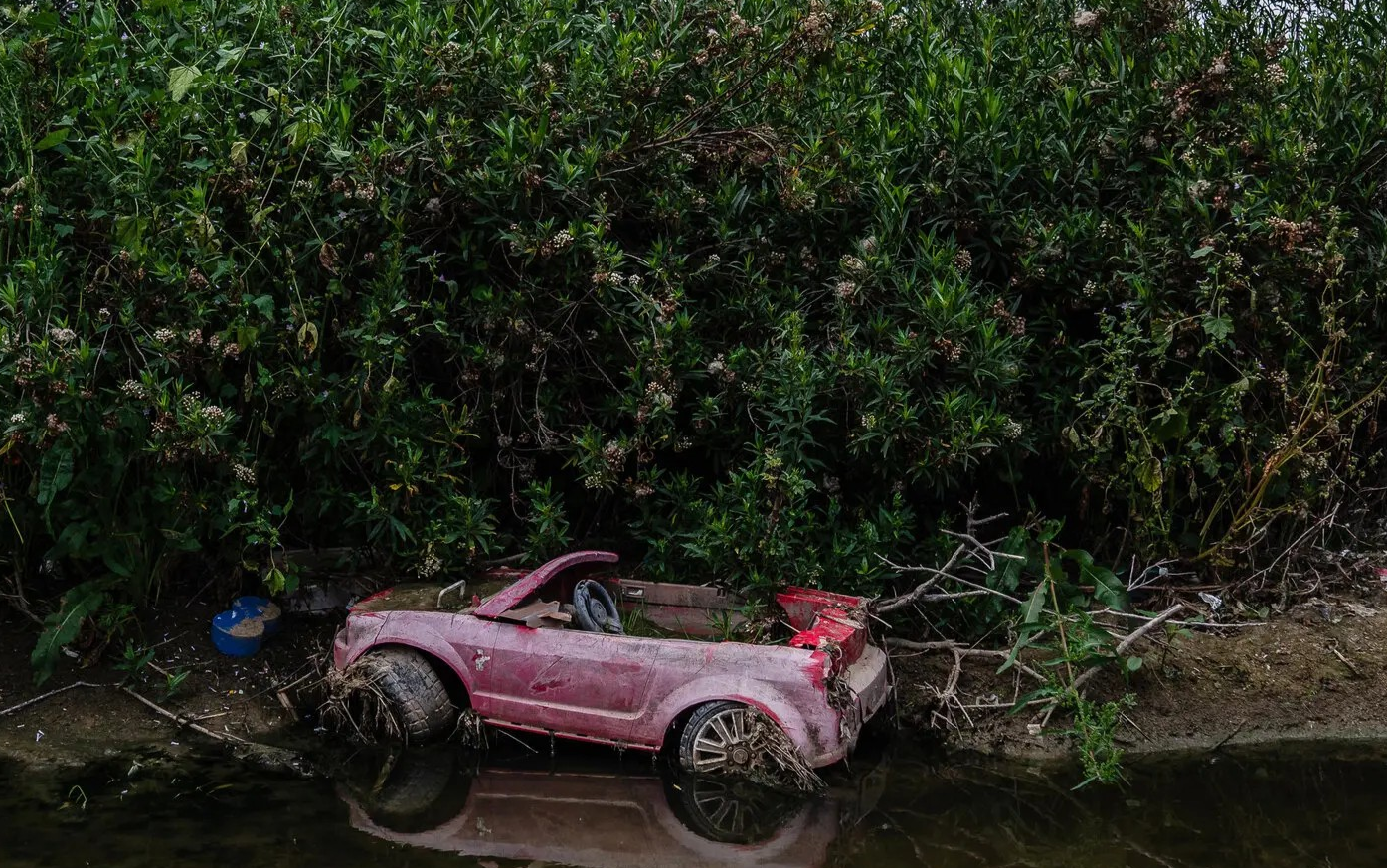
On a recent day, the Tijuana River’s water appeared fluorescent green and was flecked with scum, which scientists say is the product of industrial chemicals. Beneath leafy willows, discarded tires clogged the riverbed. Crushed milk jugs and scraps of clothing littered the muddy riverbanks. The stench of sulfur was pungent, even through a respirator mask.
Along the river, scientists have detected astronomically high levels of hydrogen sulfide in the air, which can cause headaches, fatigue, skin infections, anxiety, and respiratory and gastrointestinal problems. Residents have been complaining of these symptoms for years, said Paula Stigler Granados, a public health researcher at San Diego State University.
“I consider this to be the biggest environmental justice issue in the entire country,” Granados said. “I don’t know of any other place where millions of gallons of raw sewage are allowed to flow through a community.”
Dirty water in a drainage area
A culvert in Goat Canyon, at Border Field State Park. Many people are concerned that any changes to solve the sewage problem will take too long.
Advertisement
Tijuana River Valley Regional Park Campground in San Diego. Some short-term ideas that have been discussed include trying to treat river water before it reaches neighborhoods and providing air purifiers to residents. The U.S. Boundary Commission has secured $600 million to double its treatment capacity to 189 million liters per day, according to Frank Fisher, a spokesman. The Mexican plant is also working on repairs and expanding its capacity, he said.
Many are concerned that the changes will take too long: the expansion of the U.S. plant alone will take five years. Some short-term ideas that have been tossed around include treating river water before it reaches communities and providing air purifiers to residents.
Zeldin said when he visited San Diego in April that he was compiling a list of projects that would resolve the crisis sooner. He suggested building a funnel at the Mexican treatment plant that would send wastewater farther from shore.
Dedina, the former mayor of Imperial Beach, moved there when he was 7 and grew up surfing and lifeguarding. But in 2019, he surfed those waters for the last time, he said, and returned to shore despite the perfect 10-foot waves. That day, the water was too dirty.
“I just said, ‘I can’t do this anymore. I can’t go in the water,’” he recalled. “It’s like Russian roulette.” In 2022, Dedina moved Wildcoast, the environmental nonprofit he runs, out of Imperial Beach because his employees started complaining about toxic fumes. Then, last year, he and his wife moved to downtown San Diego, away from the stench. The health risks in their city had become too much.
“I miss the life I had,” he said. “Taking my surfboard, getting in the water. It’s over, and it’s tragic.”

Source: nytimes