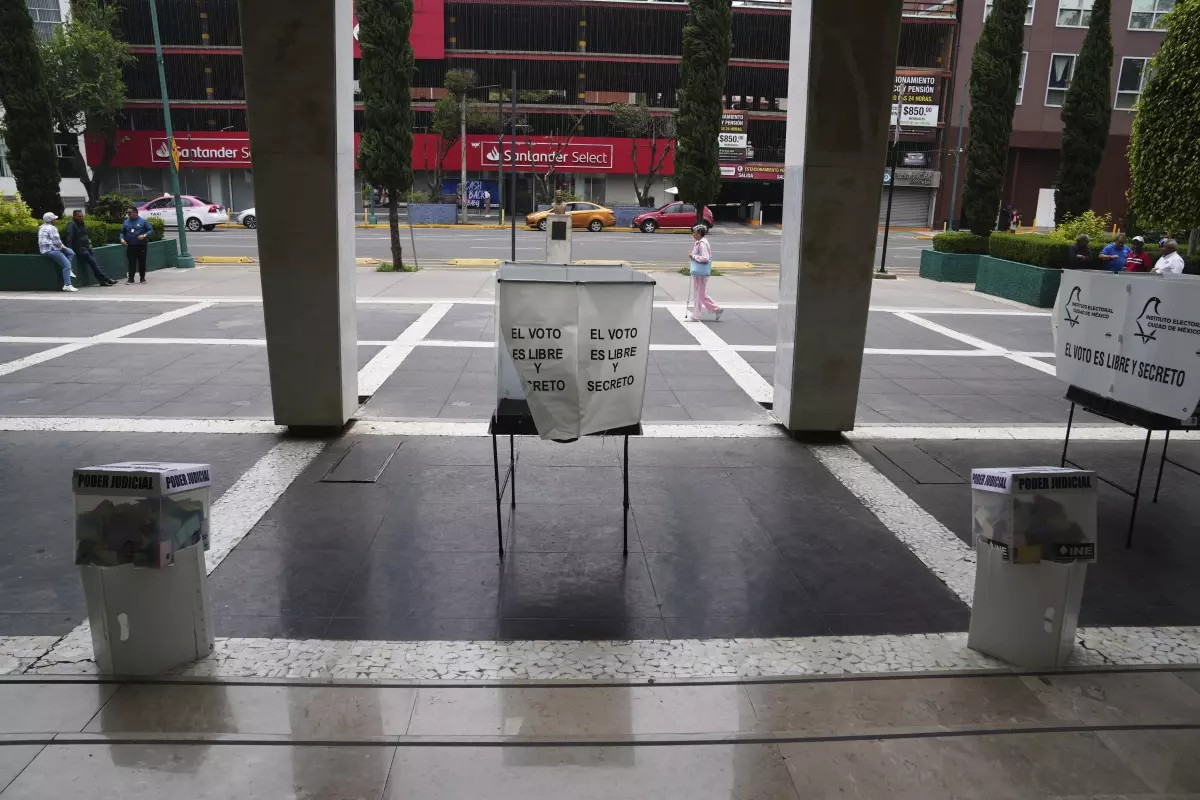

Mexico voted on Sunday, theoretically to improve its justice system, but the low turnout in these first judicial elections represents the latest challenge to a judicial reform process that relied on the election of judges as its cornerstone but has been fraught with criticism, complaints, and irregularities from the beginning. The result: much uncertainty both inside and outside the country.
The National Electoral Institute announced around midnight that the estimated turnout was around 13% of the 100 million Mexicans called to the polls. But it will still take days to find out how many spoiled votes there were, whether the main courts—the Supreme Court or the new Disciplinary Tribunal—will remain in the hands of Morena’s loyalists, or whether controversial candidates ranging from drug traffickers’ lawyers to people with criminal records won positions.
Protesters carry signs and shout slogans against Mexico’s first judicial elections at a protest at the Angel of Independence in Mexico City, Sunday, June 1, 2025. (Fernando Llano/AP)
A good portion of Mexicans abandoned the attempt to elect 2,600 positions from more than 7,000 candidates. Some voters did their best to inform themselves; others participated in protests denouncing the entire process as a farce; and a few opted for the lesser evil: going to the polls.
“This is a mockery,” said Octavio Arellano, a 67-year-old consultant who did vote, but only for the most important courts, and invalidated the ballots of the rest as a “way of protest.”
“There are things that could be improved, but it’s a worthy exercise,” said psychologist Ariadna Martínez before voting.
In either case, the outlook is not hopeful. Some academics agree that these elections are “an attempt to control the judiciary,” which is “a counterweight that exists in any democracy,” summarized Laurence Patín of the Justice Observatory at Mexico’s Monterrey Technological University.
However, Mexican President Claudia Sheinbaum once again defended judicial reform on Monday, ruling out that the country is heading toward authoritarianism or that the executive branch is seeking control of the judges.
“What we want is justice and access to justice for all the people of Mexico,” the president emphasized in her morning press conference. “And now the judges, magistrates, and ministers answer to the people, not to the president, to the people.”
Observers from the Organization of American States (OAS) are scheduled to present a preliminary report on the vote on Tuesday and, according to Heraldo Muñoz, head of the team, will keep in mind principles such as “the independence of the judiciary, the separation of powers, access to justice, and constitutional democracy,” which could be affected.
Sheinbaum lashed out the day before against criticism of the process. “Anyone who says there is authoritarianism in Mexico is lying,” she pointed out. “The true rule of law will be realized.”
“With yesterday’s (Sunday’s) election, there’s no talk of us going to Venezuela and Nicaragua and all this stuff” about an “authoritarian regime,” she said on Monday.
Perhaps to try to dissuade doubts raised by the complicated ballot count, which will last more than a week, the INE (National Electoral Institute) chose to release real-time images of the process on YouTube.
After the low turnout figures were released, the president called the election “a complete success” and asserted that it was a “transparent” process, with candidates selected by “professional commissions,” “austere” campaigns, and a free vote.
“Mexico is the most democratic country in the world,” she declared.
Judicial Independence, a Growing Regional Problem
Jaime Arellano, a Chilean academic and former director of the Center for Justice Studies of the Americas, an OAS agency, expressed concern about the low turnout. In his view, it poses a problem of political legitimacy that will weaken the new system, even if the judges who assume their new positions in September choose to be “ungrateful” to those who elected them but loyal to the Constitution.
He also fears that this voting exercise, which he does not believe is the solution to the problems of the Mexican justice system, could pave the way for the incursion of de facto powers into the justice system, such as organized crime.
Although some believe that little will change this last point. “The influence of criminal groups already exists,” said Martha Tamayo, a retired lawyer from Sinaloa and former federal representative. “The cartels go with the judges, whether elected or not,” she asserted.
For Arellano, the main problem with these elections is fundamental because, by definition, judges are a “counter-majoritarian force” who, in addition to resolving conflicts, act as a check and balance on political power.
And this, she explained, is what is being threatened in several countries in the region within democratic frameworks that are gradually beginning to show distortions. “Judicial independence in Latin America is under attack.”
Ursula Indacochea, of the Due Process of Law Foundation (DPLF), a Washington-based organization that promotes the rule of law in Latin America, indicated that there are two clear early warning signs that can detect when justice could be in danger.
The first is when politicians begin to attack justice institutions to fuel public discourse that there is a problem and then present themselves as the solution.
The second is when the government begins to disobey court rulings. Then, justice begins to be “captured,” and then those same politicians “are extremely respectful” of the law, he emphasizes.
Public criticism of judges in Mexico began with former President Andrés Manuel López Obrador, who accused them of corruption and cut off their funding. During the parliamentary process of his judicial reform, court orders aimed at expedited approval were ignored, arguing that the judges could not be both judge and party in this case.
Despite their completely different contexts, attacks against judges have also been seen in Ecuador, El Salvador, Costa Rica, and even by the current president of the United States.
Latin American Red Flags
According to Indacochea, the two countries currently in the red flag for justice in the region are Guatemala, where the UN has just denounced a policy of criminalizing certain groups by the prosecutor’s office; and Peru, which is at a less advanced stage, but, according to the researcher, the fear is that it will follow the same path.
And both there and in Mexico, despite the differences between the three countries’ situations, there could be “unfortunate outcomes in the short and medium term.”
“The case of Guatemala and Peru is the danger that a sniper could pose versus, in the Mexican case, shots fired in the air with a machine gun: you don’t know where those bullets will fall, who they will hit, but you know that many people will be hurt,” Indacochea compared.
The precedents of other countries in the Americas where some of the judges are elected do not inspire optimism either.
The case of Bolivia was “disastrous,” explained Jaime Arellano, and proof of this is that former President Evo Morales, who promoted it, tried to reverse this process.
In the United States, although the justice system remains strong, studies conducted in states where judges are elected point to a “tendency toward harsher treatment of minorities,” which could be very problematic, the academic added.
The Mexican government has asserted that this reform is here to stay, but not everyone agrees. It will be “a brief madness, and in seven or ten years, we will have to rethink our justice model.”
Until then, Indacochea warns of two major priorities in the region. One is to prevent the export of the security model of Salvadoran Nayib Bukele. “The other is to prevent the export of election by popular vote” from Mexico.

Source: latimes